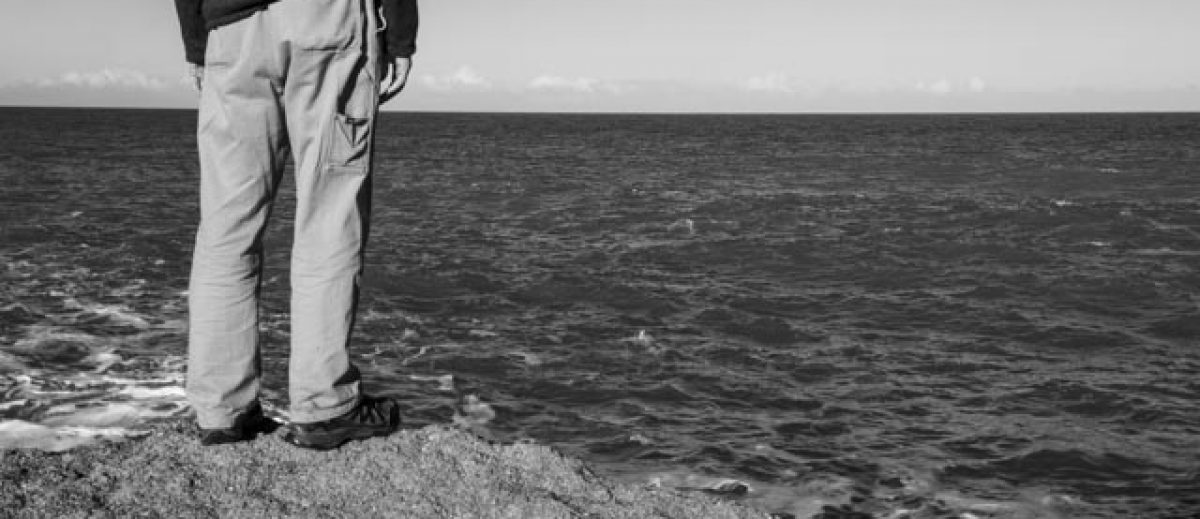
Introduction to my Body of Work
This series has been created around the coastal community of Ngawi (pronounced ‘naa-wee’). A small fishing village which is located just five kilometres from Cape Palliser, the southernmost point of New Zealand’s North Island. Known for having more bulldozers per capita than permanent residents this project scratches the hard-male surface and discovers what is holding the community together, the very backbone under the shell.
The location is exposed, with intense and prolonged periods of high winds and heat during the summer months. With very few trees, what kind of person is prepared to endure these conditions? Only the strongest it seems. Regardless of the media headlines of declining mental health conditions within rural New Zealand communities the strength lies within the softer gender in this location. They are the ones holding things together, making do and patching up both mentally and physically.
Link to the video recording of Inside the Shell ‘
Evaluation of the course: Looking back
Where have you come from?
When I started this course, it was on the back of level 2 Documentary and a final Assessment that consisted of five very personal experiences of mental health. Not my own, but five people who very kindly let me into their lives. This was a completely new avenue of photography for me, one where I pushed myself mentally and photographically to do justice to their experiences. I found that I couldn’t hide behind the camera, as that wouldn’t achieve the results I wanted. Spending time, listening and talking was key and I knew that moving forward it would be important.
The New Zealand press at the time were highlighting the issues of mental health within rural communities. We have been losing young farmers to suicide at high rates each year and it was time for the government to take action. This resulted in a $1.2billion injection but it was hard to see where this went.
My proposal was to explore and get to know a local rural community. To discover the real stories behind the Kiwi ‘she’ll be alright’ approach to life. I wanted to discover if everything that was written in the media was in fact correct. The location I chose was about an hour’s drive from my home, a small fishing community that makes it’s living from cray fishing and tourists that surf and pass through on their way to the lighthouse and fur seals that inhabit the coastline.
Assignment 1 was scene setting, producing general images of the location and trying to make connections. I’d driven through like most on several occasions but never really stopped to explore. Whilst I was walking around I stopped and started talking to Rob a resident of Ngawi. He introduced me to some others that were about on the beach and so my connection was made.
Assignment 2 saw me return to Ngawi to spend the morning with Rob and his wife Trish. I decided to spend time listening, getting to know them, their life, and life in Ngawi. I think this helped relax the nerves on both sides.
The time between Assignment 2 and 3 saw the world go into lock-down due to the COVID-19 pandemic. Initially, like most it was thought to be for a short period of time. I took advantage of not having to travel and spent that time catching up on study.
As the days turned into weeks it soon became apparent that I needed to start to think of alternative approaches. Trying to find archival images drew a blank. I didn’t panic as I still didn’t expect the situation to last as long as it did but following an on-line presentation I decided to think about other aspects of my location, what was affecting the local community and how I could use the images I have already obtained to produce an alternative. This resulted in a number of possible themes that I continued to review and progress:
- Ngawi as a location – based on its industry and effects of COVID
- Street Panorama – using a large format camera, going back to basics
- Cray fish – the decay of the subject over days and months – based around the work of Paul Hill
- The women of Ngawi
When I was able to return freely to Ngawi I completed a trip out on a cray boat photographing the whole process from a 4am start to packing and off to processing from the dock side. The owner’s wife was the real source of my final project. The casual conversation whilst I was photographing her highlighted the fact that there were only eight ladies in the village. She explained how hard it was to keep them here, the weather, isolation, constant wind and little to no employment apart from the cray boats meant that only a certain type of women could cope. Here then was my project and direction. To capture the life of these women, to show how they held the community together despite the external conditions.
What have you learned?
That even with the best laid plans no one knew the world would be hit with a pandemic but by listening, research and keeping my ideas fluid I was able to find a different direction, so probably the first lesson and one I will keep with me is don’t close down your project too tight, let it develop, be open to new ideas and influences.
A key factor for me has been never to take what is written in the media as fact. Research is key. The written word on social media and news sites, along with photography is their form of the truth. I was expecting a rundown, suicidal group of people, but instead I found hard working, welcoming and community focused individuals that protected and looked out for each other. The eight ladies who took part in this project held that community together. It wasn’t prefect – but where is?
What mistakes did you make?
Mistakes? Lots, but probably the obvious was the one concerning time and the amount needed to organise and arrange sessions with each of the subjects, cancellations and COVID! The editing process seemed to take weeks and then having to re-edit as the decision by the college to not allow prints meant a change in format to fit a book. I don’t regret having to do a book it just wasn’t on the radar from the start.
One regret rather than a mistake was not using the medium format camera, which was my original aim, but then this would have resulted in a very different style/approach. The medium format makes you slow down, arrange/stage and after getting to know some of my subjects and knowing how I feel in front of a camera I don’t think I would have achieved the same results that I did. My aim was to be an observer, capturing moments in their lives.
What were the low points? High points?
Like most I think the period of lockdown was probably the lowest point. Not being able to get out, the unknown did become very stressful, trying to think of alternative ideas that would still relate to my initial project. However, I did turn it to my advantage. My normal three hours of travel a day turned into an additional period of study time.
Trying to cope with two very complex and long modules was at times difficult and I didn’t have a very good start to my Body of Work as my initial tutor failed to respond. This resulted in a change of tutor. The whole process was not very smooth, and I often felt that it was my fault. Being an international student with a huge time difference, relying on emails and not being able to just pick up the phone does make you feel extremely isolated.
One of the high points for me has been meeting some of the people of Ngawi. Getting to be part of their lives, even for such a short period of time has been amazing. They were generous with their time. I have provided copies of the images and they don’t seem too disappointed in them.
As my original plan was to use film, and also learn an alternative development technique. My home darkroom wasn’t finished so I need to look as the use of digital negatives. The Photographic Society of New Zealand were offering the ability to learn Platinum and Palladium printing for a weekend and so I took advantage and now plan to use in the next stage.
Another high point for me has been the support groups I have been involved in. I wish I had made use of these in earlier modules. I have learnt so much, not just in photography because the ‘Rest of the World’ group covers textiles, painting and drawing. It has been interesting to see how other areas of the college work and interact with their students. The different levels of support make’s the course feel a whole lot more inclusive.
Who influenced you?
The main area of research for this project has been based around mental health and how photographers have captured other’s experiences along with their own. The methods used were many and varied from self-portraits to landscapes, from ICM to Surrealism, none of which I soon realised would really work for my project. For me the aim was to blend in with their environment, document and not disturb. I knew that as I researched more that it was just a case of representing the condition but also the place and how the resident connected with it. So, the project ‘My Place’ [https://placeintime.org/projects/my-place] was a good starting point and influence as to how I wanted to start. It consists of a series of black and white images that aimed to highlight the importance of ‘place’ to the individuals that lived there. Each of the images showed a resident(s) and how they were linked to the location and what makes it important to them. The images were staged/directed, with a direct engagement with the photographer.
I tried to find projects that were based around communities which were similar to mine and came across the work of Adrian Hollister [http://www.adrianhollister.photography/wester-ross-folios] who photographed the community of Loch Ewe in the north west of the Scottish Highlands. His landscapes and portrait images were all in black and white and in a square format showing the same elements of isolation as that of Ngawi. Folio three [http://www.adrianhollister.photography/folio-3-community] show the residents that live in this remote location and the work they do to make a living.
Looking closer to home in the form of New Zealand photographers I came across the work of Julia Johnston who documents the people and location along the west coast of the South Island from Westport to Greymouth. Julia grew up in this area and still has strong ties to the place and its community. She has managed to capture the isolation and remoteness of this part of the country, getting behind the scenes and portraying the human aspects and the ‘back to land’ idealist in a series of colour images. [https://thespinoff.co.nz/art/02-03-2020/west-coasters-the-characters-on-the-road-between-westport-and-greymouth/]
My tutor recommended that I look at the work by Chris Killip and the images and work he undertook at Skinningrove a North Yorkshire coastal town between 1982 and 1984. The town was heavily reliant on a single industry – iron smelting. In a similar way Ngawi is reliant on the sea and the export of crayfish. At the time the North Yorkshire area was facing mass unemployment and they were attempting to make a living from the sea. Ngawi faced a major issue with the COVID-19 pandemic. Killip was known for his series of images from the North of England and focused on the changing landscape and increasing poverty. He was known for immersing himself in the community and building relationships in order to show the sensitive side to the locals which was probably hard to do if you didn’t come from the area. In a similar way Ngawi is a close-knit community, they look out for each other and have learnt to make do and mend
It wasn’t until late in the project that I came across Tessa Bunney, a documentary photographer who is interested in the different environments that are shaped by human intervention. Her most current project ‘FarmerFlorist’ looks at the ‘artisan’ cut-flower farms that recently started to grow in numbers within the UK. She is an observer, not disturbing her subjects. The portraits are in the environment, often not seeing the subjects face, hidden behind their flowers. This is very much the style was trying to achieve with my images of the women of Ngawi.
Probably a photographer that would seem a little left field was Susan Lipper. An American photographer who’s work includes a project and book called ‘Grapevine’ (1994), which was why I researched her. For about 20 years she travelled to a small community in the Appalachian Mountains of West Virginia called Grapevine Hollow. Grapevine Hollow consists of few trailers and mobile homes of about 50 residents in the middle of a part of the United States badly hit by the decline of the coal industry, where alternative industries include distilling moonshine, and the newer initiative of cultivating marijuana. Lipper found the community while on a cross-country trip.
How are you critically positioned within photography as a result of your work on this course?
My work sits within the documentary genre of photography, exploring the relationship between the land or location/space and the people who inhabit it. I have tried to capture a feeling of the location through landscape and still life, showing the hard conditions and the environment which gives a feeling of isolation, hardship, mental health issues, but also the softer side. The women that through their own strength hold the community together by making do and sticking together to support each other.
How might what you’ve produced impact on your future projects?
This Body of Work has introduced me to the area of Photovoice as a technique and its something that I would like to do more of. I would like to undertake a number of courses through the Photovoice Worldwide Organisation and move on to a MA or PhD. It hasn’t been easy, being an introvert but through research and listening to countless talks and presentation I think I have started to be more comfortable when undertaking the portrait side. I don’t think I will undertake studio or posed images but the more natural, observer type I enjoy. Getting to know the subject, their story really breaks the barriers, for them and for myself, so I’m looking for more opportunities to explore this side of my practice.
Have you found a personal voice that you’d like to develop?
I think I have found ‘a voice’, not sure if its ‘the voice’ as I look at my work and see how I have changed since I started this course. I was once told that I ‘see in square’ in a workshop I attended with the fine art photographer Tony Bridge and I think he was right. I do find the format comfortable, pleasing and fits the images I take. For me this suited the images I have produced for the final selection. I did process differently to begin with but they didn’t seem to fit the mood. I prefer black and white, not because it’s the traditional documentary form, but because you need to rely more on form, tones and texture to produce the narrative.
If not, what have you learned about your personal voice and how will you go about discovering it from here on?
This is very much the start of my documentary journey and I will I hope continue to grow and experiment in this area. I want to work more in the photovoice area and continue with my studies.
How did your technical decisions impact on or impair the final outcome?
The most frustrating part was not being able to produce prints for the final submission. The production of a book was never on the horizon for this part of the course and even for Sustaining Your Practice my plan was and still is an exhibition either in the Arts museum or at Ngawi. I had planned to give a limited number of prints in the form of a book to each of the ladies who took part as a gift but this wasn’t anticipated to be part of the submission for assessment. Learning how to edit and produce a book was a step learning curve that really needs a longer period of time.
Were you true to your artistic intentions?
Yes, I believe I have been true to my artistic intentions. Have there been changes from my original ideas? Yes, and this wasn’t just because of the pandemic, this was though not taking what you read at face value, this was going and getting involved with the location and people of Ngawi to discover the facts. Under that hard male shell there are a group of women holding the placing together.
I think the series reflects both the male and female aspects of the location. The hard conditions and isolation that often results in mental health issues however what I found was a strong sense of community, held together by a core of eight women, that looked out for each other, supporting each other through the highs and lows.
What did you learn from the editing process?
That being too close to your own work means it’s hard to let go of some images. There were so many I wanted to include; Trish’s husband from Assignment 2, the trip out on the cray boat etc, but I needed to settle on one narrative.
Printing small images and placing them on the table or wall and moving them about was far easier than on a screen. The physical aspect helped me select and reject and select again a lot easier as I was able to see the whole series.
Learning to let go and putting my work out to my peers was very hard. Being open to feedback and not be defensive was a steep learning curve. That said all the comments I received were justified and constructive which made the whole process a lot easier. You soon realise that one edit is never enough, its clearly a case of edit, edit and edit, so It will be interesting to see and hear what my tutor has to say.
What are the main lessons you will take away as a result of this course?
Flexibility! The best laid plans will very rarely follow through.
Letting go of ideas – I really wanted the cray fish to work and it may have but I couldn’t wait that long for the shell to breakdown and decay. Maybe if I’d left it outside to the elements? An idea for another day. Also letting go of individual images. Some I had produced were great as single images but just didn’t work in the series and that was disappointing.
Another important lesion for me was to not use my camera as a barrier. The subjects in this project opened up to me and so I needed to do the same. Allowing time to listen, to leave the camera in the bag until the time was right.
Evaluation of the course: looking forward
How would you like your audience to experience your body of work?
The aim is to hold possibly two exhibitions the first an inside event which will consist of framed images, a mixture of digital prints and a series of Platinum and Palladium hand produced prints from the black and white images. I would also like to do a local event at Ngawi, this could be either inside or outside.
As part of the exhibition, I would like to produce a Zine to possibly show other images that I was unable to include in the final series, such as the cray boat. I had also planned to produce a book for the ladies who took part.
Do you have any ideas for venues or production formats?
The main exhibit would be at the local Arts Museum in Masterton. I have exhibited there before both as part of a large group with the local camera club and with a fellow photographer as a joint exhibition so I already have the contacts, just a case of showing the work and arranging the date.
The Masterton exhibition as stated above would be both digital and hand made prints which would be unique and one of a kind. I really enjoyed the process of making the Platinum and Palladium prints and I think that some of the black and white images from the area would work well in this format. If I can obtain approval for the outside exhibition at Ngawi this would involve a lot more work. Trying to source printers that can print large enough poster size images on plastic boards and obtaining approval to display along the roadside would involve considerably more discussion with the people of Ngawi but I think it would look really good leading up to the tourist season.
The book could be either sent to an on-line publisher or to a local firm within New Zealand. As I would like to give them something they would value the ‘Blurb’ option might not have the best quality, so this will involve more investigation. It would also be nice to engage with a local author to provide an essay or some form of written narrative to the book.
The Zine can easily be produced using InDesign as I now have some experience and send to a local printer in a high enough resolution to obtain a good print quality. I would need to investigate costs and paper etc and the breakeven point as I would like them to give a ‘gold coin donation’. I know the Arts Museum also undertakes printing so I can also discuss this when I try and book an exhibition.
What do you need to do for this to happen?
Well, depending on final feedback and confirmation that I can move onto the final part of this course I would need to:
- Arrange a meeting with each location to agree dates, durations and approval for an exhibition;
- Arrange for printers and complete hand printing of the black and white images
- Cost and order frames, matts
- Re-edit for book, research publisher/printer v self-publish
- Advertising and social media
Do you need to make any changes to your portfolio?
I don’t think I need to make many changes but this has been produced prior to submitting for review by my tutor. The selected images and the digital book for Assignment 5 have been peer reviewed and apart from one person saying I had too many images the comments were positive so its really now down to my tutor.
I know I will not include all the images in either exhibition so these will be changed following discussions with both sites. Also, the images and the layout of the draft Maquette would be too large for a book so a re-edit would be need before publishing.
 Michele Usher