Initial Plans and Exhibition Progress
The initial plan for my Body of Work was to submit digital prints and to then during Sustaining your Practice organise and produce a solo exhibition. I had exhibited with another local photographer previously on two occasions and so had contacts with the local art centre, and frame supplier. My fellow photographer had previously undertaken the printing and so the plan was set. This however was pre pandemic and little was known of the full impact of that situation and how it would affect the whole world.
During my Body of Work and Contextual Studies modules the lockdowns here in New Zealand and around the world allowed me time to catch up on my studies and research and look for alternative approaches to the project as a whole. The lockdown gave me time to experiment and explore alternative processes and ideas of displaying may work but it also meant that my initial plan for submitting prints was not feasible as the OCA had decided to only accept digital submissions and by the time New Zealand had come out of lockdown my initial plan of using the art centre was also unlikely, although they did state they were still interested in showing my work they did have a large number of commitments from previous artists that had been cancelled due to the closure of the facility.
New Zealand is renowned for someone knowing someone who can help when you have a problem and so through friends, I was able to contact a local artist who owned an exhibition space that he used to promote his own work but also other local artists within the Wairarapa area.
The space is ideal as it is lends itself more to my project and the warm tones of the images. The small intimate space will mean that the images will not be lost amongst other work, there will be more of a connection between image and viewer. Although the gallery is a simple white box it means that I can have curative control over how the images are presented and my work represented which is something I would not have in the larger gallery. I will be able to hold an open evening just for my work and interact with the audience to gain first hand feedback about my project from many non-photographers.
Additional Work
The change due to COVID and the OCA submission requirements led me to reconsider how my Body of Work would be presented. I had researched on-line virtual exhibitions and did not really like the results, the images were of poor quality and the systems were often frustrating to navigate or were automated and speed through the exhibition far too fast. The prints needed to be seen in person and as the lockdown would not last forever and I still had twelve months to produce an exhibition I retained the intension for SYP to complete a physical exhibition. This left the issue of assessment for Body of Work and so for this I explored and produced a mock-up of my project in the form of a book (here). This initial design was handmade and videoed for submission. The designed had been through several edits and iterations following feedback from my peers and tutor.
I had planned on producing a limited number of copies as thank-you gifts for the women who had taken part in the project and so decided to progress this through SYP. There was no feedback from the assessment on the project which was frustrating as I was left unsure as to the direction to take, but luckily part of SYP required professional feedback which I arranged. The comments and encouragement resulted in several different approaches to show both my voice and the narrative of the project (here). Each design I think had it’s merits and there were no strong views as to any that didn’t really work, but I really needed to make a final decision as the final design needed to be printed professionally and not just on a laser jet printer and taped together, so there were printers to be found and designers to consult over the cover, font/text and overall size. I finally sort advice from my tutor who offered an alternative suggestion. This resulted in the sixth and final design that I have progressed (here). The design offers a perspective of the location as a space to live and work but also the gender divide within the environment.
Photobook Research
During Body and Work and throughout SYP I have continued to review a series of photobooks, both my own copies but also on-line through artist talks and via artis websites with the aim to gain ideas and techniques that could be applied to my project. During the professional portfolio reviews I was pointed in the direction of several that related closely to my project:
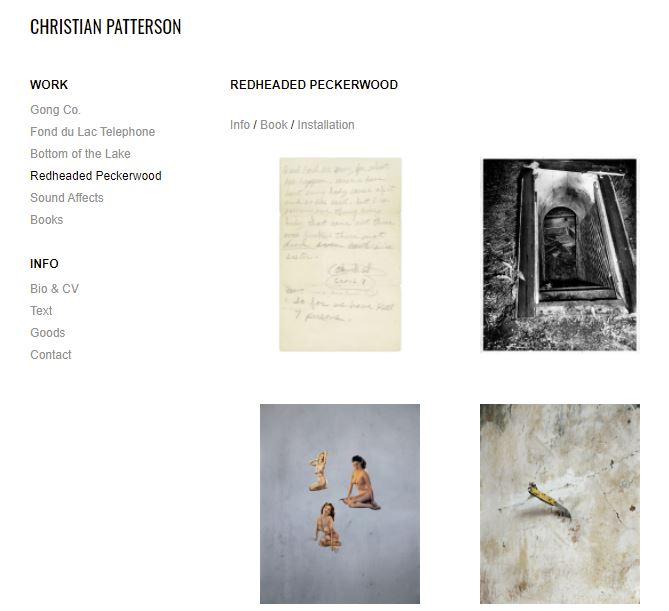
‘Redheaded Peckerwood’ by Christian Patterson
This book was recommended during one of my portfolio reviews as a way to consider how I reconsider the use of text in my original versions. I do not have a copy of this book and so the following image has been taken from the artist’s website:
The book is based around the tragic events of a three-day killing spree across Nebraska by a 19 year old and a 14 year old. They were finally captured in Wyoming. None of the images show these individuals but include forensic, staged and landscape images to represent the narrative. The artist uses a mixture of archive material that is both factual and fiction to represent what happened. There is a link to the killers in the form of items that once belonged to them such as maps, poems, confession letters, stuffed animals, and ornaments.
It was interesting to see the layout and mixture of image styles with small images showing limited detail to those that filled both pages. The hardback book also contained a postcard and separate booklet at the back which contained additional text/essay by Luc Sante. Several inserts are also included which obscure the underlying image, so the viewer has to stop and move them out of the way.
The interaction with the book rather than simply turning the pages was an interesting approach as it makes the viewer stop and consider the purpose and the narrative the artist is trying to portray. Although I am not including inserts, I am using bifold pages to stop the viewer and to open and to look inside the world of Ngawi, to compare the man and female perspective, but to also see the location and the beauty that is the East coast of New Zealand, a location that is rarely seen.
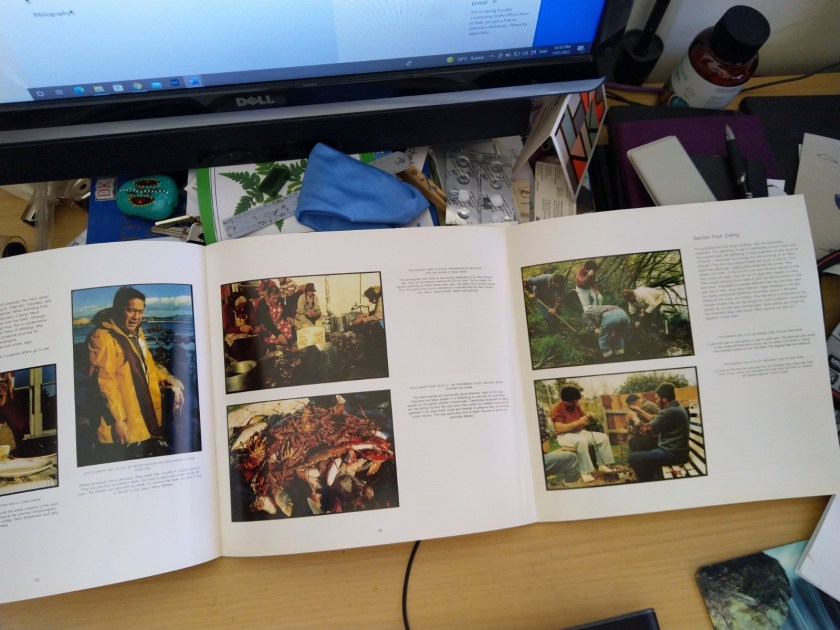
‘Kai Moana Local Politics’ Fiona Clark
This work is not a standalone book but forms part of a collection from local New Zealand photographers: ‘Views/Exposures 10 Contemporary New Zealand Photographers’ (1982) published by Minolta.
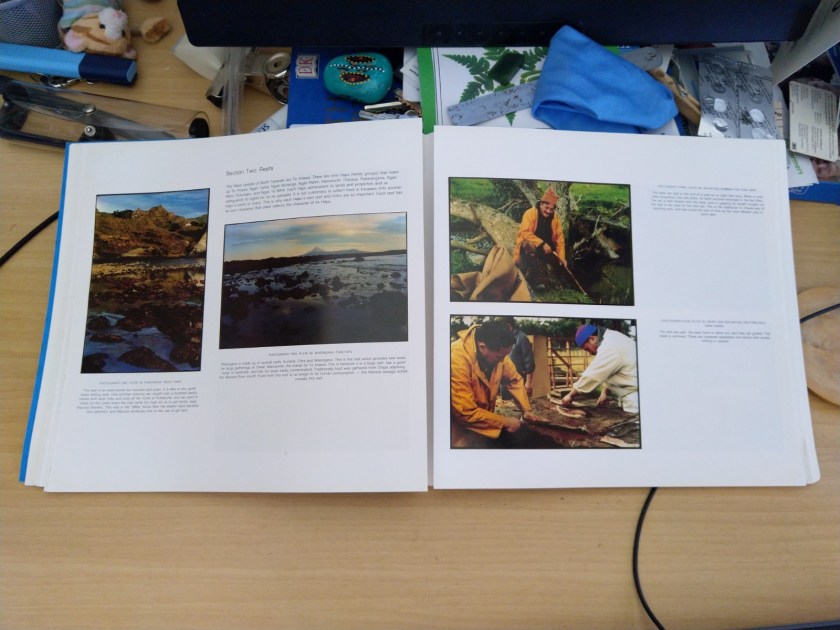
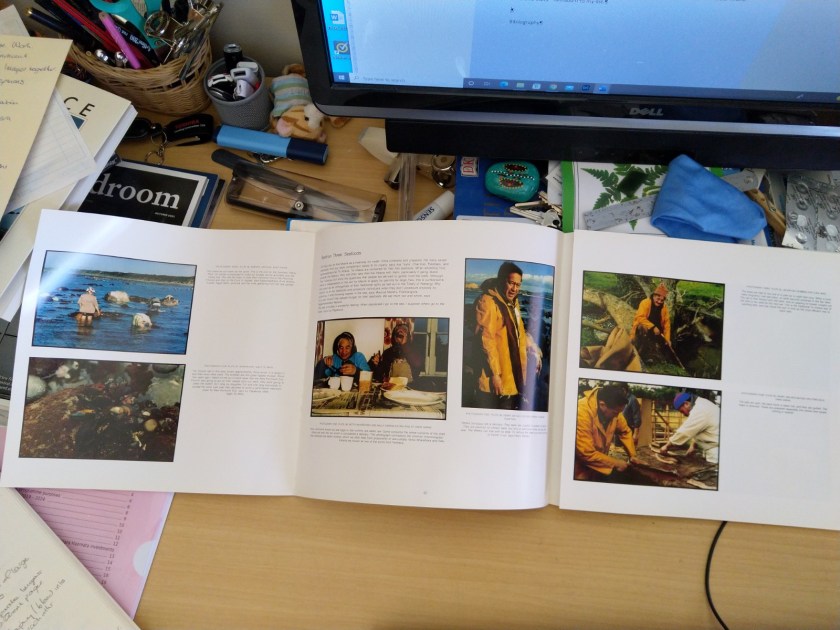
I was drawn to the work of Clark whose images and text are spread over ten pages the majority on a double bifold. The images are of both the environment and portraits. The latter with very few having direct eye contact between the subject and photographer, they are of subjects at work within the environment. They show how the community lives and works off the land. The selection of images is limited to just ten pages with the whole project consisting of well over one hundred and forty images. The pages have been divided into sections covering the reef, seafoods, eeling and the Waitara River.
There is a strong feeling of community and how they live and feed off the environment. The use of text provides extensive detail and leaves nothing to the imagination of the viewer the aim to record and to push for political change. This combination of mixing community and place was very much my aim for my project. Clark mixed both of these elements across her bifold pages, but I wanted my viewer to first see the location or space that this community worked and lived in and then open up to stark the comparison of male v female in that space. The bifold offers the viewer the opportunity to stop and interact with the book making it more of a physical object and a way to convey the narrative.
Clark utilised text more extensively than I wanted to. My aim has been to introduce the location and let the images portray the project but to also link the project bad to the lands origins with the use of Māori.
‘Sense of Place’ by Robin Morrison
The book is divided into several chapters covering; landscapes, buildings, people, churches, backyards/structures and finally memorials. This is a whistle stop tour of New Zealand. As the foreword states it is ‘a collection of visual stories concerned with the way we present ourselves as New Zealanders and how we have altered the appearance of this country to reflect our sense of place’ (Robin Morrison, 1984).
At the start of each section there is a paragraph or two as a way of an introduction and then the images sit one or two to a page with a simple text description of what the image is, the rest is left to the viewer.
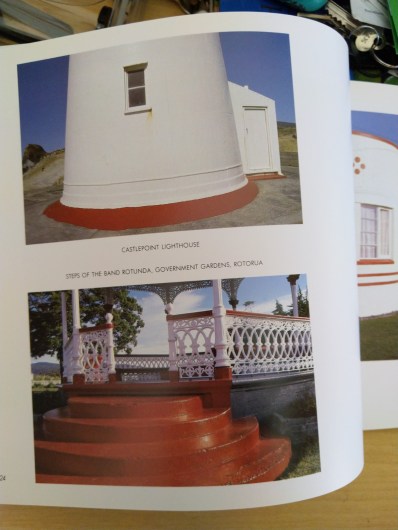
His style is very much in the documentary genre, an observer of life in a style very similar to mine. A window rather than a mirror to quote a term from an earlier course. In an interview with Art NZ in 1981 Morrison was quotes as saying that the view finder of his camera was ‘the boundary round the window, the boundary round the world, the boundary round the piece of information, the frame around the piece of time’.
Morrison’s quote really resonates with me and the approach I have taken with my project. I have tried to show the lives of these women and the landscape without disturbing or affecting their lives, but as we know that it not truly possible. I have recorded and tried to present a visual record as I saw it. This project is my window on the community of Ngawi.
Collaboration Work
From the professional portfolio reviews and the book reviews I have completed I realised that I needed to introduce the project in some form. Most books have an essay or foreword written by someone other than the artist/photographer which, was fine with me as I am not really a writer. The challenge I had was finding someone that would offer an independent view of the location and had knowledge of the community. I contacted several local authors but was turned down due to current work commitments, not relating to the subject or the fact that as a student I would not be able to fund their time.
To find the correct person to work with I returned to my initial research conducted during Body of Work and the work of Jim Graydon. Graydon had written a book all about the communities of the Wairarapa, the very place that this project was based. ‘On the Edge’ included Ngawi, the location, history, industry and the community, however he had not identified the demographic of the location but that was not an issue as I only wanted to understand his impression.
I managed to track Graydon down and make contact via the local camera club. He has been a lifelong member and the current Secretary provided email details (following approval first). Our first meeting over coffee consisted of me providing an overview of my course and the project. When we spoke about the project, he highlighted the fact that the community was very protective and wary of strangers, so he was really surprised and interested to see my work. At the meeting I also spoke about what I had envisioned. We initially spoke about an essay to sit in the centre or towards the rear of the book, but through discussions we settled on a piece that would set the scene to the community, location and industry. . For me it is important that the viewers remember the images and the impact of those rather than the words. Over the following weeks we exchanged versions and discussed amendments to finally settle on the version that has been included in the book. The final version can be found here.
To continue the collaboration process and as a fall-back option in case the work with Graydon did not work out I also worked with a fellow student whose work I had followed for some time (here, here). He had previously completed the creativity writing module before changing to photography and had included written work as part of his Level 2 Landscape and Documentary submissions. As part of this I also applied for and obtained an OCA enterprise grant. The money will be put towards the final book production.
This second piece of collaboration was probably the hardest to complete and finalise as although the student had seen my images through the various forums, we both attended; Documentary Student Forum, L2/L3 Support Group and L3/SYP Support Group, he wasn’t as close to the project as I was, so we had a number of discussions around aims, progress and the resulting narrative I wanted to show through the images and the final submission of a book. This whole process was more challenging as I had to articulate myself, but it also helped me with the final edit of the images to ensure I took a step away from the work and looked at it from a different perspective. Often questioning both the layout and the images I had selected.
The third piece of collaboration originally started during Body of Work with the introduction of a small piece of illustration work by a first-year student. She offered to draw a series of cray fish for me which I incorporated within the draft book submitted for Assessment (here). I wrote extensively about the collaboration during this stage, but it was not commented on during post assessment feedback, so I did wonder as to the value of collaboration or if the type of collaboration was wrong for the project, but no advice was given. I did not want to discard the work but following feedback and the editing process of the book resulted in a large number of changes that I have decided to use the illustration in a completely different way.
As part of my exhibition, I decided to consider a bespoke book of prints, however the type of paper I wanted to use was not available in the correct size so I have decided to complete a short series of prints matted and presented as a boxed set. The illustration will be used to produce a lithophane – a 3d print, which will be embedded into the lid of the box (here).
Book Commission
Once the final design had been set, I needed to find a suitable printer. Research into the most popular on-line prints such as Blurb and Momento would have been ideal if the book was a standard digital print of a production size, however it isn’t and the bifold pages would be a concern. I needed to find a local printer that would be interested in completing a relatively short run of 50.
After face-to-face discussions with several local printers, it soon became clear that the bifold construction was going to cause them issues. The print length along with the folding was too long for most printers. I am so glad I produced a physical draft so that I was able to demonstrate my ideas. The draft also allowed me to see the flow of the project, the overall narrative and if the interaction with the bifold pages would cause issues. I knew that I wanted to keep the bifold design as this offered the viewer an image of the place and then the contrast between the male and female aspect of the life in Ngawi.
Following discussions with possible printers and recommendations for possible alternatives I finally managed to show my design to a printer that had the capability to print to the length required. We have agreed that a proof of the book will be produced so that we can check the colours, layout and the binding. Further details can be found here.
Exhibition
Printing for the Exhibition
As my original plan for this project had always been to submit and display the work as physical prints, I wanted to investigate an alternative method of printing. I have had my own darkroom for some time, but this has been for the development of black and white film and silver gelatine printing, for these images and for the final submission/exhibition I wanted to show them in a different way than the standard digital inkjet prints.
During Body of Work, I attended a two-day workshop on Platinum and Palladium printing (here). During this I learnt the process from the development and printing of digital negatives, to mixing the chemicals, coating/sensitising the paper, exposing, and developing the final print.
For me this method offers a more personal feel to the image when compared to a digital print. Each print is unique and cannot be reproduced. The hand production, the tones and process add to the whole narrative of the project, the making and mending of the women of Ngawi.
The printing journey has been documented here.
Staging for the Exhibition
From the extensive artist talks I have attended and the personal portfolio reviews where I spoke about my aim/intent of exhibiting it has been clear that producing a book is very different to that of curating an exhibition. It isn’t a case of just taking the images from the book and pinning them to the wall and expecting the viewer to understand your intension. To some extent you have more control over how a viewer interacts with a physical book but with an exhibition you have very little control how a viewer will wander around and view the images and in which order. It is therefore important to plan and visualise the flow and placement and selection of the images to ensure the narrative of the project is maintained.
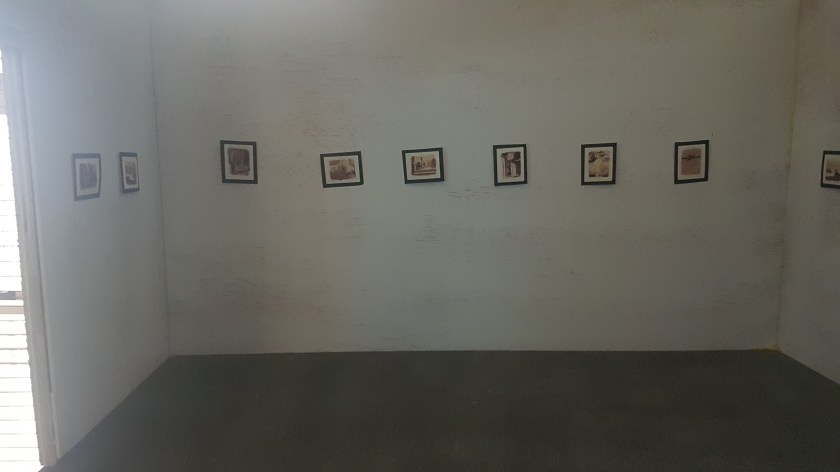
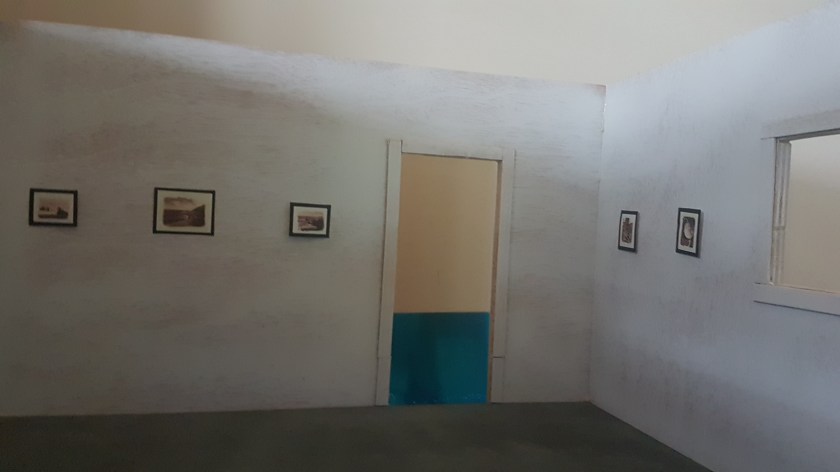
A large number of the artists utilise virtual exhibition sites to show their work. This method was extremely popular during lockdown and a number of fellow students seemed to also use this to show their final submissions. Reading the on-line forums and websites the most popular solutions seemed to be Artsteps (https://www.artsteps.com/) and Kunstmatix (https://artspaces.kunstmatrix.com/en). Both solutions offered free trails and several different room options but as the exhibition space I have booked for November is just a simple white cube I decided to move away from technology and create a maquette. This technique had been highlighted in several on-line talks and seemed a good way to see how the images would fit.
I first approach the exhibition space back in October 2021, knowing that I needed to plan ahead and lock in a location as soon as possible and then plan for the size and layout. The Miracle Rooms is a small independent location that supports only local artists – not just photographers. The location was the local bank that had been converted to a house but also a small exhibition space. I managed to secure the month of November. This simple white box would be idea. Initial estimate of the wall space would take fifteen A4 prints, there were a few odd, placed windows to work around but these didn’t seem to present too much difficulty as long as the size was kept to A4.
During May 2022, the owner moved the location of the Miracle Rooms to a new location. Still within Featherston, but now larger in size. This increase in size will allow me to be more fixable on the number of prints and introduce a single larger print that would act as a centre piece.
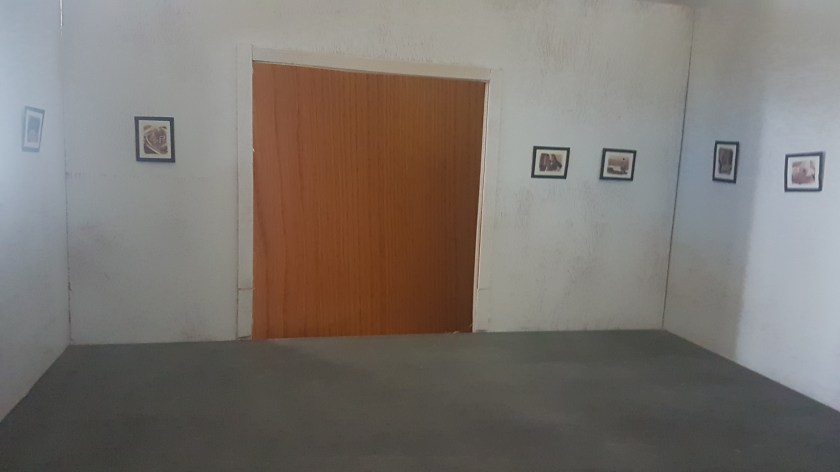
A part of the design process for the exhibition I had seen other photographers discuss the merits of producing a maquette of the gallery space. This they said allows you place the work within the space to see how it will hang together. Laying the images on the table or pining to my own walls gives a very different feel.
Details of the maquette build can be found here along with image selection.
The use of the maquette allowed me to explore a number of different possible layout styles before settling on the more traditional style of a single row of images that utilises the whole of the gallery.
This layout offers a number of advantages; it gives a clear focal point to the display as the large single image is place opposite the entrance way; there is space for the audience to view each of the images in isolation but also to move from left to right and still see a link and see the narrative and the whole of the space is utilised without feeling cramped into a small corner of the space.
The other examples I explored can be found here.
Artist Statement
Inside the Shell
My photographic practice has been based around that of being an observer, of light, the moment and life. I aim to capture these in camera with little or no post processing, using a combination of film and digital in both colour and black and white.
This series has been created around the coastal community of Ngawi (pronounced ‘naa-wee’), a small fishing village which is located just five kilometres from Cape Palliser, the southernmost point of New Zealand’s North Island. Known for having more bulldozers per capita than permanent residents this project scratches the hard-male surface and discovers what is holding the community together, the very backbone under the shell.
The location is exposed, with intense and prolonged periods of high winds and heat during the summer months. With very few trees, what kind of person is prepared to endure these conditions? Only the strongest it seems.
Through eight women I have explored the relationship between the land, space and the community who inhabit it. I have tried to capture a feeling of the location through landscape, portraits and still life, showing the hard conditions and the environment which gives a feeling of isolation, hardship, but also the softer side of these women that through their own strength hold the community together by making do and sticking together to support each other.
This series has been produced using platinum and palladium a technique that can be traced back to the 1830s which is only slightly older than lineage of some of the residence of Ngawi who can trace their ancestors back to one of the first boats to arrive in New Zealand. This technique provides a durability to the image that standard silver gelatin cannot. These images are all handmade and unique, one-offs that can never be reproduced. The combination of both platinum and palladium offers the warm tones that give a different dimension to the image and reflect the warmth of the Ngawi community and the women that make this place a home.
Biography
Michele Usher is a New Zealand based photographer. Her love of photography started at an early age within the darkroom and has progressed to a combination of both analogue and digital techniques. She has a love of travel and landscape photography, but this has grown to include documentary and social aspects and a growing awareness of the use of photography and the arts to help and support communities through difficulties such as mental health to help drive change and increase awareness.
She has taken part in several joint exhibitions and is an accredited Photography Society of New Zealand judge. In 2014 she started on her journey to a formal degree with the Open College of the Arts.
For her latest project she has turned her back on the often considered traditional but cold black and white silver gelatin images of documentary photography to focuse on the alternative printing method of platinum and palladium. The warm tones of this technique soften the harsh environment of the East coast of New Zealand known for its bulldozers, cray fish, and lighthouse. The process lends itself well to the location as many can trace their lineage back to just after the process was developed in the 1930s.
Michele has explored this location that is exposed to both extreme heat and high cold winds from the Antarctic which leaves little vegetation where only the hardy can survive. She has focused on the core of this community, one could say the softer side, those that hold things together and are often not seen but are beneath the shell of this village – the women. The images offer a glimpse into their lives and offers the warmth and detail that is not usually seen.
Exhibition Promotion
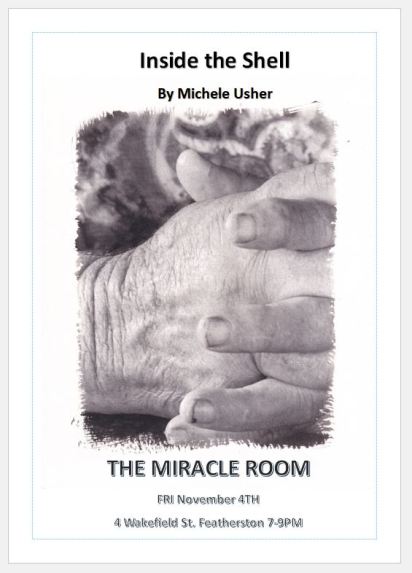
The promotion of the exhibition will take several forms. I will be using my network contacts within the Photography Society of New Zealand and the New Zealand Institute of Professional Photographers to post the event on their Facebook site. I will also use a more localised promotion through the local camera club Facebook site and of course my own Facebook and Instagram sites.
The owner of the gallery will also promote the event prior to and during the month the exhibition is in place, and I will also contact local newspapers. I did think about using OCA but as this is mainly focused on UK based students there would be little or no interest, but I will still post on the Facebook site, my own blog and the ‘Inside the Shell’ website.
Social media will not only inform my audience about the exhibition but also the printed book which I aim to sell not only at the exhibition but also through my website and Facebook.
I have made contact with a representative from the local paper to discuss the possibility of doing an interview and a promotional article closer to the event date.
Draft Poster for Facebook and Instagram
Draft Press Release
Inside the Shell
Local Wairarapa photographer Michele Usher will be holding her first solo exhibition at the Miracle Rooms in Featherston from the 4th November. This work will consist of one-off platinum and palladium prints taken during a three-year project. These images are unique and cannot be reproduced and will be an opportunity to see one of the oldest printing techniques. The warm tones of these images show Ngawi in a new light representing the community and the landscape.
To accompany the exhibition Michele has also produced a limited-edition bespoke book of digital images which includes a foreword written by Jim Graydon author: ‘On the Edge – Wairarapa’s Coastal Communities’ pub 2013, 2nd Ed 2021.
For further interest in the project, please go to https://ushermichele69.myportfolio.com/ or contact Michele directly through http://www.mcuphotography.co.nz/
 Michele Usher