Feedback from James Gilberd 23rd December 2021
I had previously attended a studio lighting workshop will Gilberd during BoW with a fellow student Mark from Christchurch. I hadn’t been too impressed with his teaching style and the workshop wasn’t really that well run and so when it was suggested by Mark that I approach him I wasn’t that sure I would get much back in the form of constructive feedback.
The following is the email received on the 23rd December 2021:
Hi Michele
I just had another look through your PDF, and the website – which is great.
I’m strongly reminded of Fiona Clark’s work in Taranaki in the early 1980s, as published in the book Views/Exposures (National Art Gallery, Wellington, 1982). If you haven’t seen this book you should get hold of a copy, as it’s still fairly available on the 2nd hand book market. There are two copies for sale currently on TradeMe – $35 buy now looks good – https://www.trademe.co.nz/a/marketplace/books/non-fiction/art-photography-design/photography/listing/3396918890?bof=dusbtZ2g
Anyway, I think the treatment of Clark’s work is a good model for your work, with the amount of writing providing strong context for the images. I feel that your images are quite context-dependent, being of a fairly straight documentary nature.
For this reason, too, I don’t feel like the photos are well suited to a gallery show. They are more suited to a book or magazine presentation, with the website providing additional reach and accessibility. To be frank, I don’t think the photos are visually compelling enough to present in a gallery context, as there is no real sense of mystery or the unspoken to draw you in. They are matter-of-fact. This is a really a strong point for the project as you’ve done it but not so much for an art gallery situation.
In case you’re wondering – yes; I do believe ‘straight’ documentary photography belongs in art galleries, but the images have to somehow go beyond recording surface realities for the gallery walls to be an appropriate setting. I’ve come to this after years of presenting and attending gallery exhibitions of documentary-type photography. Each series of photographs needs to be individually considered, though: there is no rule to be applied. (As I write, I’m looking at John Williams’ photos of the ‘Freedom Marches’ on the wall opposite, a grid of 36 A3 prints. The photos were taken in November in Wellington in Civic Square and Parliament grounds, and they speak for themselves without the need for writing. (Photo attached.)
The other thing is Photospace Gallery is well booked up until 3/4 of the way through 2023, so I don’t really have much space to exhibit new work.
On the website, the images under ‘Portraits’ are mostly not really portraits, they are photos of people doing things. These are really part of the wider documentary framework, not a particular section to be demarcated. Have a look at Robin Morrison’s ‘Sense of Place’ book, for example. There are environmental portraits and documentary-style portraits (where the person is doing something other than engaging in the process of the photography).
In terms of the actual images in your book & website, I feel both could be strengthened by some tighter selection. Some of the ‘portrait’ photos are not strong, and I’d drop some of the photos of rust and decay, which I know are part of Ngawi but are also a bit cliched as photos – the camera club competitions are full of them. Generally, pulling the weaker photos makes the rest of the photos look far better.
I wonder if the entire project should be presented in black & white and the photos from the sections you’ve created be intermingled into a flow. This might convey a stronger sense of the place itself and the people being more contiguous.
My recommendation would be to print out all if your photos (cheaply, it doesn’t matter about the quality – black & white laser prints from Warehouse Stationery are ideal and are less than a dollar each) and lay them out on the floor. Then sequence them differently, intermingling people, details, and landscapes. Then stick them into an exercise book/spiral bound pad, or a file folder.
I think this would be a worthwhile exercise that could lead to a stronger resolution of your project.
There are numerous examples of NZ photo books that show community. David Cook’s recent photos of council/community housing are but one example, as is his ‘Lake of Coal’.
An audience beyond NZ? That’s a toughy. The rest of the world is not as interested in NZ as some would have you believe. Mostly, people just like pretty pictures of rivers and mountains, and photos of bungy jumping and snowboarding. If you’re going to present documentary photography on an international forum, it has to be visually very powerful. Most Magnum agency photographers and the annual World Press Photo awards exhibitions fit this bill.
A lot of local photographers spend time entering the numerous international online photography competitions. There are sites like Penumbra (fantastic) and other photo websites that send out newsletter emails way too frequently for me to pay attention, but they provide an international platform. I’m not the best person to ask as I delete their emails – I just don’t have the time to take it all in. (I’ll forward you a Penumbra email, but that’s just a start. Here’s another one: https://www.colorawards.com/ – Nick Servian, who exhibits here sometimes, has had some success with it.
Next March is Photobook / NZ https://www.photobooknz.com/
We have two tie-in exhibitions at Photospace, and will the displaying the finalist photo books throughout March as well. One exhibition is by Hannah Watkinson – The Near Future – https://coca.org.nz/exhibitions/the-near-future
If you’re in Wellington March 4th-7th you could come to the openings here and the Photobook 2022 events and talks.
Anyway, I hope that’s some use. It’s rather a lot to think about I guess.
Thanks
James
James Gilberd
Photospace, 1st floor, 37 Courtenay Place, Wellington 6011, New Zealand
Reflection and Research on Feedback
Well, I’m not really sure where to start to respond to this review. Do I give up now and run for the hills or try and understand where he is coming from? To me it seems that he hasn’t read the brief I sent or the main questions I posed. It is clear that he thinks the New Zealand market should revolve around his gallery and as I never asked for time there I’m quite disappointed that he thought I would as this project is not about Wellington or New Zealand, but about community and the strength you can find there, so maybe I’m completely off track.
Points to consider:
- Use of more text – the foreword by Jim and maybe additional text with some of the main images
- Review the work by:
- Fiona Clark – Views/Exposures 10 contemporary New Zealand Photographers (1982)
- Robin Morrison – Sense of Place (1995)
- David Cook Lake of Coal (https://www.davidcook.nz/ accessed 27/12/21)
- Re-editing – this was something I was planning on undertaking following the first two reviews, to experiment more with layout and to try to introduce more of my voice and the male v female elements.
Fiona Clark (b.1954)
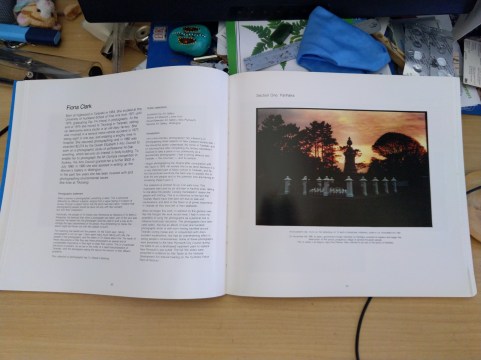
Clark was born in Taranaki New Zealand and studied Fine Art in Auckland, returning home to set up her own gallery, darkroom and studio in 1975. After an accident and a long period of recovery she returned to photography and has been awarded several grants. In 1980 she assisted in setting up the Women’s Gallery in Wellington.
The project that Gilberd directed me to was ‘Kai Moana Local Politics’ which can be found in the book ‘Views/Exposures 10 Contemporary New Zealand Photographers’ (1982) published by Minolta and also on her website here. I managed to obtain a really good second-hand copy for $35 from the link Gilberd supplied.
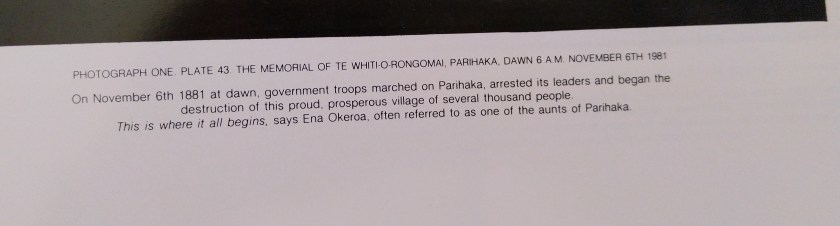
The project started with the aim to document the culture and lives of the local Māori community as it was feared that this would be lost as large amounts of land were being sold to industrialise the ports. As Clark states in the introduction of her section on the book ‘I had in mind the possibility of using the photographs as a political tool to influence local body decisions’ (1981).
Clark’s images and text are spread over ten pages the majority on a double bi-fold, the only photographer in the book to do this and maybe this is something I should reconsider in one of the re-edits – will add it to my list.
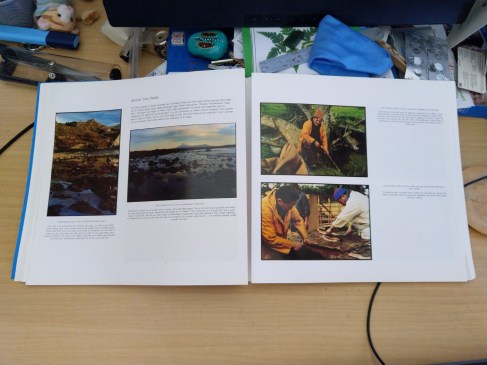
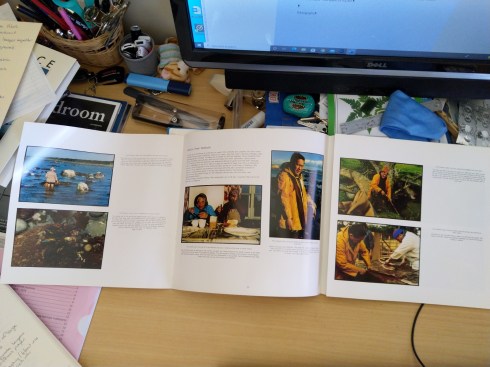
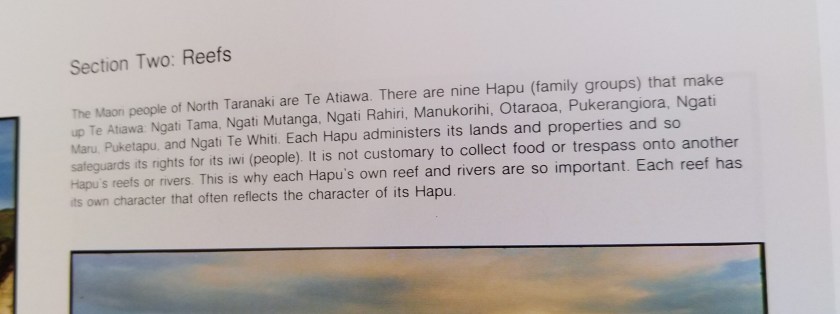
The images are of both the environment and portraits. The latter with very few having direct eye contact between the subject and photographer, they are of subjects at work within the environment, very similar to the images I have tried to create with my project. They show how the community lives and works off the land, once again in a similar manner to mine. The selection of images is limited to these ten pages with the whole project consisting of well over one hundred and forty images. The pages have been divided in to sections covering the reef, seafoods, eeling and the Waitara River.
There’s a strong feeling of community and how they live and feed off the environment. These are documentary images and show the life these people live. The use of text provides extensive detail and leaves nothing to the imagination of the viewer and I think this is her intent as the aim was to record and to push for political change. There are some very personal comments/thoughts and some from the subjects detailing their lives and how for example the octopus is a delicacy with a taste like crayfish – not sure the fishermen of Ngawi agree with that!
I like the use of the bi-fold pages and I agree the text does add to the narrative but leaves nothing for the viewer to imagine. It shows the life and conditions under which this community lives and survives. This way of living has been going on for decades and it’s important to capture and maintain this well into the future.
The following images show the pages from the book:
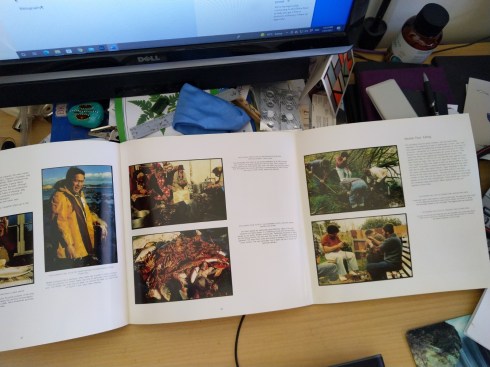
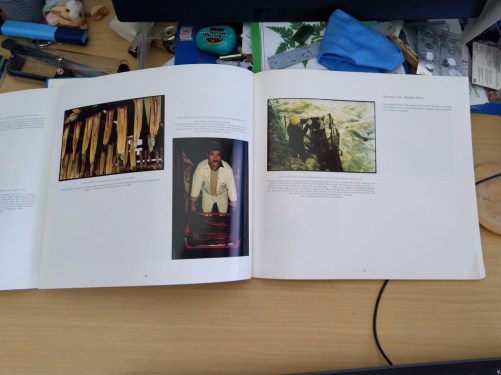
Text that accompanies the images:
Bibliography
Sites accessed between 27/12/21 and 01/01/22
https://fionaclark.com/portfolio-item/kai-moana-local-politics/
Robin Morrison (1944 – 1993)
Born in Auckland and educated in Palmerston North, Morrison was a self-taught photographer whilst living in London. He won 3 major book awards within New Zealand and worked as a freelance photographer but died at the age of only forty-eight.
The book that Gilberd suggested I review ‘Sense of Place (1984) has been out of print for many years but I was able to track a copy down in a second-hand bookshop in Christchurch for $35. The book is divided into a number of chapters covering; landscapes, buildings, people, churches, backyards/structures and finally memorials. This is a whistle stop tour of New Zealand. As the foreword states it is ‘a collection of visual stories concerned with the way we present ourselves as New Zealanders and how we have altered the appearance of this country to reflect our sense of place’ (Robin Morrison, 1984).
At the start of each section there is a paragraph or two as a way of an introduction and then the images sit one or two to a page with a simple text description of what the image is, the rest is left to the viewer.


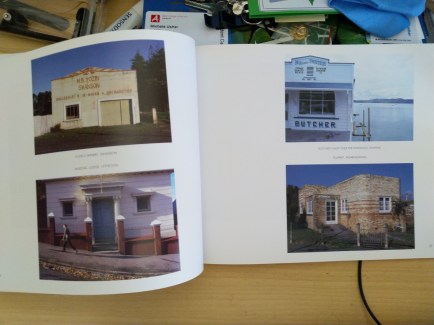
His style is very much in the documentary genre, an observer of life. A window rather than a mirror to quote a term from an earlier course. In an interview with Art NZ in 1981 Morrison was quotes as saying that the view finder of his camera was ‘the boundary round the window, the boundary round the world, the boundary round the piece of information, the frame around the piece of time’. He goes on to say:
‘Editing plays a very important part in my work, because I work round a subject. I could never be a 10 x 8 cameraman, set up the tripod, put the camera on, and take just that one shot. I’d feel very nervous about that. Something might happen to the negative. Apart from that, I like to work round it until I feel right … just that fraction to the left, just that fraction to the left, or just those few more minutes waiting until the sun comes out and the light’s better, or someone moves in front. Happenstance. Fate. I’m very much aware of that in photography’.
This was interesting to read as it’s very much the way I approach a subject especially portraits. With landscapes its different unless you are trying to capture the sunrise.
I’ve noticed that the portraits are mainly central which goes against the ‘rules’ but this really seems to work as the viewer can move around the image to explore other aspects of the scene but still return to the main subject. The angle is straight, simple and wide-angle to include the surroundings. He asks them to look into the camera, taking several images so they start to relax. This is a different technique to mine as I allow my subject to just live their life and I try to blend into the background. The text is factual, minimum and to the point, often without names, for example ‘Family at Pouto’, ‘Walking the dogs, Christchurch and ‘Man in yellow T-shirt, Gisborne’.
Bibliography
Sites accessed between 27/12/21 and 01/01/22
https://www.art-newzealand.com/Issues21to30/2photographersb.htm
https://www.nzonscreen.com/title/sense-of-place-robin-morrison-photographer-1993
David Cook
Cook is both a photographer and a lecturer at Massey University in Wellington. His work is based around communities that are dealing with change or transition. He has worked as part of the team that organises the Photobook NZ Festivals the next of which is in March 2022.
‘Lake of Coal’ published in 2006 was not available to purchase, but is available in the National Library, however there were a number of images available on his website. The project has been divided into three parts; Before, During and After. The website provides a brief overview explaining that Rotowaro is one of New Zealand’s largest mining operations. The project starting in 1984 and last for twenty years. He has recorded the history and the people and how the change and direction to move away from coal mining (below ground0 to open-cast mining has affected over 400 families.
Before – consists of both black and white and colour images, his own and archive. Covering life above and below ground. Domestic life, interior images, portraits, still life and a very personal typed letter. The local pub and dance and the how the community was focused on this one form of industry. It shows the hardship below ground, the hot uncomfortable conditions and then in contrast the drawing by a school child covering the fact that the town is being destroyed to make way for the open cast mine.
During – covers the evacuation and clearing of people’s homes in preparation for the change to opencast mining. The images are all black and white, showing burning homes, children standing on the top of graves at night depicting the end of their homes and life, large panorama images of the environment with no sign of life, the land before the change.
After – Shows the effect of the change and mans need for power. This is a twenty-four-seven operation in order to keep the Huntly power station supplied. The only evidence of the old township was the carbonisation factory.
I managed to find a pdf on-line version of the book. Starting with what looks like a google map of the location and then a panorama of the area before the opencast mine was started. The book includes cook’s notes, planned images and sketches of the area and thoughts. It was great to see and read his thought processes. A large amount of scene setting, history/background is provided in the form of text. A detailed map of the town and the people he has contacted and able to image was also included. Archive images, presumably given to him from people he photographed have also been added to the project. He has also included old polaroid images. Each image has a brief description, but overall, the viewer is left to form their own option.
As I move through the book, he has changed approach and used interviews and transcripts of his interactions with residents of the location/township. This is something that I didn’t really want to do, just wanted to let the images speak for themselves. He moves on to discuss his experience of going underground, the processes being undertaken and his own challenges of photographing in such poor conditions – not easy when he was using film and not digital!
The images clearly document the situation and are a mixture of environmental and portraiture. I do get a real feeling of isolation and abandonment at the end. The combination of text and images, both personal and those from the community have really brought this whole community to life. I think that I need to revisit my environmental images to bring this out more. I have already discussed the need for a return visit to capture this. Reconsidering text is once again an important consideration.
Bibliography
Sites accessed between 27/12/21 and 01/01/22
 Michele Usher