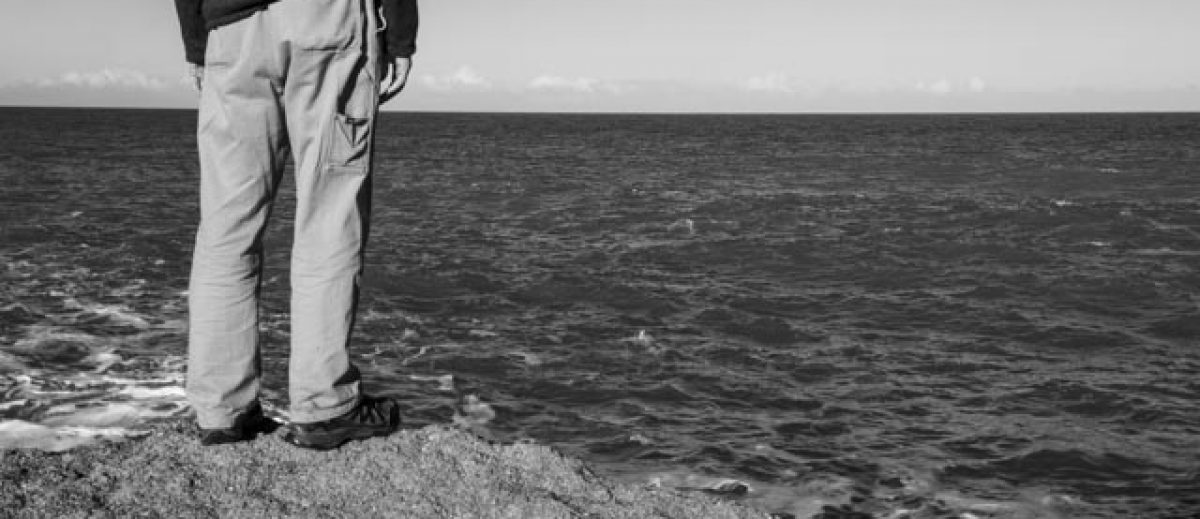
Following our initial conversation and whilst waiting for the report to be sent through I did progress a number of areas. The first was thinking about the importance of Place and how this should be reflected in my Body of Work. Ngawi is a very special place, especially to the residents, otherwise why would they or how could they mentally cope with the isolation, the extreme weather conditions and the limited infrastructure? These factors need to be reflected in my work but reading the work by Dean & Miller (see Body of Work WIP page) Place is often difficult to locate let alone define. At of the research has been based on the ‘geographical’ aspect of place but I think it should be more about the people that make it.
I reviewed a number of photographers who base their work around the importance of place; Eugene Atget, Larry Sultan, Adrian Salingar and Thomas Struth – full notes and discussions have been included in my Work in Progress pages, but it wasn’t until I can across the quote from John Berger (2001) that I think the importance of capturing this element in my work was made apparent:
Place is more than area. A place surrounds something. A place is the extension of a presence or the consequence of an action. A place is the opposite of an empty space. A place is where an event has taken or is taking place…. . When a place is found it is found somewhere on the frontier between nature and art. It is like a hollow in the sand within which the frontier has been wiped out. The place of the painting begins in this hollow. Begins with a practice, with something being done by the hands, and the hands then seeking approval of the eye, until the whole body is involved in the hollow. (Berger 2001:28-29)
Additional research has highlighted similar projects to mine (see WIP) and the one which closely links is that by Julia Johnston documents the people and location along the west coast of the South Island of New Zealand from Westport to Greymouth. Julia grew up in this area and still has strong ties to the place and its community. She has managed to capture the isolation and remoteness of this part of the country, getting behind the scenes and portraying the human aspects and the ‘back to land’ idealist in a series of colour images.
My tutor recommended I read the joint collaborations between John Berger and Jean Mohr, which I have done and provided details thoughts in my WIP, however for me the book ‘A Fortunate Man’ has offered a possible new direction to my Body of Work with the thought of just following one person for a few days. This maybe the couple I have already photographed for Assignment Two or another person if I get a new volunteer. Its an idea I will progress once lockdown is over and I can return to Ngawi.
The return to the work by Chris Killip really made me review my location of Ngawi and compare the two locations on a more macro level and see how very similar they are. Skinningrove was heavily reliant on a single industry – iron smelting. In a similar way Ngawi is reliant on the sea and the export of crayfish to China. At the time of his images the North Yorkshire area was facing mass unemployment and they were attempting to make a living from the sea. Ngawi is currently facing a major issue with the COVID-19 pandemic and the fact that it can’t export its main source of income. Killip is known for his series of images from the North of England and focuses on the changing landscape and increasing poverty. He is known for immersing himself in the community and building relationships in order to show a sensitive side to the locals which is probably hard to do if you don’t come from the area. In a similar way Ngawi is a close-knit community, they look out for each other and have learnt to make do and mend. It’s not a simple five-minute drive to the local hardware store, it’s a 4 hour round trip.
Killip states that Skinningrove cannot be seen from the road, the village is very insular and they are very protective of the village and not particularly friendly to outsiders. Ngawi is probably similar in size but unlike Skinningrove they are used to strangers as the population grows at peak holiday times with campers and local bach owners. The local houses were built for the iron ore miners and in a similar way the properties of Ngawi were built originally for the lighthouse owner and then farm hands and finally those finding a living from the sea. In Skinningrove the men worked in both the mine and at sea for lobsters, in Ngawi its cray. In both locations they use tractors to take the boats into and out of the sea.
Due to the lock down and the lateness of drafting this review I have been in lockdown for some time but working on addressing comments and research for other parts of my Level 3 but I have also been taking advantage of the increased amount of free on-line discussions provided by various organisations around the world to support photographers. So on the morning of the 16th April I logged into the British Journal of Photography 1854 Access presentation with Laura Pannack. I have provided more detail in my Exhibitions section to this blog. However, although the presentation was a little disappointing and focused mainly on how she was coping with the lockdown one interesting question was raised by a lecturer from Spain who asked what she should advise her students who are trying to complete their final projects. Laura say she would tell them to ‘do a one eighty’ if they were trying to photograph a particular group of people, for example think about what would be the effect of this on them and try and photograph that. This really made me think about my current Body of Work project. If I can’t get out how can I apply that process to the people of Ngawi?
The residents of Ngawi as previously highlighted in the blog rely heavily on the export of live crayfish to China. The value to the New Zealand economy prior to lockdown was $320 million per year and directly and indirectly employs 2500 people.
When I was completing the images for Assignment two there was much discussion around the impact this would have on the village as they waited for the Government to provide direction. Thinking of this and the question and answer session with Laura I remembered the work by the British photographer Paul Hill that was covered in Level 2: Landscape. Hill works extensively within the north of England and as part of his project ‘White Peak Dark Peak’ which is based in the Peak District national Park he produced a series of images of a dead badger as it decayed. The meaning behind his image is around the cyclic processes of nature, mine will be about loss of a resource to the village. I will run this in parallel to my planned project of photographing the residents and a single series with my main subject of Assignment two.
http://www.hillonphotography.co.uk/projects/landscapes.php
There will be a number of challenges with this – the smell being one, so I think setting the subject i.e. cray, outside in one of my fields would be best. Ensure that the local wild life don’t take it between images is another. I might have to tie it down and make sure I have a second in the freezer as a backup just in case I have to start again.
An alternative would be to set one up in the field and a second as a still life in the garage, fingers crossed this doesn’t encourage rats. I started to investigate how to create a set of studio lights via a number of YouTube videos – seems easy enough – just need to find all the parts.
So, in summary there are three possible avenues:
- Trying to photography as many of the residents of Ngawi as possible;
- Focus on a single subject;
- Loss of income in the form of a decaying cray
 Michele Usher