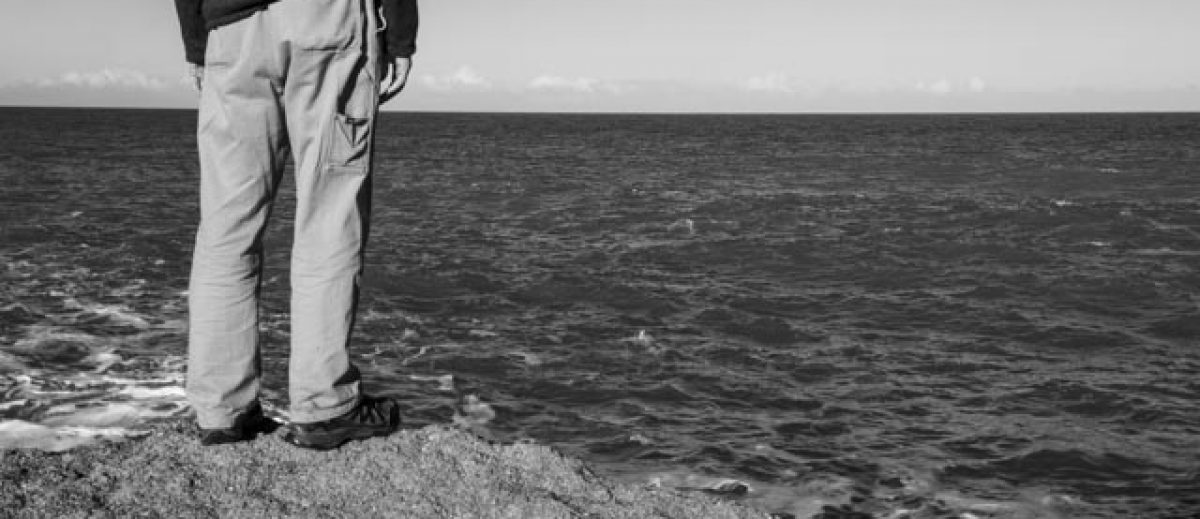
Chance: Coincidence and Street Photography
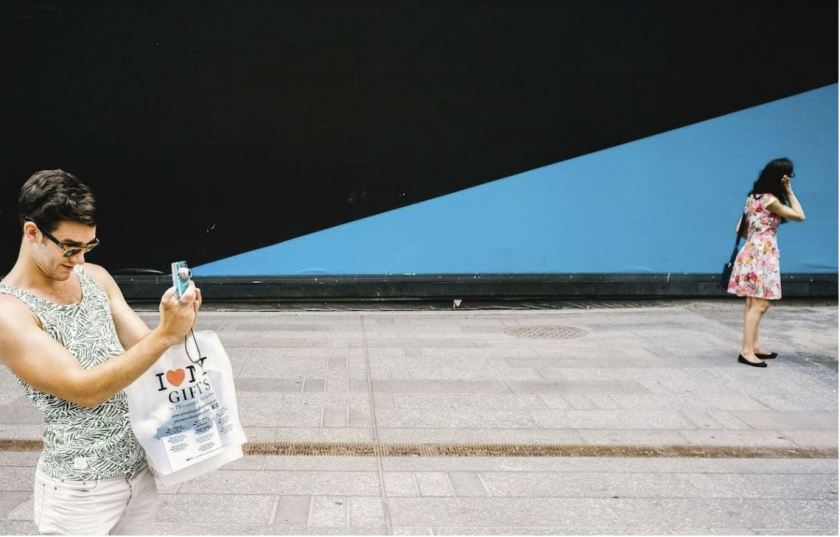
Street photographers seek out the perfect moments in life to frame an image. One of the most popular street photographers seems to be Jonathan Higbee. Higbee a 2018 Hasselblad Masters finalist manages to capture the moment when people and object align. Unlike other street photographers who roam the streets Higbee finds a location and sits and waits for the right moment, this may take several return trips but the results are a testament to his success:
Bibliography
Website accessed 27/03/2020
https://www.jonathanhigbee.com/
https://mymodernmet.com/jonathan-higbee-coincides-interview/
Louis-Jacques Daguerre is thought to be the very first street photograph with his iconic image Boulevard du Temple, Daguerre pointed his camera out of his studio window to capture the boulevard below. The use of a long exposure meant that the street appears empty, except for two men – a shoe-shiner and his client – who remained still for long enough that their images to be captured.
Later William Henry Fox-Talbot had developed the Calotype, which offered the capability to produce a flexible negative from which multiple copies could be made. The Calotype camera was adopted by Charles Nègre who took his camera out of the studio onto the streets of Paris. Nègre managed to capture movement for the first time. His most successful images were Market Scene at the Port de L’Hotel de Ville, Paris and Chimney Sweeps Walking, taken in 1851. Other examples include John Thomson’s Street Life in London in 1877 and Paul Martin’s London by Gaslight series (c. 1896).
By the turn of the century, New York, was the likes of Alfred Stieglitz and Edward Steichen turning the city architecture into photographic art. Whilst in Paris, Eugène Atget used the deserted city streets and alleyways for the aim of preserving the forgotten and unremarkable aspects of the French capital.
Sophie Calle (b. 1953)
Calle is a French born writer, photographer and artist. Her work revolves around vulnerability, questions our identity and acts of intimacy.
Suite Venitienne (1980)
In this project Calle explores the world as an observer. In this series of black and white images which include text, illustrate a journey she made whilst following a man she met at a party to Venice. The trip took place in 1980, the text describes in detail the actions made over the 13 days of the trip, where she also enlists the help of friends and acquaintances she makes along the way. The man simply named ‘Henri B finally realises what she is doing and they walk together. She continues to follow her subject even after being recognised until he returns to Paris. She explains, “At the end of January 1980, on the streets of Paris, I followed a man whom I lost sight of a few minutes later in the crowd. That very evening, quite by chance, he was introduced to me at an opening. During the course of our conversation, he told me he was planning an imminent trip to Venice. I decided to follow him.” (Los Angeles Times accessed 28/03/2020)
The Hotel (1981)
This involved Calle being hired on a short three week basis as a chambermaid for a hotel. During the three weeks she cleans 12 bedrooms but whilst there she looks through personal belongings and uses personal items such as perfume and documents her findings which for me crosses the ethical boundary, when using a hotel the guests expect a certain level of trust and respect. She is unashamedly voyeuristic in her approach
Take Care of Yourself (2007)
In this project Calle depicts the response to being ‘dumped’ by her boyfriend via an email that ends with the statement ‘take care of yourself’. After two years thinking about this event in her life she decided to print off the email and distribute the email to over 107 women and photographed them whilst they read the email. She then asked them to analyse it according to their profession. A number tore apart his grammar, the method of delivery and one even used the email as target practice. “The idea came to me very quickly, two days after he sent it,” she said. “I showed the email to a close friend asking her how to reply, and she said she’d do this or that. The idea came to me to develop an investigation through various women’s professional vocabulary.” At first it was therapy; then art took over. “After I month I felt better. There was no suffering. It worked. The project had replaced the man.”(The Guardian 2007).
Bibliography
Websites Accessed 28/03/2020
https://www.latimes.com/books/jacketcopy/la-et-jc-sophie-calle-suite-venitienne-20150324-story.html
https://www.theartstory.org/artist/calle-sophie/artworks/
https://frieze.com/article/sophie-calle-1
https://www.theguardian.com/world/2007/jun/16/artnews.art
https://www.youtube.com/watch?v=Q9E4dA0EGaM
https://www.youtube.com/watch?v=c-TuNcKA6aY
Chris Coekin
This photographer from Leicestershire produced a series of images whilst hitchhiking around the UK. In it he was both the director and participant. The chance meetings between him and the driver gave him the opportunity to capture the random acts of kindness from willing drivers to give this stranger a lift on the next leg of his journey. The work doesn’t include any details about the driver and you are really left feeling like you want to know more. There is a complete lack of emotion or insight in the images.
Bibliography
Websites Accessed 28/03/2020
https://www.lensculture.com/articles/chris-coekin-the-hitcher
https://www.telegraph.co.uk/culture/3675360/Chris-Coekin-The-Hitcher.html
https://www.photobox.co.nz/content/news/fotb/the_hitcher
Gillian Wearing
Signs That Say What You Want Them to Say and Not Signs That Say What Someone Else Wants You to Say
Wearing is a British artist that often uses masks to portray herself, other individuals and groups. In the above project she approaches strangers and asks them write what they were thinking or feeling at that moment in time, then photographs them holding the sign. “It’s always important as an artist to find a unique language, and that’s why the Signs excited me,” she said of her series. “They felt new. But I didn’t realize they were going to be so influential, on everything from advertising to people doing signs for their Facebook page.” For me I think she has captured that emotion and rawness that these people feel. They are chance encounters but often they will have effect that will stay for some time.
Bibliography
Websites Accessed 28/03/2020
http://www.artnet.com/artists/gillian-wearing/
https://www.theartstory.org/artist/wearing-gillian/artworks/
https://www.theguardian.com/artanddesign/gallery/2012/mar/04/gillian-wearing-signs-in-pictures
Chance: Found Photography
Joachim Schmid (b. 1955)
https://www.lensculture.com/articles/joachim-schmid-celebrating-photographic-garbage
Whilst researching Schmid I found a very interesting article on the American Suberb X website (link below) that claim Schmid was a thief and a liar. According to the article he was taking the work of others in the form of discarded photographs and claiming they were his own. I’m not sure that is the case as in the interview he quite clearly states where the images come from, and the project has lasted over twenty years. He is in fact not the first and wont be the last to utilise other peoples work in their art. The Surrealists would buy old photographs and present them as examples of the unconscious mind. A number of arts use images from CCTV, Google Earth and rein act adverts that they see magazines.
The majority of his work is using other people’s images, sourced from the streets, fleas markets or on line from social media sites. I have to question if this is art or even a genre of photography as there doesn’t seem to be the use of a camera in this second process. I also question if you can even claim ownership as you didn’t press the button on the camera, therefore the IP is not yours to claim.
I find the whole idea of found photography quite challenging as a subject, the reliance of random images being found or discarded and then using them to create new art. There must be a point when printed copies will run out? Then I suppose you turn as Schmid has done to the internet, Flicker and other on-line media. People put their images on-line without any thought of privacy or ownership and one could argue that if that’s the can then feel free to down load and use, but I do think that is different to archived images, these are deliberately stored for history, they have an owner and there are a whole new range of legal implications to their use.
Bibliography
Website accessed 29/03/2020
https://americansuburbx.com/2011/06/joachim-schmid-joachim-schmid.html
https://aperture.org/blog/observing-by-watching-joachim-schmid-and-the-art-of-exchange/
http://www.artnet.com/artists/joachim-schmid/biography
https://www.telegraph.co.uk/culture/photography/8868271/Joachim-Schmid-QandA.html
Alec Soth (b. 1969)
Soth an American photographer who is based in Minneapolis, Minnesota and started his own publishing company called the Little Brown Mushroom’. According to the Magnum Photos website ‘Soth’s work is rooted in the American photographic tradition that Walker Evans famously termed “documentary Style.” Concerned with the mythologies and oddities that proliferate America’s disconnected communities, Soth has an instinct for the relationship between narrative and metaphor’. I have been reviewing the work by Soth for my own project especially his project ‘Sleeping by the Mississippi (2004) and how it relates to the people and communities of the East Coast of New Zealand.
The project entitled ‘Frank’ is based around a purchased photo album that seems to belong to a person called Frank from his trip to Japan and nothing else is know about him. Soth set up a blog [https://thefrankalbum.wordpress.com/ [accessed 30/03/2020]] and asked people to make up entries. Soth then published a book around the whole fictional information provided on the blog site and the images from the album. I found the following link:
https://vimeo.com/76839278 [accessed 30/03/2020]
As part of this review we have been asked to consider the ethical issues and to what extent we consider the original album ‘private’. These images were taken prior to the extensive use of social media and what seems to be the total lack of privacy now adays. The question for me is if Frank knew this was going to happen would he want the public to see these images? We will never know unless Frank was one of the people responding to the blog posts. Should Soth have tried to return the album? I’m not clear as to the circumstances under which this album was purchased, but if Frank didn’t want anyone else to see the images then he should have either destroyed them or stored them more securely.
Bibliography
Website accessed 30/03/2020
https://alecsoth.com/photography/
Chance: Accident Photography
Paul Graham (b. 1956)
Graham in his project ‘American Night’ (1992 – 2002) documents the African-American underclass at the outset of the 21st century. The project consists of 63 photographs which have been divided into three distinct groups.
The majority of the images are bleached-out/over exposed which were the result of an accident. The images consist of urban blacktops with solitary African-Americans walking through or just hanging around. There are also a number of what I would call more middle-class suburban homes, but one thing that they have in common is that there is no evidence of life. The final set of images consist of street portraits both men and women, many appear to be suffering from some form of physical or psychological impairment.
The change of image format from the bleached to the colour is a shock to the system and as he writes in the course notes gives that feeling of coming out of a dark place into the sunshine where you are momentarily blinded.
We are asked to consider our own mistakes and if they caused us to change direction. I have to admit that I probably make far too many and most are discarded and never used or considered. Would I consider changing my approach? Probably not. Although I like the images that Graham produced it’s not something I would aspire to achieve or use in my Body of Work
Bibliography
https://www.paulgrahamarchive.com/americannight.html
Adam Broomberg (b. 1970) and Oliver Chanarin (b.1971)
According to their website Broomberg and Chanarin travelled in June 2008 to Afghanistan to be part of the British Army in Helmand Province. They took normal cameras and a roll of photographic paper. The video link below follows the journey this paper took
They couldn’t have arrived at a more difficult time in the conflict. On their first day a member of the BBC fixer team was dragged from his car and executed and nine Afghan soldiers were killed in a suicide attack. Following this, three British soldiers died and casualties continued until the fifth day of their trip when nobody died. Throughout this period Broomberg & Chanarin didn’t record the events like normal documentary photographer but on this fifth day unrolled a six-meter section of the paper and exposed it to the sun for 20 seconds.
I have to admit I kept asking the question why? Why carry that box of paper all that way for just 20 seconds? Why film it and not document the whole events that were happening at the same time but I found the following questions taken from an interview in 2008 [https://cphmag.com/convo-broomberg-chanarin/][site accessed 01/04/2020] and the answers addressed these questions:
Jörg Colberg (JC): In 2008, you went to Afghanistan, “embedded” with the British army, to make pictures (The Day That Nobody Died). You went with a roll of unexposed photo paper, unrolled parts of it on different days and exposed them for a period of time. This was a conceptual way to look into the process of embedding, of having the army transport you and your box of film, of making pictures in a war zone. This all makes perfect sense, at least as long as you’re familiar with all of these mechanisms (and with the idea of conceptual photography). Most of the consumers of the news, however, might not have the background needed to make these connections. They might simply be baffled. I’m wondering how you navigate around that risk, the risk that people outside of the art world simply don’t have enough exposure to this fairly sophisticated thinking about photography to get what’s going on?
B&C: Interviews like these, teaching and speaking in public is very much part of our work and we try and explain everything about our motivations, our working methods and our mistakes. In the project you mentioned we wanted it to raise questions. It was at the height of the insurgency in Afghanistan, and the embedding process was in full swing. When we began investigating the embedding process it bewildered us, and revealing its working underpinned the project. To truncate its history, the US and UK realised that the public would demand access to photojournalists after the first Gulf War in the 90’s, where no photographers were allowed into the conflict zone, and we all sat behind televisions watching so called “smart bombs” exploding randomly (often brought to us by cameras mounted on the noses of these intelligent weapons). At the same time the US administration had noticed that during the Falklands war – where boats taking troops alongside a limited amount of photojournalists to the frontline took three weeks – led to a different depiction of the war. The journalists had developed an affinity with the troops and this led to a more traditional , ‘heroic’ depiction of their actions. So they invented the embedding system, which on the surface promises the photographer unprecedented access to the frontline (but less apparent was the access it granted the defense ministries to the photographer’s movement and material). It was a deal with the devil. In order to get embedded we signed a form effectively banning us from taking any images that showed evidence of conflict (no dead bodies, no wounded bodied, non evidence of enemy fire… the list is endless). So our only option was to make a performative act of resistance. To go there we lied and said we were photojournalists and signed their embedding form, and once there never made any pictures. To get back to your question, the controversy it raised helped us ask these questions in public. But less cynically the “images” we brought back (6 meter, abstract swathes of colour all made at moments when a traditional photojournalist would make a picture) are in a sense real witnesses. Those documents, that piece of paper was actually there in the place. Its relation to the event is more clear than a traditional photograph. It ears the scratches, the effects of the light, the heat, the environment on its surface.
JC: Important events such as wars or disasters need to be witnessed and documented or reported. How can this work, though, in a world where the news and media in general have become so heavily commercialized and where, I think as a consequence, the general trust in images in the news has been diminished?
B&C: The civilian journalist, anyone armed with a mobile phone is now a potential witness. Did you know that Associated Press now have more people scouring social media then they have professional photographers in the field looking for ‘evidence’? The playing field is now wide open, and hopefully with more and more people feeling the need to blow the whistle the more we’ll know about the dark workings of the state.
Bibliography
Website accessed 01/04/2020
https://www.youtube.com/watch?v=HHLtElcCkZ8
http://www.broombergchanarin.com/the-day-nobody-died-1-1
https://www.tate.org.uk/tate-etc/issue-32-autumn-2014/points-memory-broomberg-and-chanarin
David Bates
Bungled Memories (2008)
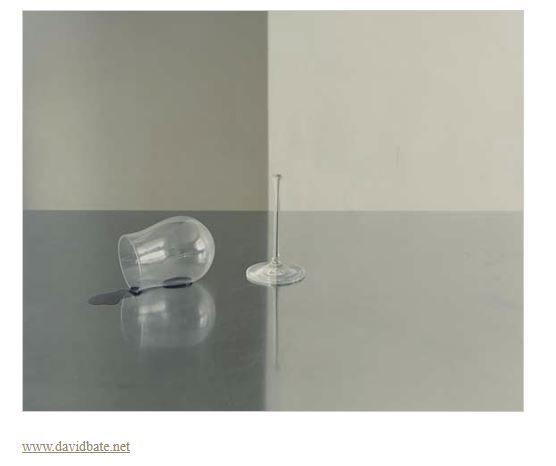
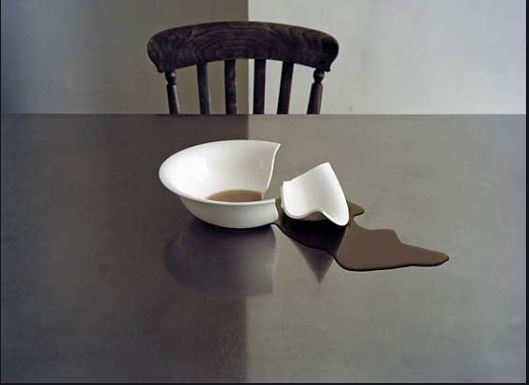
In this series of still life images Bates used broken crockery to examine the thesis that Freud called ‘the psychopathology of everyday life’ that in fact accidents are not necessarily ‘accidents’. Bates draws on the use of the still life genre to challenge the assumptions that many make. The images are said to draw attention to the social and cultural aspects of domestic life, a position I’m not sure I see as I find the set very difficult to interpret.
I read the essay ‘The Memory of Photography’ (2010) by Bate’s for both of my level 2 courses in Landscape and Documentary and so reviewing again helped when I tried to understand this series. For me the main thread of his argument is centred on the fact the photographic image is not always what it is about. It is often a ‘trigger’ for your memory in a form of a parapraxis or the ‘Freudian slip’. Bate’s discusses this in his essay around the concept of voluntary v involuntary memory and in the following quote taken from his essay:
“Freud argues that these apparently insignificant memories from childhood, which usually stay with the individual throughout their lives as representations of the lost years of childhood, are actually screens, a displacement or shield from other significant memories.” (Bate 2010: 253)
The images are made on a highly reflective surface in muted tones which give an overall sense of calm. The frame is divided into zones maybe to imply there are two sides to every story.
I have read a number of essays by Bate’s throughout this course and enjoy his writing and ideas. I hadn’t planned to use still life for my Body of Work but if the current situation around the Covid-19 pandemic continues and we remain in lockdown then I will have to consider it. My submission cut off is not until November 2021 so hopefully we are not isolated until then.
Bibliography
Websites accessed 02/04/2020
Bate, D. (2010) The Memory of Photography. Photographies, Volume 3 No2, accessed via https://www.tandfonline.com/doi/full/10.1080/17540763.2010.499609
http://davidbate.net/ARTWORKS/BUNGLED-MEMORIES.html
https://fkmagazine.lv/2011/09/26/art-without-coincidences-interview-with-david-bate/
 Michele Usher