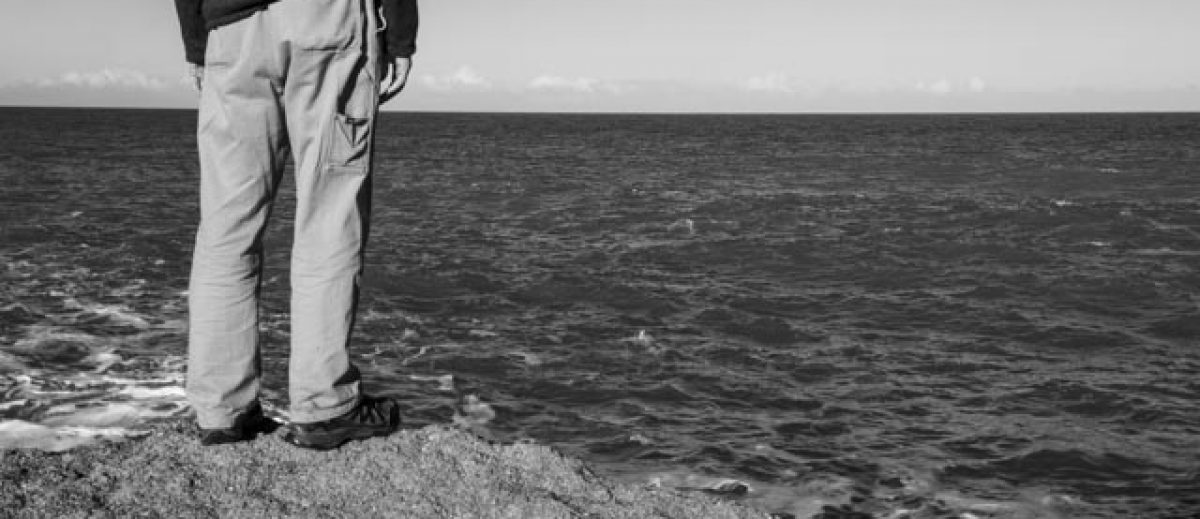
5th March 2020
For the past few months, I have been working very much on my own and progressing as best as I could, however after some discussions with the Support Team at OCA I was assigned a new tutor who I managed to meet, via an internet session to discuss Assignments one and two. The following areas were discussed and agreed to be added here:
- Add all images produced to show my progression – including the ones in colour;
- Progress the human aspect of the location and consider doing a further shoot with Rob and Trish
- Try and touch base with other residents of the area and record my discussions as fully as possible – discussed the use of a letter drop request
- When I return to Ngawi – return with no intension of trying to solve a missing aspect, go and shoot but shoot with a theme
- Don’t rush, show progress between Assignment Two and Three
- Research the importance of ‘place’ and the work by John Berger and Jean Mohr in the Seventh Man and Another way of Telling.
Additional Images
The initial shoot of the 31st December was in colour and I included all the images from that session. Prior to submitting Assignment Two I did rework a few images from that session and turned them into the square format and black and white. I feel that the black and white gives more of an isolated feel. The following are from the second session but show the colour version:


My second shoot covered additional images from the beach and a photo shoot with a couple who live in Ngawi. These images I processed solely in black and white and issued in my Assignment in the square format however I should have also shown my progression and this I will done in future sessions:


For me the black and white images ensure that the viewer concentrates on the subject and not the many distractions surrounding the subject. Black and white images although considered traditionally documentary I’m trying to capture more than that. I want to see the rough surfaces and the warn out equipment and the isolation. For me black and white shows the signs of hard work on the faces of these two people who have lived and loved in this place for years. They make do as its over a two hour drive (one way) to the nearest hardware store. They have to fix and make do and this kind of life is hard and that’s what I want to show. It’s a special place but so are the people who live here. I think this project is moving away from concentrating on the mental health issues and migrating into the individuals who call this place home.
10th March 2020
Additional Volunteers
In order to try and find additional volunteers in the form of local residents I decided to write a brief letter explaining what I was looking for and mail these through the mail boxes in and around Ngawi when I next go there for a photo shoot. I drafted the following:
Hi
Are you a resident of Ngawi? If yes, can you please take the time to read this request.
My name is Michele and I’m a photography student looking for volunteers for my final project. I need a few hours of your time to photograph you and your family in and around Ngawi. In exchange I will provide copies of the images in either digital or print form. The images will be used in an exhibition which I will contact you when and where this will be taking place.
If you are interested in helping I would love to hear from you. You can contact me in the following ways:
Mobile: 0211169974
Email: ushermichele69@gmail.com
If you would like to see any of my previous work my website can be found here:
Thank you so much for your time and I look forward to hearing from you.
Regards
Michele
I printed off approximately 60 and placed in envelops:


Fingers crossed this works. I will also take the opportunity to talk to people if they are about when I do the mail drop.
15th March 2020
The Importance of Place
Whilst listening to the other students on the tutor led discussion (17th March) I made a few notes that I think would relate strongly to my Body of Work – that of Ngawi as a ‘place’ and how this is important to them. Rob from my second photo shoot kept saying that it was a ‘special place’. I want to research this more and look at how other photographers have represented ‘place’ in their work.
As a starter I have pulled through some research I completed for my Contextual Studies.
Dean, T and Millar, J. (2005) Place. London, Thames and Hudson
The following notes have been made on the book by Dean and Miller pages 11-26.
The book is divided into what seems to be a walk through a gallery with the introduction being entitled ‘entrance: Place the first of all things’. The subsequent chapters are called rooms.
Following a quotation from Aristotle concerning the difficulty in answering the question ‘what is place?’ Dean and Miller state:
‘Place can be difficult to locate. One might think that one can spot it somewhere, some way off in the distance, perhaps, and yet as one approaches it seems to disappear, only to reconfigure at some father point, or back from whence one came. Place itself can seem a confusing place in which to find oneself, an uncertain place to explore, even with someone to guide us’ (Dean & Miller 2005: p.11)
The very question about what is place has been asked by major philosophers over the decades and according to Dean & Miller this has been asked ‘with increasing frequency in recent decades’ as it seems to be important in a large number of academic and social fields such as anthropology, architecture, ecology, feminism, literature, music and of course art.
‘Place’ doesn’t seem an easy word to define. According to Dean & Miller ‘there are more concepts of place than actual geographic ones’ (p.12). Dean & Miller begin their discussion within the landscape genre, because this is where they state ‘place’ occurs the most (p.12). Landscape they say ‘is not only the most popular of the genres within the visual arts, but also the most recent, at least within the Western tradition’ (p.12). When they considered Renaissance painting, they highlighted the fact that what was considered to be landscape was usually only seen though a window or archway or else ‘provides an exterior backdrop against which is set the main subject of the painting’ (p.12).
As the meaning and our understandings have developed and changed with respect to landscape over time due to changes in culture, improvements in technology, and infrastructure so to have our understandings to that of place. It could be said that place ‘is something with which we engage in our everyday lives; we can use it to describe the relative ‘rightness’ of a situation’ (p.13). Place is often ‘more sensed than understood, an indistinct region of awareness rather than something clearly defined’; it has ‘no fixed identity,’ and has thus ‘been subject to numerous demands, whether theological or philosophical, political or aesthetic’ (p.14). Dean and Millar state, ‘in attempts either to wrest control of it or, conversely, to despoil it, to render it of little use or value’ (p.14). Reviewing the work by Yi-Fu Tuan it is suggested that often the familiarity turns spaces into places. ‘Place is something known to us, somewhere that belongs to us in a spiritual, if not possessive, sense and to which we too belong,’ (p.14).
Dean and Miller continue by highlighting that by the 14th and 15th centuries, the meaning of ‘space’ is considered in its most expansive sense and gradually gained precedence over what was then considered the more bounded notion of place,’ and space came to be seen ‘as the more useful concept with which to explore the infinite,’ and ‘the very things to which place seemed best suited—a sense of belonging, for example—were now considered intellectually irrelevant. The particular had been eclipsed by the universal; space had triumphed over place’ (p.15).
As stated earlier place ‘is a complex, ever-changing terrain,’ Dean and Millar continue, one in which familiar landmarks or points of reference might shift position, become obscured by the cultural weather, or simply disappear altogether’ (p.15-16). As we continue to move forward Dean and Miller suggest that we need to remain alert to these shifts in meaning (p.16).
‘The infinite space of the early modern period must have seemed overwhelming,’ writes Dean and Millar, ‘yet there were some for whom it must have offered immense possibilities rather than existential anxiety’ (p.16). Space was considered to be ‘better suited to exploring the immensities of a universe that was beginning to be revealed by Copernicus and Galileo’. Place, Dean and Miller continue, ‘was absorbed within space in a distinctly subordinate role’ (p.16). Distance ‘also contributed to the diminishing of place’ (p.16). As measurement came to be seen as all-important, other qualities of place—’colour, temperature, and texture’—became unimportant and were therefore considered irrelevant (p.16).
The philosophers of the 17th and 18th centuries were ‘unable to raze place completely,’ (p.16). ‘We retain a strong sense of place, even if we find it hard to define with any satisfaction, and this in itself demonstrates a refusal to accept the mathematical model of place-as-location proposed by such seventeenth and eighteenth-century philosophers,’ Dean and Millar write (p.16-17). But even while those philosophers were attempting to eliminate unmeasurable place as a category, artists were making some of the first landscape paintings and rejecting mechanistic ideas about the universe. ‘The work of these artists . . . not only marks a refusal to accept the impoverishment of nature, and place, proposed by the rationalist philosophers of the period, but also puts forward a different, more generous, approach to engaging with the world,’ Dean and Millar suggest (p.17). To help clarify this they use a quote from the English landscape painter John Constable, who asked, (1836), ‘Why, then, may not landscape painting be considered a branch of natural philosophy, of which pictures are but experiments?’ (p.18), they then go on to suggest that ‘the most important such artistic experiment of recent times is that established by Ian Hamilton Finlay at Stonypath, just south west of Edinburgh,’ where he has ‘initiated the creation of one of the most celebrated gardens of the twentieth century’ (p.18). ‘A cultivated place, the garden acts as a form of threshold, and encourages us to dwell, whether that be in the form of static contemplation, a wandering, or both,’ Dean and Millar state (p.18). They suggest that Little Sparta’s importance ‘is that as both place and art it can lead us to a greater understanding of both of these things’ (p.18).
Dean and Millar use the work by Henri Lefebvre who writes on social spaces and how they ‘interpenetrate’ each other or are superimposed on each other. Dean and Miller suggest that this is true of places as well: ‘We might even suggest that any single place is a process of such interpenetrations and superimpositions, whose scale, force and rhythm are engaged in an ongoing movement of shifts, rolls and waves, all of which generate new senses of place, or new senses of the same place’ (p.20).
Dean and Millar recognise that often local places are ‘sacrificed for the ‘national good,’ a concept that is most often defined in relation to other nation states and the ‘necessities’ of the ‘global market’’ (p.20). ‘There are many people who value, and fight to protect, the particularities of place, however, although within a society which often operates on a principle of economic utility, the calculable “benefits” presented by developers, investors or corporations are often more easily grasped than the more intangible “sense of place,’ (p.20).
‘Art, like place, is a process of accumulation and seldom calls for the active destruction of that which came before, Dean and Millar write. ‘It is often said that artists ‘build upon’ the art that came before them, but it is an unfortunate phrase. Artists are not bound in the same way that property developers are, and so have no need to build upon what is already in place’ (p.21). Instead, ‘[t]he art they create may open up onto the art created by others—as Finlay’s opens up onto Claude and Poussin, for example—but it has no need to take its place, or to deny it’ (p.21). Dean and Miller cite the work of American conceptual artist Douglas Huebler as an example of art that explores the example of ‘how we perceive, and represent, time and place’ (p.21). ‘In Huebler’s work, the commonplace is utterly transformed, the most banal view afforded the potential for immense significance,’ (p.23).
Cresswell, T (2004), Place a Short Introduction, Blackwell Publishing.
According to Cresswell, place is the most important discipline in the study of geography and as he states ‘The popularity of place is an opportunity for geography. It is also a problem as no-one quite knows what they are talking about when they are talking about place. Place is not a specialized piece of academic terminology. It is a word we use daily in the English-speaking world.’ He asks us to consider all the ways we use the word in everyday life such as: ‘Would you like to come round to my place?’ – implied ownership, ‘She put me in my place’ – results in a sense of position in some form of social order, another example would be as Cresswell cites: ‘A place for everything and everything in its place’ which again suggests an order on a ‘socio-geographical’ basis. These examples define place as making a blank location into something of meaning to you as an individual. Even though they may have traces of a history, these show that the space doesn’t transform from a space into a place until you make it into your own.
In order to explain his next point, he starts with a set of geographical coordinates which as a comb8ination of degrees and points on a compass don’t really mean anything unless you know that 40.46oN 73.58oW is New York, these are not how we think of a place. Cresswell covers the history of the location from the influx of immigrant families which contained multiple families to a place of political unrest. He documents the changes that the location has gone through with rising house prices to people sleeping in parks because they couldn’t afford to live there. This sleeping in the park caused residents to feel unsafe resulting in the removal of these people.
Cresswell explains that each individual turns a space into a place as they turn it into a place of memory and ownership. Gardens throughout the city, offer a sense of cultural identity, thus each location becomes meaningful. Cresswell uses the work by political geographer John Agnew (1987) who outlined three fundamental aspects of place as a ‘meaningful location:
- Location;
- Locale (a setting for ‘social relations’); and
- Sense of place
Cresswell also argues that not all these places need to be stationary (e.g. a ship), there is however, a material setting that produces an emotional attachment with that place.
He explains that space itself is much more abstract than place. ‘When we speak of space we tend to think of outer-space or the spaces of geometry. Space have areas and volumes. Places have space between them. YiFu Tuan has likened space to movement and place to pauses – stops along the way.’ Cresswell states that ‘Naming is one of the ways space can be given meaning and become a place.’
Cresswell raises an interesting contrast between the European concept of place and that of the native canoeists of the coast between Seattle and Vancouver, to demonstrate the cultural differences. The European explorers emphasize land as a place, taking in its forests, mountains, and assessing its worth based on their ability to settle and populate, take ownership. Whilst the canoeists emphasized the sea as a place, believing that the forests were places of isolation, darkness, and exile. ‘When humans invest meaning in a portion of space and then become attached to it in some way (naming is one such way) it becomes a place’. Cresswell states that place may not always remain meaningful; long periods of absence could make an individual lose the qualities that saw the life within a landscape, but stresses that this too is not permanent and places can always be re-established. ‘Landscape is an intensely visual idea. In most definitions of landscape the viewer is outside of it. This is the primary way in which it differs from place. Places are very much things to be inside of.’
To conclude Cresswell argues that place represents a way of understanding the world. With seeing connections between people and place we are open to seeing meaning and experience, and as an aspect of how we decide to think about the world. ‘‘Place’ is not so much a quality of things in the world but an aspect of the way we choose to think about it – what we decide to emphasize and what we decide to designate as unimportant’.
23rd March 2020
Mohammadmiri, Marzieh (2018). Place in Photography: How Photographers Encounter Place. European Journal of Media, Art and Photography, p110-117
In a similar vein to that of Dean and Miller and the work by Cresswell Mohammadmiri discusses how place is specifically based around a geographical location (p 111). He goes on to cite the work by Thomas and Cross (2007) who argue that place is not solely based on a geographical location but also on the ‘integration of relationships and interactions’. They claim that a place needs both a geographical description and a social aspect for it to have a meaning and importance. Mohammadmiri states that ‘Human’s existence is undeniably connected to place, to the extent that humankind experiences itself through perception of and in the place’ (p112).
The article states that through the use of photography space is organised and in some way given ‘a new credit’ (p 112), which covers any location into a place. Mohammadmiri states:
‘Place, therefore, is a part of an environment that has been taken note of; an environment that is of a particular interest to us and has earned a meaning. Taking photos of a location reflects the photographer’s attention given to the space making it meaningful. In fact, if there are no values and meanings beforehand, these are created when the photographer encounters the location within his/ her photography practice. Therefore, photography can be considered as a place-making practice. During photography practice, the framed shot converts a space into a definable place’. (p 112).
A number of photographers are discussed within the paper and I will address these outside of this brief as I think they are important to research further for my Body of Work.
Annear, Judy (2008). Photography & Place: Australian Landscape Photography 1970s until now. Broadsheet, Vol 37, no 3 pp 204-07 (and errata Broadsheet, vol 38, no 4, Dec 2009, p231)
Annear also refers to the importance of the social aspect of a space to become a place when she cites the work by W J T Mitchell (1999) ‘landscape is a ‘social hieroglyph that conceals the actual basis of its value…by naturalising its conventions and conventionalising its nature’. She goes on to say that ‘place can be about belonging because of the inference of a social space: a photograph of a place, because of its apparent lack of human subjects, can perhaps more easily reflect the thoughts, ideas and feelings of both the photographer and the viewer precisely because there is no obvious mediator’. I’m not sure I fully agree with this statement as the photographer makes the conscious decision on what to include within the frame, just because there are no human elements doesn’t mean it isn’t a place.
24th March 2020
Eugene Atget (1857 – 1927)
A French photographer renowned for his images of architecture and the streets of Paris. He began shooting in 1898 and sold his images to painters, architects and stage designers. His images were noted for their use of diffused light and wide views as they were taken at dawn with a large format camera. These images gave a feeling of space.
His career would span over 35 years but it was around the 1900s that his focus would shift. Paris was being reshaped by a campaign of modernization called ‘Haussannization’. A destructive process that saw Paris change from medieval neighbourhoods to one of broad avenues and public parks. These changes became a major interest for Atget and he established himself as a specialist in ‘pictures of Paris’ as he systematically documented the changes through the city.
According to Mohammadmiri (2018) ‘Rootedness in place’ obliged him to shoot the same place or even a specific tree in a park of Paris over and over to document and archive the changes that happened due to the spread of modernity’. According to Grundberg (1985) some of Atget’s photos are eternal and poetic and strongly reflective of his sense of nostalgia. Grundberg states that ‘More than any other photographer, Atget makes explicit photography’s ability to render all things nostalgic, so that the past seems to ache in us’.
GRUNDBERG, A. (1985): Photography view; Eugene Atget-His art bridged two centuries, in The New York Times. On-line accessed 24/03/2020: https://www.nytimes.com/1985/03/10/arts/photography-view-eugene-atget-his-art-bridged-two-centuries.html
25th March 2020
Larry Sultan (1946 – 2009)
An American born photographer who was known for his creative images that bridged the gap between fiction and documentary. One of his best know project ‘Pictures from Home’ (1992) a project he started during the presidency of Ronald Reagan, Sultan states in an interview with The Guardian (2nd May 2017) ‘the institution of the family was being used as an inspirational symbol by resurgent conservatives. I wanted to puncture this mythology of the family and to show what happens when we are driven by images of success. And I was willing to use my family to prove a point.’
According to Relph (1976) ‘home is the foundation and basis of human’s identity and existence’ and the work by Sultan demonstrates this. His project ‘Pictures from Home’ shows the physical location but also a very emotional one. This project lasts over 10 years and according to Williams (2014) ‘Sultan almost obsessively photographs his parents, capturing them in both brutally honest and heartbreakingly sweet moments’. You can clearly see the tension between his parents in a number of the images. There are both implied and physical barriers between the two but then there are some where their relationship really shines.
Bibliography
Website accessed 25/03/2020
https://www.theguardian.com/books/2017/may/02/larry-sultan-pictures-from-home-review
Relph, E.(1976): Place and Placelessness. London: Pion.
WILLIAMS, M (2014).: Larry Sultan’s Humanizing Investigations. Artbound. Available from: https://www.kcet.org/shows/artbound/larry-sultanshumanizing-investigations.
Adrian Salingar (b. 1956)
There seems to be very little information written about Salingar, an American born photographer who’s initial project was based on the life of teenagers and their bedrooms. ‘Our bedrooms tell stories about us. They become the repository for memories, desire and self-image,’ says Salinger (2016). ‘I was fascinated going into strangers’ homes and into people’s bedrooms, asking them about their lives and hearing their stories,’ she says. ‘I was interested in the rich visual information showing the contradictions and ambivalence of coming of age.’
These private places are important to people, they represent that person in a very raw and personal way. Ralph (1976) explains that that the personal place may be, for example, part of the home belonging to a member of the family such as a room, corner or drawer used exclusively by the individual or by others who have his/her permission’. These images were not staged, she asked them not to change or clean the rooms and the results seem to link a documentary style with that of portraiture whilst capturing the essence of place.
Bibliography
Website accessed 25/03/2020
https://www.itsnicethat.com/articles/adrienne-salinger-teenage-bedrooms-90s-120416
Thomas Struth (b. 1954)
A German born photographer who explains his approach: ‘I was interested in the possibility of the photographic image revealing the different character or the ‘sound’ of the place. I learned that certain areas of the city have an emblematic character; they express the city’s structure. How can the atmosphere of one place be so different from another?’ (Bezzola et al (2010)). Struth in ‘unconscious places 1’ focused on finding places of the city that ‘express most clearly the nature of the city’.
Bibliography
Website accessed 25/03/2020
Bezzola, T. and J. Lingwood (2010): Thomas Struth, Photographs 1978-2010: The Monacelli Press: Munich.
https://www.theguardian.com/artanddesign/2011/jul/03/thomas-struth-interview-photography-whitechapel
26th March 2020
Papastergiadis, Nikos (1993). John Berger (1926 – ). Fifty Key Writers on Photography. Routledge, UK, 2013
In this essay Papastergiadis reviews the essays and writings of John Berger who passed away in January 2017. Berger was an English critic, novelist and poet who won the 1972 Booker Prize for his essay on ‘Ways of Seeing’. One of the key quotes from both this essay and that of Berger for me is ‘Seeing comes before words. The child looks and recognizes before it speaks’ (Berger et al 1972:7). Papastergiadis discusses the point of the camera being an extension of the eye which allows the user to and the viewer of the image to see beyond their normal boundaries and to also create new perspectives on the world.
My interest in this essay was around Berger’s writings around space and place and I think the following is important for my Body of Work subject of Ngawi:
Place is more than area. A place surrounds something. A place is the extension of a presence or the consequence of an action. A place is the opposite of an empty space. A place is where an event has taken or is taking place…. . When a place is found it is found somewhere on the frontier between nature and art. It is like a hollow in the sand within which the frontier has been wiped out. The place of the painting begins in this hollow. Begins with a practice, with something being done by the hands, and the hands then seeking approval of the eye, until the whole body is involved in the hollow. (Berger 2001:28-29)
Bibliography
Research and Websites accessed 26/03/2020
Berger, J., Blomberg, S., Fox, C., Dibb, M. and Hollis, R. (1972) Ways of Seeing, London: BBC and Penguin Books
Berger, J. (2001) The Shape of a Pocket, London: Bloomsbury
Similar projects to mine
In 2011 Christchurch New Zealand’s 3rd largest city was hit by a 6.3 magnitude earthquake. This incident killed 185 people and affected the lives both physically and mentally of thousands. Although Christchurch is not a small place like Ngawi it does have a large number of close-knit communities that had to learn to cope with the devastation and loss and isolation just as much as the residents of Ngawi.
Following this event, a number of photographic projects have been undertaken. One called ‘the Christchurch Documentary Project’ consists of a series of photographic projects following both the people and the environment post the earthquake:
https://placeintime.org/ [accessed 26/03/2020].
Examples of the projects include:
‘My Place’ [https://placeintime.org/projects/my-place] a series of black and white images that aim to highlight the importance of ‘place’ to the individuals that live there. Each of the images show a resident(s) and how they are linked to the location and what makes it important to them.
‘The Freeville Project’ [https://placeintime.org/projects/the-freeville-project]. In a similar way to the Kingsmead Eyes project this uses the work by professional photographers, teachers and students of the Freeville School in New Brighton which was scheduled to close following the earthquake. The images are all in colour and include images of the location, art work produced by the students and text. It demonstrates the importance of this place to the teachers, students and community as a whole.
‘Thx 4 the Memories’ [https://placeintime.org/projects/thx-4-the-memories/73] The earthquake ‘red zoned’ a large portion of the city and the surrounding area. The scientists didn’t even think that ‘liquification’ was possible in location but it caused homes to be uninhabitable. This series of images documents these homes and the residents affected in a strange mix of both colour and black and white images. They tell a very powerful story of the effects of nature but also of mankind to pull through.
There are also a number of other projects documenting the rebuild and the transition of the place:
- Transitional Landscapes [https://placeintime.org/projects/transitional-landscapes]
- (Re)orientation [https://placeintime.org/projects/reorientation]
- Rewilding [https://placeintime.org/projects/rewilding]
- Re-build [https://placeintime.org/projects/re-build]
- Adaptation [https://placeintime.org/projects/adaptation]
Adrian Hollister
If I was trying to find a similar location to that of my project then I couldn’t go wrong with the work by Adrian Hollister [http://www.adrianhollister.photography/wester-ross-folios] who photographed the community of Loch Ewe in the north west of the Scottish Highlands. His landscape and portrait images all in black and white and in a square format show the same elements of isolation as that of Ngawi. Folio three [http://www.adrianhollister.photography/folio-3-community] show the residents that live in this remote location. The framing is tight with just hint of the location with just a hint of the persons link to the place, be that fishing or using the harvest from the sea to smoke the fish. [sites accessed 26/03/2020]
Julia Johnston
The work by Julia Johnston documents the people and location along the west coast of the South Island of New Zealand from Westport to Greymouth. Julia grew up in this area and still has strong ties to the place and its community. She has managed to capture the isolation and remoteness of this part of the country, getting behind the scenes and portraying the human aspects and the ‘back to land’ idealist in a series of colour images. [https://thespinoff.co.nz/art/02-03-2020/west-coasters-the-characters-on-the-road-between-westport-and-greymouth/][site accessed 26/03/2020]
 Michele Usher