9th November 2019
Initial Project Idea: Kingsmead Eyes 2009
Website accessed November 2019 [http://www.kingsmeadeyesspeak.org/]
This is a revisit as I had previously reviewed the project for my Documentary module back in July 2019 and thought that it might possibly make a Level 3 Body of Work. The Kingsmead Eyes 2009 Project was the result of the collaboration between photographer Gideon Mendel and 28 pupils from Kingsmead School in Hackney. The children documented their world over a six-month period, photographing what was important to them. At the same time Mendel undertook a parallel photographic engagement in the school and the Kingsmead Estate. Using old Rolleiflex cameras he made a portrait of every child in the school. The 249 portraits were used in a video and assembled into a composite image for an exhibition.
The Kingsmead Estate had been recognised as amongst the highest 4% for deprivation in the UK. The estate suffered from a negative reputation, but conditions did improve with regeneration initiatives. The school played a major role in this turnaround. For the project pupils were trained in the use of digital cameras in a series of workshops led by photographer, Crispin Hughes. The project leaders spent time with the pupils explaining photography, documentary, technical skills with the cameras to be used and the project itself.
Just like the Kingsmead school New Zealand schools contain a high level of different cultures which would be interesting to understand what they consider is important but also there is a large difference between inner city schools and those of rural areas. I think it would be interesting to see the results and to compare the different outlooks between the schools but also between the NZ school and those of the children within the UK after ten years – how has technology affected their outlook? Is social media the be all and end all in these young lives? How does their culture affect what is important?
I think it would be interesting to take them away from their digital phones and get them using the basic disposable cameras. My local camera club has just run a monthly challenge with the members, so I will contact the organiser – the whole project would really depend on cost of the units and processing, might work out too much unless I can get sponsorship. Another problem – this would show the work of the students but not mine – apart from my lack of ability to take portraits!
16th November 2019
Back to the drawing board!
I received a response from the Camera Club organiser around the cost of each unit $38.00 and processing $15.00, so considering an average class size in an inner-city school is around 30 and approximately 20 in a rural class this would mean $2,650 – assuming I get full participation.
I also spoke to several teachers who stated that there may be some concerns around fitting it in to the class schedule, parent approval (would need written consent and that would mean issuing forms which go missing or never returned!), they also suggested I investigate the legal position around using these images and any privacy acts. The cost alone has put me off and so need to look at another angle.
19th November 2019
Review of old course work for Ideas
I decided to review both of my level two courses to try and inspiration and a new project. I enjoyed the work I researched on memory and landscapes and wondered if I could develop that. New Zealanders are renowned for leaving markers in the landscape for lost relatives or friends, I even photographed the row of Oak trees planted for the soldiers lost on the World Wars in my local area. Reviewing other student projects have highlighted that this has been covered in one form or another – I know the course material says that other angles can be found but I’m not sure if this will hold my interest for the 12-18 months.
As part of my research for these memories and the memorials I did come across a very disturbing fact on the number of suicides that take place in NZ. This resulted in several of my Documentary assignments being based around mental health, so next is to review the research I completed for the issues on Mental Health.
23rd and 24th November 2019
Photovoice and NZ Mental Health
I reviewed the articles and pulled forward those that I think I could reuse or might result in a suitable project.
‘Using Photovoice to explore patients’ experiences with mental health medication: A pilot study’
Amy B. Werremeyer, PharmD, BCPP1; Gina Aalgaard-Kelly, MS, PhD2; Elizabeth Skoy, PharmD3
Site accessed 23/11/19
https://doi.org/10.9740/mhc.2016.05.142
Photovoice is a process in which individuals use cameras to photograph their everyday realities, thereby focusing on issues of greatest importance to them and communicating these issues to those who can make changes. Photovoice studies typically invite participants who have first-hand experience with the phenomenon under study, be that depression, drug abuse, physical disability etc and invite them to capture the experience from their own perspective using photographs. Participants are then able to reflect on their images which often leads to the creation of a shared perspective, which in some cases has been used to promote a social change in attitude towards mental illness.
This paper detailed the use of the ‘photovoice methodology’ with the people living on medication and how they felt, their experiences and journey to in some cases recovery or control. Each person was given a 27 exposure disposable camera and a journal. 10 days to complete the task and then interviewed. 5 images were selected and taken forward to a group show and tell which gave them the opportunity to share their experiences. The results highlighted how the participants thought that photography could be used to educate others about the condition of mental health and illness. The use of photovoice allowed the participants in the study to express their perspective on living with medication in their own unique way and to completely direct the discussion and area of emphasis which I think in most cases people feel isolated, alone and without a voice.
‘Photovoice in mental illness research: A review and recommendations’
Christina S Han, John L Oliffe
First Published February 10, 2015 Research Article. Site accessed 23/11/19
https://doi-org.ucreative.idm.oclc.org/10.1177/1363459314567790
This research article highlighted the fact that mental illness has become one of the leading disease burdens within the developed world which was a shock to me (National Institute of Mental Health, 2006; World Health Organization, 2010). The article states that one potential avenue to describe and address mental illness issues is the use of visual research methods (Emmison and Smith, 2000) and although visual methods have been under-valued in health research (Eisner, 2008), their capacity to provide an understanding to basic health and illness issues has also been evident in a number of research projects (Bauer and Gaskell, 2000; Knowles and Cole, 2008).
Over the years visual research addressing health and illness issues has used various methods including: photographs, drawings, diagrams, advertisements, and visual performances (Bauer and Gaskell, 2000; Emmison and Smith, 2000; Knowles and Cole, 2008), but photography has been the most prominent, and featured in a variety of photo-elicitation approaches (Harper, 2002), including photovoice (Wang et al., 1996) – the latter being a common theme to my research.
The article states that photovoice also draws on ‘participatory action research’ (PAR) to activity connect the researchers with participants to design projects, to gather and interpret data and to publish the findings from the work produced (Catalani and Minkler, 2010; Wang and Burris, 1994; Wang and Redwood-Jones, 2001). In the “giving the lens to participants,” there is a sense of empowerment, and education, to what is called a ‘non-traditional approach’ to documentary photography. This they claim is central to photovoice: (1) enabling people to record and reflect their community’s strengths and concerns, (2) promoting critical dialogue and knowledge about important issues through large and small group discussion of photographs, and (3) reaching the public and policymakers (Wang and Burris, 1994).
In terms of benefits the article claims that, photovoice can facilitate dialogue and storytelling (Bauer and Gaskell, 2000; Foster-Fishman et al., 2005; Tinkler, 2013). The sharing through images can result in a wealth of information including both contextual and symbolic (Harper, 2002) that results in self-reflection (Berman et al., 2001). What I found difficult to comprehend was that one in four people suffer mental illness (World Health Organization, 2010), it remains deeply stigmatized, inhibiting individuals from expressing their feelings and/or seeking professional help (Lysaker et al., 2007).
The One project – Therapeutic benefits of Photography and Writing
Sites accessed 24/11/19
https://theoneproject.co/therapeutic-photography/
In 2018, researchers at Lancaster University (https://www.sciencedaily.com/releases/2018/04/180430131759.htm) found that taking a daily photo improved wellbeing through:
- Self-care
- Community interaction
- The potential for reminiscence
“Taking a moment to be mindful and looking for something different or unusual in the day were seen as positive well-being benefits of the practice.”
In 2017, Sumin Zhao and Michele Zappavigna published Beyond the self: Intersubjectivity and the social semiotic interpretation of the selfie stating, “Our analysis suggests that the potential for empowerment is inherent in the visual structure of the selfie, and that, as a genre, it is open for recontextualisation across contexts and social media platforms.”
As well in 2015, Re‐storying narrative identity: a dialogical study of mental health recovery and survival in the Journal of Psychiatric and Mental Health Nursing states (https://www.sciencedaily.com/releases/2018/04/180430131759.htm), “narrative re‐storying may help the recovery process for individuals and communities; that hybrid transcultural writing positively undermines barriers between professionals and consumers of mental health”.
In 2010, researchers analysed and reported a summary of over 100 studies focusing on the effects of art on physical and psychological health in ‘The Connection Between Art, Healing, and Public Health: A Review of Current Literature’ (https://www.ncbi.nlm.nih.gov/pmc/articles/PMC2804629/).
A few of the positive ways visual art and expressive writing are claimed to affect health included:
- Arts the expression of feelings in a symbolic manner
- Helps to focus on positive life experiences, relieving preoccupation with illness
- Gives the opportunity to demonstrate continuity, challenge, and achievement enhanced self-worth and identity
- Allows patients to forget about their illness for a while and escape intense emotions
- It is thought that artistic self-expression might contribute to maintenance or reconstruction of a positive identity
- Art was thought to reduced stress by lowering levels of the stress hormone cortisol
- It enabled patients to maintain an identity of who they were before they got sick and expand their identity in a way that resisted being defined by their illness
- Emotional writing about upsetting experiences produces long-term improvements in mood and health and can influence frequency of physician visits, immune function, stress hormones, blood pressure, and a number of social, academic, and cognitive variables
Studies have shown that, relative to control group participants, individuals who have written about their own traumatic experiences exhibit statistically significant improvements in various measures of physical health, reductions in visits to physicians, and better immune system functioning. (Stuckey and Nobel 2010))
Bibliography
Zhao, S and Zappavigna, M (2017) ‘Beyond the self: Intersubjectivity and the social semiotic interpretation of the selfie’ Volume: 20 issue: 5, page(s): 1735-1754 Article first published online: May 7, 2017; Issue published: May 1, 2018
https://journals.sagepub.com/doi/abs/10.1177/1461444817706074
Stuckley, H and Nobel, J (2010) ‘The Connection Between Art, Healing, and Public Health: A Review of Current Literature’ Am J Public Health. 2010 February; 100(2): 254–263
https://www.ncbi.nlm.nih.gov/pmc/articles/PMC2804629/
Visual Methodologies in Qualitative Research: Autophotography and Photo Elicitation Applied to Mental Health Research
Accessed 24/11/19
https://journals.sagepub.com/doi/10.1177/1609406917748215?icid=int.sj-full-text.similar-articles.1
Xanthe Glaw, Kerry Inder, Ashley Kable, Michael Hazelton (2017), International Journal of Qualitative Methods, Volume 16 issue: 1
This article details two types of visual methodologies that are used to understand and interpret images, which have been used in other areas of research but is relatively new to that of the medical health research:
Autophotography:
Autophotography is asking participants to take photographs of their environment and then using the photographs as actual data. Autophotography captures the world through the participant’s eyes with subsequent knowledge production. Autophotography has become an important tool for building bridges between marginalized groups in research because it does not rely on participants having to speak for themselves.
A similar research method to autophotography is Photovoice developed by Wang and Burris (1997) which involves getting community members to take photographs of their concerns and assets so they can identify, represent, and enhance their community through the specific photographs they have chosen. This then allows them to act as possible catalysts for social action and change. It allows people to see the viewpoint of the people who live the lives rather than seeing them through the eyes of the researchers.
Photo Elicitation:
Photo elicitation is using photographs or other visual mediums in an interview to generate verbal discussion to create data and knowledge. Different layers of meaning can be discovered as this method evokes deep emotions, memories, and ideas. Photo elicitation interviews contribute to trustworthiness and rigor of the findings through member checking.
The article described the use of both types of approach to compare people with depression and those without. The article highlighted a number of positives – using photography allowed the researcher to gain new information not captured previously, it allowed participants to clarify what they meant, there was an increase in trust, different information was obtained with more emotion, feeling, and memories. However, there were limitations also noted to this research – that visual materials may be interpreted differently by researchers compared to participants. Autophotography should be used in conjunction with photo elicitation interviewing to allow participants to explain exactly what the photographs mean so that misunderstandings or misinterpretations of the photographs are minimized.
Photographers Using the Camera as Therapy
Site accessed 24/11/19
https://www.vice.com/en_us/article/mbw7a3/six-photographers-using-the-camera-as-therapy
Leah Freed
For the past few years, Seattle-based Leah Freed has been using traditional and alternative techniques with film and darkroom chemicals to better understand and move through her daily struggles with anxiety and depression. Her images are abstract, textural, and dark. They visualize the “feeling” of depression’s existential, incapacitating gravity.
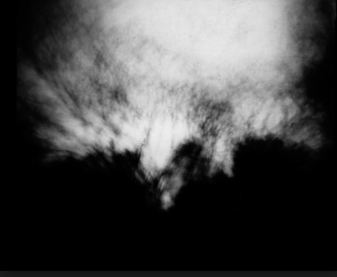
Leah Freed Breath Study 12
Freed’s recent thesis exhibition at Seattle’s Photographic Center Northwest,Feeling Bad About Feeling Good About Feeling Bad, pulls from her obsessive need to make work as a distraction, helping her cope with everyday stressors she describes as “things that linger and absorb mental focus, time, and energy.” It’s a continuous, repetitive, and therapeutic cycle. In exhibition form, a grid of more than 100 variations of a technical mishap from a 35mm negative—each printed by hand using lith chemistry—looks like an aged surface of the moon: open and impressionable, yet falling apart. Freed animates these into a painfully slow-burning video that’ll make you cry just by watching it.
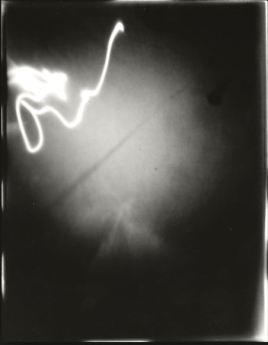
Leah Freed Breath Study 11
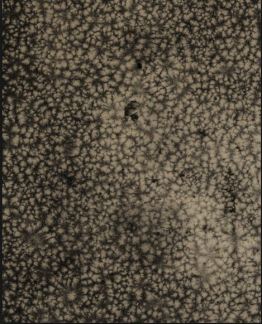
© Leah Freed
Freed’s longest-standing series is Breath Studies, which she makes by placing a pinhole camera loaded with 4×5-inch light-sensitive paper on her chest during panic attacks and lets it expose as she gathers her thoughts, counting to ten each time. The resulting black-and-white pictures, contact prints made directly from her negatives, show various stages of clarity—bits of clouds and dark skies blend together, illustrating the weight of the world above.
Michael Bach
Now 58, Michael Bach has been plagued with depression for much of his life. Social stigmas prevented him from addressing it until he was 30 and suffered a breakdown shortly after completing his MFA in photography. He destroyed all of his negatives and most of his prints, vowed to never again work in photography, and instead began working as an artists’ model to make ends meet.
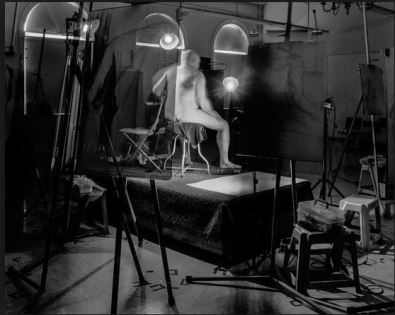
© Michael Bach
But ten years later, something changed. After taking antidepressants, he began seeing the world in visual terms again. “I found myself making mental pictures in my head as I observed the world before me,” Bach says. “Suddenly, the world was full of light and possibility.”
When neurological tremors short-stopped his modeling, he began making timed self-portraits with an 8×10-view camera to capture them. The resulting images—often shot in dark basements, or outside at night—are blurry and chaotic, and—to the limits of what photography is capable of capturing—give viewers a glimpse into the raw emotional and physical discomfort of Bach’s experience.
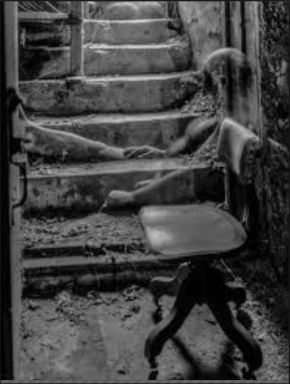
© Michael Bach
Bach’s physical debilitations recently limited his ability to shoot and process analogue film, so he’s moved to an iPhone and small digital camera, which continues to be a form of visual therapy. Bach’s iPhone photographs have a different, more off-the-cuff vibe, breaking from the staged parameters of his large-format work, but still, with brutal self-awareness and honesty, help him come to terms with his every insecurity. “They dance the fine line between the repulsion and disillusionment I feel toward my own body,” says Bach, “and the beauty I struggle to find and create in the pictures.”
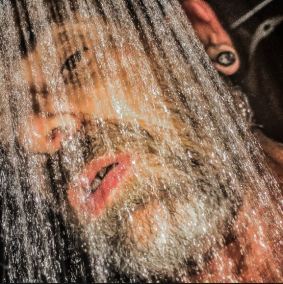
© Michael Bach
Ryan Pfluger
In his 2017 talk at TEDx Pasadena, Ryan Pfluger described photography as a “salve for loneliness.” Growing up, the photographer battled depression, which came from his family life and early challenges coming to terms with his sexuality. Photography became a means to cope with his anxiety, specifically around social interaction. “I’ve never been the kind of photographer that approaches people on the street or immerses myself within a community,” Pfluger says. “My own social anxieties got in the way of that.” Instead, when he was in graduate school at the School of Visual Arts in New York City, he used the internet to find men in Brooklyn to photograph, and ultimately used his camera to facilitate interactions that might otherwise be uncomfortable.


© Ryan Pfluger
The camera grew into a tool not only to interact with strangers but to reconnect with his estranged father on a cross-country road trip where he made intimate, emotive portraits along the way. In one of these images, Pfluger and his father lay head first on separate, parallel hotel beds. His father, shirtless, stares off, somewhere in thought, while Pfluger confronts the camera and viewer head-on. It’s a breakthrough image, one that not only suggests Pfluger’s internal monologue but perhaps foreshadows his work to come.
Describing himself as extremely introverted, Pfluger continues to live a fairly solitary life, preferring his relationships to be one on one, which he says, “can get very lonely.” Like his early work with internet strangers and his father, photography has helped Ryan to overcome this on a professional level. He channels his own uneasiness into a mechanism that gets his subjects—whether they’re common people posing for a personal project, or celebrities like Tilda Swinton, Cat Power, and Billie Joe Armstrong, or even President Barack Obama—to open up. “It’s ironic for sure,”Pfluger says, “predominantly being a portrait photographer but being uncomfortable around people in general.”
Pfluger’s recent travels over the past few years have shown him that discomfort can be universal. “There is an underlying feeling of being misunderstood or lacking in community or not feeling like your home is where you should be,” he says. “I think we forget how the simplest of acts, of being kind to a stranger and taking the moment to make some feel special in a non-transactional experience can really go a long way.”
Nathalie Ghanem-Latour
Like Leah Freed, Nathalie Ghanem-Latour uses photography as a “ventilation of stress”—in this case, from a six-month-long destabilizing downward spiral. Despite success in her day job, the photographer’s mental health was rapidly deteriorating and her personal relationships were suffering along with it. “Every day,” she writes, “I was questioning aspects of myself, slowly becoming unhinged.” As the unraveling continued, photography and her series The Six Months helped her exhale and confront her mental health.
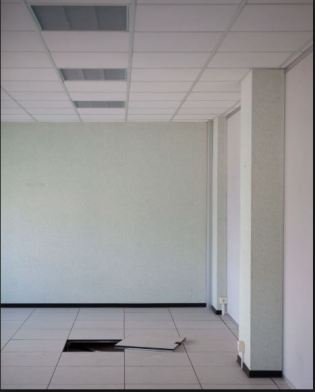
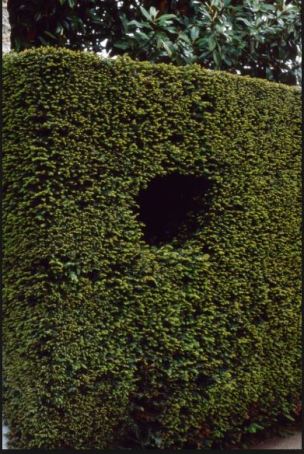
The Six Months is a collection of subtle everyday scenes of obstruction that reflect Ghanem-Latour’s ongoing mental barriers, shot during lunch breaks at her job in a strange and remote neighbourhood outside of Paris. In one photograph, a red-and-white candy cane–striped rope stretches diagonally across a plane of freshly mowed green grass. It’s a weirdly geometric break in the frame—a bright, obvious detail in the urban landscape that stands in the way yet likely goes unnoticed by the everyday passer by. Another photograph depicts a black hole cut into a similarly manicured suburban bush—perhaps a sign for unsuccessful attempts to push through the emotional walls the artist stood against. In another image, scaffolding surrounds the bust of a Grecian statue, protecting it, yet boxing it in.
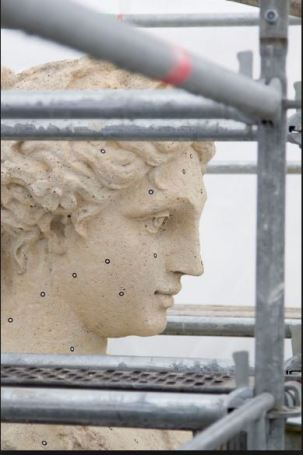
For Ghanem-Latour, these photos are mementos of times when she felt out of place in the world. “Walking and taking photos was subconsciously my way of coping,” she says. “In that brief moment, I felt like I could finally let go and be myself. With photography, I can take control of my surroundings, and it allows me to express myself in ways that my anxiety and shyness won’t let me. It gives me a voice and helps me show my strength in times when I have none.”
Joseph P. Traina
For Joseph P. Traina, who battled ADD and dyslexia for much of their life, photography is a way to describe unease in the world and give visibility to depression and trauma more naturally than words. This flows through multiple projects, whether it’s unpacking and recovering from the end of a marriage, learning to understand and love oneself through doubling self-portraits, or using Instagram’s face morph feature to reflect dysmorphia. For the photographer, these many ongoing projects are “a way for me to have control in a life where I sometimes feel like I have no control.”
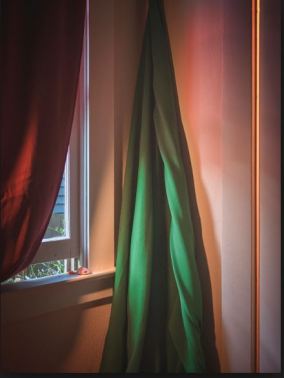
The cover image of Traina’s recent book, Lost in Seattle, published by Kris Graves Projects earlier this year, could be an umbrella for it all. Traina sits on a plastic-covered mattress looking away from the camera, face spotlighted in natural, Hopper-esque light, waiting for something to change, with no end in sight. Other images capture Seattle’s changing landscape as a symbol of Traina’s unease in the world. Photos of trees swathed in protective bug nets share space with interior shots of window drapes sagging like weeping willows.


Many of the images in Lost in Seattle are part of the photographer’s ongoing series Be Gentle with Yourself, in which Traina juxtaposes doubled self-portraits with altered images from their childhood to better understand the root of it all and learn to implement methods of self-care. “During this time in my therapy,” says Traina, “I learned to listen to what my inner child needed, to cultivate a safe space to grow, a place to be visible.” Many of these portraits—reenactments created during Traina’s lowest points—are a means to step back, self-reflect, and process it all.
“I’m my own biggest enemy,” Traina says. “I joke sometimes that no one hates me more than I hate myself. It’s strangely comforting, being the best at hating myself. I’m working on it. I’m finding ways to love, and to feel loved.”


Michal Macku
Michal Macku developed his own artistic technique to best tell stories through his photography. Calling it “gellage,” he moves the gelatinous emulsion around on film negatives and alters their appearance in dramatic ways. In these images, the subject seemingly rips himself apart, not unlike the feelings that depression and anxiety can bring.


Bibliography
Also reviewed and accessed:
https://www.huffpost.com/entry/too-tired-project-depression-photos_n_5c1ab9d8e4b08aaf7a84a2ee
https://www.diyphotography.net/how-photography-can-help-you-fight-depression/
After all of this I don’t feel as if I have enough of a personal experience of Mental Health issues to produce images based on my own personal circumstances – yes, I’ve had down times and things haven’t always gone my way but not to the same extent as the photographers above. I do feel however there is something that could be utilised here.
The state of mental health within NZ has resulting in the government pouring over $1.9 billion into improving services throughout the country. The funding is expected to help approximately 325,000 people with classification of a mild to moderate mental health requirement by 2024. A further $200m will be pumped into existing mental health facilities, and $40m over four years will go into suicide prevention services. The latter being one of the major causes of death within teenagers of NZ.
Nearly 47% of New Zealanders will experience mental illness and/or addiction at some stage in their lives. New Zealand has the highest rates of anxiety, mood and substance disorders, so much so that mental disorders are the third-leading cause of health loss. Conditions leading the charge are anxiety and depressive disorders (accounting for 5.3% of health loss), alcohol use disorders (2.1%) and schizophrenia (1.3%). Women, young people, Maori and Pasifika people are consistently over-represented in mental health statistics along with those experiencing deprivation. Instances of comorbidity (the co-occurrence of two or more disorders) are common.
So where is all the money going? Are the stats covering all the country correct? There is a large portion of the population in rural areas, have they been considered? Suicides are high amongst young farmers. It’s easy to see the results in the city, great market opportunity for the Government if these figures
 Michele Usher