2nd December 2020
I finally received the written report for Assignment 3 back from my tutor. There are a number of additional areas to research as suggestions:
- Tessa Bunney
- Portraits in a Chinese Studio by Grace Lau
- A rolling edit to keep me focused
- networks, support, and human connections and mental health
- differences in the urban/metropolitan
- ideas of community
- ideas of the dramaturgical – Erving Goffman’s The Presentation of Self in Everyday Life
- Course work: Part three, Showing not Telling
5th December 2020
I decided to work though the suggestions above as well as in the background start reviewing the images, I had produced to select those that I want to consider to print for editing. I need to also look at the course folder which I don’t seem to have touched for months and read part three: Showing not Telling which should help me with the editing process. I had planned to do this over the Christmas holiday but as my tutor seems to be expecting Assignment 4 by the first of January, I had better take a look as soon as possible. There’s a large number to review and that will take some time.
First the work by Tessa Bunney, a documentary photographer who is interested in the different environments that are shaped by human intervention. She works on both personal and commissioned projects. From her website she states: ‘For over 25 years, I have photographed rural life, working closely with individuals and communities to investigate how the landscape is shaped by humans. From hill farmers near my home in North Yorkshire to Icelandic puffin hunters, from Finnish ice swimmers to Romanian nomadic shepherds my projects reveal the fascinating intricacies of the dependencies between people, work and the land.’
Her most current project ‘FarmerFlorist’ looks at the ‘artisan’ cut-flower farms that recently started to grow in numbers within the UK. Looking at these images on her website I like how she is an observer, not disturbing the farmers as they go about their daily working life. The portraits are in the environment, often not seeing the subjects face, hidden behind their flowers, no direct camera interaction which seems to be the fashion at the moment. This is very much the style I’m trying to achieve with my images of the women of Ngawi. As the images rotate on her website they punctuated with text from the growers. These have obviously been gathered from her interactions with them. I don’t get a feeling that she is intruding in any way – leaving only a few footsteps and taking only photos.
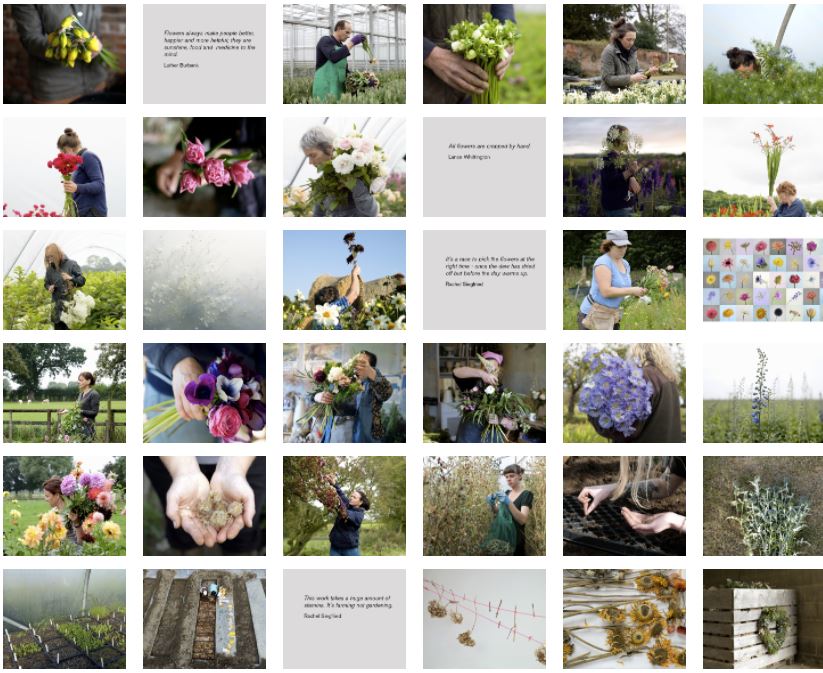
Screen shot from http://www.tessabunney.co.uk/project/farmerflorist/ accessed 05/12/2020
Bibliography
Websites accessed 05/12/2020
https://www.lensculture.com/articles/tessa-bunney-hand-to-mouth
http://magazine.landscapestories.net/en/archive/2013/vietnam/projects/tessa-bunney
https://vimeo.com/user12139949
http://www.northeastphoto.net/?portfolio=tessa-bunney-flower-farming-in-lincolnshire
As part of my discussion with my tutor following Assignment three, we spoke about the possible use of more formal portraits and hence the suggestion to research the work by Grace Lau. In 2005, Lau set up a temporary portrait studio on the seafront at Hastings. The location was on a busy route based between a well-used food store and a council facility which would ensure a good stream of tourists and locals. Over a six week period she managed to produce over 400 photographs, each group or individual receiving a free print.
In an article I found on line [ https://gracelau.co.uk/portraits-in-a-chinese-studio-2/ accessed 05/12/20] Lau states; ‘Through this project I am making an oblique comment of Imperialist visions of the ‘exotic’ Chinese and by reversing roles, I have become the Imperialist photographer documenting my exotic subjects in the ‘Port’ of Hastings… I played the formal photographer, asking them to sit still and look serious while I fussed with focusing and waited for the right shutter second. I also asked them to keep their accessories in the pose, their sunglasses, coke bottles, ice cream, mobiles, souvenirs, sunhats, supermarkets plastic bags…. all this added a contemporary layer to my old-fashioned studio, compressing history and the present into one eclectic image.’
I could apply this process to Ngawi during the summer but all I would get are the large number of tourists that travel to see the Lighthouse and the seals on the beach. This to me would not show the real people of Ngawi. The access I have managed to gain was hard enough. My project has changed from what I thought I would find; high levels of mental health issues, depression, poor health, isolation etc, to a community with a backbone. The women I have found are the community, yes there is a large number of men working there full time in the cray industry or retried from it, but it’s the ladies that keep things ticking over and people pulling together. The tolerate the ebb and follow of ‘weekenders’ and tourists and this is not what my project is about. It’s the core and how they work and live in this remote location.
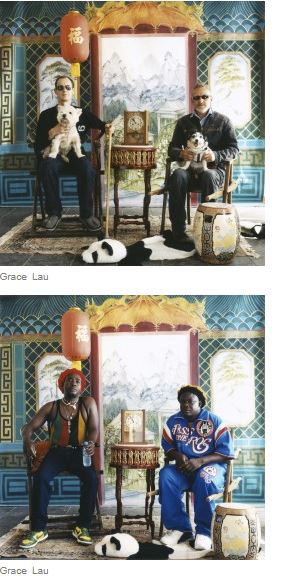
Images by Grace Lau taken from https://www.photofusion.org/exhibitions/grace-lau/ (accessed 05/12/20)
15th December 2020
Started working on Part three of the course material for Body of Work – really needed to do this before I started to select any of my images for editing. I trying a few different types of software to play around with selecting and playing in to some kind of series/order but found that I really needed to see them all laid out on a table to then start selecting for showing and considering my options.
I don’t have a printer so to get hard copies a friend has offered the use of a Sony printer that produces small postcard sized printed that will be ideal to place on the table and organise. The printer is old and I’m hoping that the drivers are still available and are compatible with Microsoft Windows 10 – fingers crossed.
20th December 2020
Finding drivers for the printer was not successful, however finally manged to get the printer to work with an old 128mb flash card, so had to just transfer a few image files at a time as the system couldn’t cope with too many images and large file sizes at a time. Another, issues was I had selected far too many images than paper and ink cartridge allowed. I could order more but they were US$53 and wouldn’t arrive till well after the holidays, so I decided to print what I could with this printer and then send the rest to the colour laser printer I have.
About halfway through the print run, there seemed to be problems with the flash card and everything came to a griding halt. Some additional research on line highlighted the fact that I could get drivers that would work with XP. Now to find that old laptop.
22nd December 2020
Took the image files to work and managed to print them all off just in case I couldn’t find my old laptop. I also contacted a fellow photographer to see if they had an old laptop – turns out they had and it even booted up, now just needed to download the drivers for the printer and complete the task.
23rd December 2020
Finally managed to get the drivers transferred to the XP laptop, and complete the printing, all of which seemed to take a lot longer than necessary. With the age of the laptop and internal drivers it wasn’t possible to download the printer drivers by Wi-Fi so these had to be copied from another system and then uploaded. Once this was completed, I was able to start the printing. As previously highlighted, I couldn’t print all the images I wanted and the change from flash card to laptop caused the images to change in format but as this is for just editing, I’m not too worried.


 Michele Usher