NZIPP 10-10-10
26th November 2019
The local Regional group for the New Zealand Institute of Professional Photographers presented 10 local photographers to spend 10 minutes talking about 10 images from their career or current projects. The evening offered the insight into some amazing work that was being produced in the region from well established photographers to those that had just completed a diploma.
The following from the event:
Ben Duncan – originally from Britain, moved to NZ and takes gorgeous black and white photos of steam locomotives. [https://www.benduncanphotography.com/]
Jasmine Chalmers – recent Te Auaha photography graduate, twisting still life genre towards the macabre. [https://www.jasminechalmers.com/]
Bob Zuur – spoke about a light installation he was recently part of as part of the climate change action happenings at the UN in New York. [https://www.joemichael.co.nz/]
Lindsay Keats – Wellington commercial photographer and Fuji X photographer. [http://lindsaykeats.com/]
Werner Kaffl – originally from Germany, relocated to NZ and bringing an utterly unique perspective to exploring Wellington’s city and coastlines. [https://www.wernerkaffl.com/]
Jenn Hadley – showing photos from a recent trip to Japan. [http://folkyeah.co.nz/]
Amber-Jayne Bain – presented food and editorial photos. [http://ajbain.com/]
Jenny O’Connor – ex-PSNZ President, put out a book called “Visible at 60” a few years ago, with portraits of women in their 60s. [https://www.boredpanda.com/]
Frankie Finnigan: recently graduated from Te Auaha with a Diploma of Photography, presented a range of her medium format fashion work plus a self-portrait series with a twist.
Andy Spain – Wellington commercial and fine art photographer [https://www.asvisual.nz/]
Relevance to my practice
At this stage of my course this was mainly for interest and networking as a number of the presenters had also published books and undertaken the challenge of an exhibition within Wellington so took the opportunity in the breakout session to talk to some of them about their experiences and get some advice.
Excio Photo Community: ‘Photography for Women’
30th November 2019
Excio started in New Zealand and has grown into a global community of photographers who are committed to making a positive change. They encourage all photographers from professional through to the hobbyist to progress along their own creative journey through sharing and gaining feedback from other like minded photographers around the world.
On the 30th November they arranged a day of lectures for women by women on starting out to business to promotion and networking.
https://www.eventbrite.co.nz/e/photography-for-women-tickets-76651176733#
Relevance to my practice
A great way to meet other female photographers and network as the organisation works for change via communication through images which is the main theme to my Contextual Studies extended essay. It was also an opportunity to see how I could promote my work as I move towards the SYP part of the course.
New Zealand Portrait Gallery Wellington
19th December 2019: ‘Being Chinese in Aotearoa.
The exhibition explores the rich and varied stories of the Chinese immigrants within New Zealanders. It documents and celebrating the 175 years of Chinese life and culture within New Zealand, the exhibition opened in November and is due to continue until the 2020 Chinese New Year Festival.
There were nearly 100 gripping and rarely seen photographs. The journey starts with the first settler Appo Hocton, who arrived in 1842 to new migrants in the 2000s, from pioneering goldminers and merchants to architects and entrepreneurs, from early settlers to established communities.
The exhibition also featured new artwork by Wellington-based artist Kerry Ann Lee created in response to the exhibition and a series of public events and activities developed in collaboration with the Wellington Chinese Community.
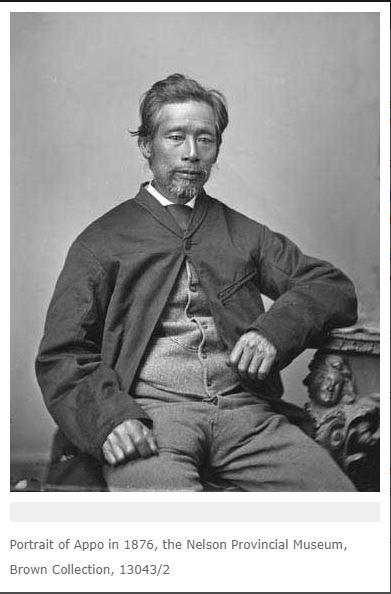
© Kerry Ann Lee
Bibliography
Research
Sites accessed 23/12/19
http://www.theprow.org.nz/people/appo-hocton/#.Xf_vn0czaUk
Relevance to my practice
I used this as a way to approach my Body of Work and how to view a community. Also how to approach them, gain their trust to gain some insight to how they live and survive in the location of Ngawi. I would image that the Chinese community felt equally isolated when they first moved to New Zealand as the people of Ngawi do when they get cut off due to road erosion.
Photospace Gallery Wellington, New Zealand
Susie Baker ‘Ripple Effect’ 17th January 2020
Baker is a Scottish photographer who has lived and worked in Kaikoura for the last 13 years. She uses a series of experimental printing techniques from black and white images, where she brushes on additional chemicals to achieve a very unique effect. These are all carried out in her own darkroom. She uses a medium format roll film and prints onto watercolour paper
The images are based on the changes following the Kaikoura earthquake of 2016. The give a glimpse of both the physical and emotional impact of the earthquake. The images include structures during stages of destruction and renovation – one such example it the Mayfair Cinema which was designed by Wilford Melville Lawry. As Baker says ‘We all have an impact on the people and places we encounter, and these effects can be emotional, physical, or spiritual. Likewise, places, objects and events mark us, leaving an impression that can last for generations or just for a fleeting moment.’
Bibliography
Research
Sites accessed 12/01/2020
http://www.photospacegallery.com/
https://www.thebigidea.nz/events/225424-susie-baker-ripple-effect
https://www.stuff.co.nz/marlborough-express/your-marlborough/68253588/susie-baker-reaps-rewards
Relevance to my practice
At this stage of my studies my initial thoughts around my final submission are prints and an exhibition in my SYP part of the course. I was really interested in Baker’s different approaches to printing and as I progress with my own darkroom, I hope to explore these techniques more with my own film development.
Ed Templeton in conversation with Matt Martin
On-live 7th April 2020
https://photolondon.org/video/ed-templeton-in-conversation-with-matt-martin/
Due to the current COVID-19 pandemic I have tried to find talks and exhibitions that are virtual or streamed on line. This talk by Ed Templeton (b. 1972) who lives and works in the US covers his ideas and approach to the production of his many ‘zines’ (magazines which are self-published and given away for free as a means to get your work out in the public eye) and books. He started as a skateboarder until he broke his leg which I assume caused him to give up, but he had already discovered photography and painting and his work focuses heavily on this subculture. His publications are not the typical photobook but look more like a scrap book consisting of text, sketches and photography. Text is used to add context only when necessary to help the reader/viewer to understand the situation being presented.
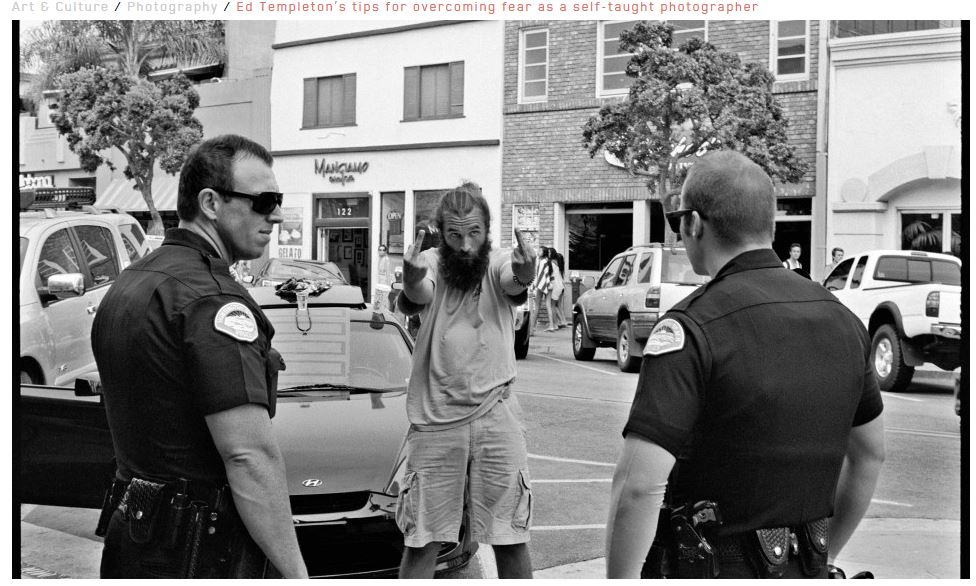
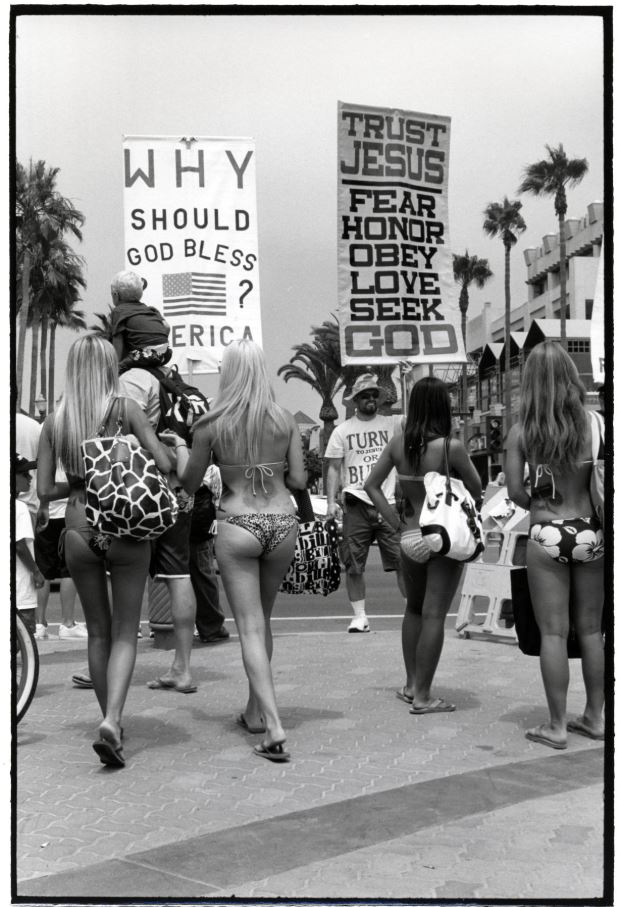
© Ed Templeton
Bibliography
http://www.artnet.com/artists/ed-templeton/
https://palmstudios.co.uk/feature/ed-templeton/
https://www.huckmag.com/outdoor/skate/long-read-ed-templetons-suburban-scenes/
Relevance to my practice
Another opportunity for me to explore different methods of displaying my final submission which in these times of lock down seem so far off but are only just round the corner. I was thinking of a coffee table book but the cost would be probably too high, especially if I also look at an exhibition. The rumours of fully digital submission are across all the forums which is a little frustrating as my work leans more to prints and hard copies and I have little interest in mix media. The zine that Templeton uses and distributes is a possible alternative and something to consider.
Susan Bright talk on her book and exhibition ‘Feast’
Online Forum 7th April 2020
This was a well attended on-line presentation and discussion by this British writer and curator of photography who presented her latest work – well, by latest I mean a project that had been in progress for some years and was finally published in a book ‘Feast for the Eyes: The story of Food Photography” in 2017. The book and exhibition didn’t contain any of her own images but a collection of other photographers over the years. It was turned into an exhibition and have been touring the world for several years and due to finish this year, but that depends on the current lock down situation that is affecting the whole industry.
The following quote was found on the British Journal of Photography but was also the start of the night’s presentation around the receipt of a copy of the Good Housekeeping cookery book:
‘Mention Good Housekeeping cookery books in any gathering of women and someone is bound to say, ‘Oh yes – all those lovely colour pictures of food’,” she says. “In fact, the colour pictures in the book are scarce – only 64 as the cover proudly states.”
“In the post-war era, after the food rationing at the end of the Second World War, and during the New Deal in America, we saw the rise of domestic cook and advice books that promised new ways to cook and serve food, to have neater homes and better lives,” she says.
“This food photography was aspirational. Those cookery books would promote recipes with ingredients that were hard to get hold of. It was a way, in my opinion, to get women to create a job out of the home, complete with the latest technology and appliances. Not long before, those same women were in factories making bombs and guns, now there was a real push to get them back in their homes, back in the kitchen, making dinner for their husbands.”
Bibliography
https://aperture.org/shop/feast-for-the-eyes/
https://www.bjp-online.com/2018/12/feast-for-the-eyes/
Relevance to my practice
Attended to see alternative examples or work, the use of archive material, something to think about if this pandemic and the lock down continues for a continued length of time and I’m not able to get back to Ngawi. I think I need to explore other options and archives within New Zealand. Will progress this within my Work in Progress section of this blog
Tour of the exhibition ‘Crossing’ by Claudia Beck
8th April 2020
Another example of the lock down situation which is hitting the world but gives us all the opportunity to view exhibitions from other locations, this maybe the new ‘norm’. I do hope not as although the tour was interesting you only got to see the images briefly. I would normally linger and trying to understand more of the image. The following link has been taken from the Capture Photography Festival in Canada. An exhibition that explores the use of photography in many forms and the many procedures used to obtain the final result.
Bibliography
Another example of the website was that of Adad Hannah ‘Social Distancing Portraits’ very apt in the current situation. The work consists of a series of short, unedited videos which I initially thought had been taken with her phone, but I later read were in fact taken with a long telephoto lens to adhere to the 5m rule. Each video is approximately 20 seconds in duration, you see a range of people, friends, relations, students and workers. There’s a little bit of moment in the individual but otherwise they look like a standard portrait. There is a clear connection between subject and photographer. According to the website these were first shown on social media and each video was accompanied with quotes from the subject which offered their thoughts and feelings of the current situation of the pandemic. Just like many people around the world their concerns related to money, panic buying and the thought of isolation.
Bibliography
https://capturephotofest.com/exhibitions/social-distancing-portraits/
Relevance to my practice
Good to see alternative ways of showing finished work. On-line exhibitions are all about timing, I think. If I need to go down the full on-line submission, I will need to ensure that they solution I use provides the viewer enough time to fully view each image. I will explore other software solutions for on line exhibitions, the page turning of a book I find distracting. I have been told by other students that there are software packages that allow you to virtually walk around an exhibition. I will research and review within my Work in Progress section.
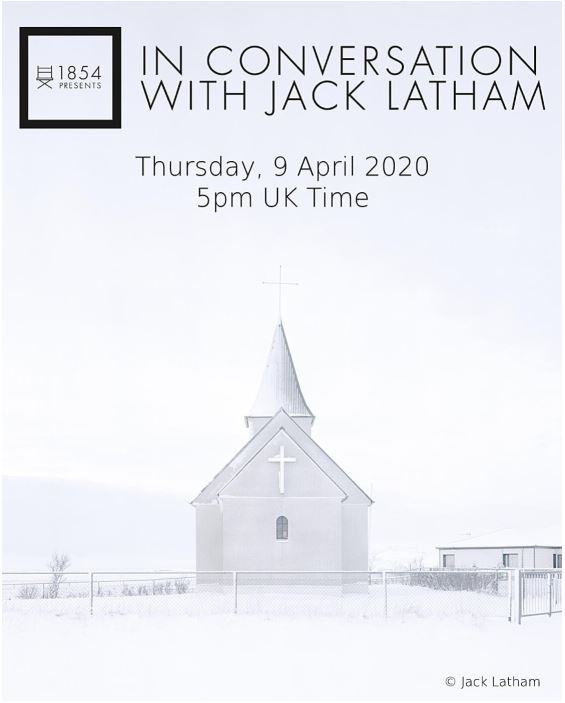
1854 Access: In conversation with Jack Latham 9th April 2020 (5:00pm UK time 4:00am NZ time)
Bit of an early start here for this inaugural live discussion with Jack Latham. Latham is a Bristol based photographer and tutor who has produced a number of books which he discussed in detail: A Pink Flamingo (2015), Sugar Paper Theories (2016) and Parliament of Owls (2019). It was interesting to hear the large amount of research that went into each of these projects and the relatively limited time he spends behind the camera. For one – Parliament of Owls, there were only two trips to location and a years research in between. I have never really thought about producing a book but it was fascinating to listen to the thought processes and the collaboration required.
Bibliography
The conversation has been recorded and can be found at: https://access.bjpsubs.com/1854-presents-jack-latham-kmz1/?utm_campaign=Memberships%202020&utm_source=hs_email&utm_medium=email&utm_content=86031517&_hsenc=p2ANqtz-_vUVcbjm1r8KZieQS9PCBlVLbCJH5qod_AzCOVGIp-P11L8kvmvt5OBB1GavwqDC-v-EzcDDOSN6JCv5dpOrmANBk4QQ&_hsmi=86031517
Bibliography
Websites accessed 10/04/2020
https://www.bjp-online.com/tag/jack-latham/
https://www.itsnicethat.com/articles/jack-latham-parliament-of-owls-photography-180719
https://americansuburbx.com/2020/03/jack-latham-interview-is-conspiracy-a-medium.html
Relevance to my practice
Glad to hear that the basis for a solid project is based on masses of research something I seem to be doing for both aspects of my cause at the moment, mainly due to the lock down situation here in New Zealand and now around the world. It is a little frustrating to not to be able to get out and take images for my Body of Work, but great to take advantage of all the online resources. Latham offered some valuable insight in to the importance of understanding your subject when you only have a limited available
1854 Access Presentation by Laura Pannack
15th April on-line
I have to admit I didn’t know her work and so the following has been taken from the invite to the on-line invitation ‘Laura Pannack is a London based photographer. Renowned for her portraiture and social documentary work, she seeks to explore the complex relationship between subject and photographer’. There wasn’t a presentation as such it was more a question and answer session with those on-line posting questions into the ‘chat box’ which the interviewee read out. Laura did show a few of her images but didn’t really talk about them. The main theme was how she was coping with the current lockdown situation. One interesting question was raised by a lecturer from Spain who asked what she should advise her students who are trying to complete their final projects. Laura say she would tell them to ‘do a one eighty’ if they were trying to photograph a particular group of people, for example think about what would be the effect of this on them and try and photograph that. This really made me think about my current Body of Work project. If I can’t get out how can I apply that process to the people of Ngawi?
Bibliography
Website accessed 16/04/2020
https://www.lensculture.com/laura-pannack
https://www.bjp-online.com/2019/10/laura-pannack-the-cracker/
https://www.theymadethislondon.com/laura-pannack
Link to presentation:
Relevance to my practice
For me the most important part of this talk was centred around that single question – how can I show Ngawi in an alternative way? I have explored this more in my Work in Progress section of this blog, by thinking of the effects of this pandemic on Ngawi, the way they must be coping with the isolation, this time not due to road erosion but due to a virus from China – the very market that forms the basis of their livelihood
1854 Access Presentation by Peter Funch
17th April on-line
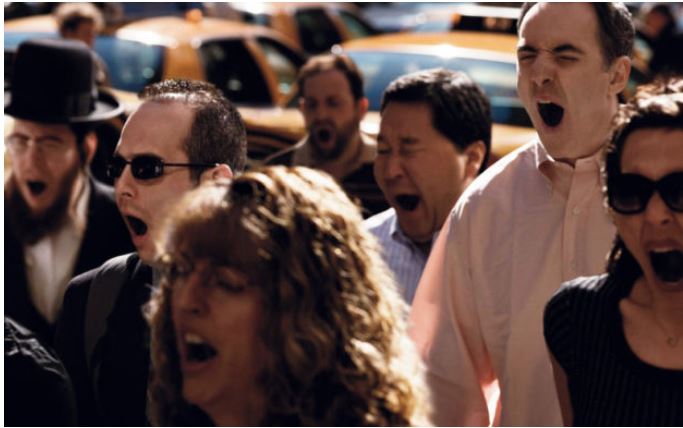
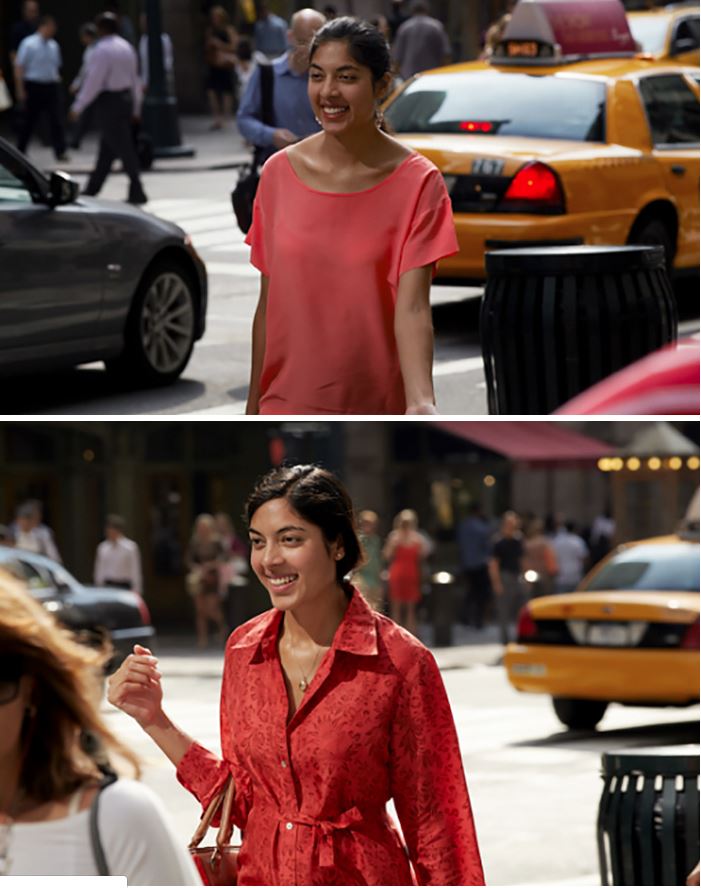
Another in the series by BJP and this time more of a presentation with a Q&A session at the end. Funch is a Danish born photojournalist is currently in lockdown with his family in France. Some of his projects include ‘42nd & Vanderbilt’ where he visited the same location day after day and photographed the same people. A study of human nature at its most basic, the comedy of human routines. Reviewing his work I can see myself doing the same thing day in, day out when I travelled into London each day, standing on the same part of the station, sitting in the same seat. I did realise that a large portion of this work is created, taking multiple images that have the same theme and then stitching together in photoshop. He his now finding a creative view from things within the house and from local walks.
Bibliography
Websites accessed 18/04/2020
https://www.scandinaviastandard.com/artist-spotlight-danish-photographer-peter-funch/
©Peter Funch
Bibliography
Link to presentation:
Relevance to my practice
Not really of direct relevance to either my Body of Work or Contextual Studies but a great example of human nature, the commuter culture, the observer of life and maybe that’s what I am as I plan to return to Ngawi. My letters are ready to post to ask for support, not sure if I will get any responses but I have a number of other avenues to explore. It was interesting to hear how his work developed and I could draw parallels with how this course is making follow a similar path.
Rachael Talibart – Finding your voice. 20th April 2020
I was sent this from one of the members of the rest of the World Forum. Rachael is a former lawyer turned professional photographer based in England. She is best known for your beautiful portfolio of images called ‘Sirens’ which are the most amasing images of stormy seas. The presentation was simple and to the point. She gave five points of advice; Persistence, repetition, inspiration, observation and production of a portfolio.
She has returned to the same place each year, knowing that she will return she concentrates on getting different aspects, looking for the small things, finding a unique way of telling your story. I think this is what I’m doing wrong with my body of work, expecting to nail the images in one visit, as soon as this situation is over I will return to Ngawi on a more regular basis, and probably stay the weekend.
Bibliography
Presentation link:
Website [accessed 20/04/2020]
https://www.rachaeltalibart.com/
https://mastersof.photography/rachael-talibart/
https://www.sohnfineart.com/rachaeltalibart
Relevance to my practice
The relevance here is don’t give up, keep returning and exploring different avenues, if one doesn’t work look for others. Both my Body of Work and Contextual Studies seem to have been turned on their head so many times as we all copy with the current world situation. I keep looking at the letters waiting to be delivered and the blank page for my Contextual Studies and hope that this situation will end.
1854 Access Presentation by Martin Parr 22nd April on-line
As an introduction I have taken the words from the Access site as this offers a summary of Parr in a very simple way ‘Martin Parr is one of the best-known documentary photographers of our time. He is author of over 100 books and his work has been collected and exhibited by leading museums including the Tate, Pompidou, MoMA New York and NPG London. A member of the Magnum agency since 1994, Martin was President from 2013 – 2017; he also curates several major photography festivals and exhibitions’. I have followed Parr’s work for years and think that he has the ability to show a place/location/situation to its fullest extent (warts and all). The introduction of colour into documentary at the time was frowned upon at the time but for me this just add to emotion and mood of the image. His approach seems to be to revisit a location and explore and this is something I really need to do with my Ngawi project.
Bibliography
Link to talk:
Relevance to my practice
I have followed Parr for a number of years and so took this opportunity to listen with interest as I think his work and his approach will be useful for both aspects of my current studies. He has the amazing ability to capture life and a community in a single image – warts and all. I’m not sure his work is directed to highlighting mental health or social change which is the area of my Contextual Studies but it does document cultures, communities and life and that is the aim of my Body of Work. The talk highlighted the need to revisit the location, to take my time, to gain trust and to blend into the background to allow people to relax and show me their true self.
1854 Access discussion with Fiona Rogers, Hannah Watson and Shoair Mavlian 29th April on-line
Accessed another on-line discuss (no images just a chat really) by Fiona Rogers, Director of Photography and Operations at Webber Represents and Webber Gallery; Hannah Watson, Director of TJ Boulting Gallery; and Shoair Mavlian, Director of Photoworks.
The panel discussed the industry, their own position in the current lockdown, the effect on the photography community and how other organisations are responding to and managing. There were a few initiatives that were mentioned and I did get to understand the workings of both Photoworks and Fire-cracker a lot more.
Bibliography
Link to the talk: https://access.bjpsubs.com/1854-presents-fhs1/
Relevance to my practice
A number of the discussions I’m attending at the moment are to help me keep informed and support others during these COVID times. Its just good hear that you are not the only one feeling this way.
Capture Photographic Festival Virtual Exhibitions Artist Talk 29th April 2020 (NZ time) with:
Artist intro from the website:
Adad Hannah is an artist based in Vancouver. He was born in New York and raised in Israel, England, and Vancouver. He received his BFA from the Emily Carr University of Art + Design, Vancouver, and was awarded his MFA and PhD from Concordia University, Montreal. Hannah is represented by Pierre-François Ouellette art contemporain, Montreal and Equinox Gallery, Vancouver.
Rydel Cerezo is a Filipinx-born emerging artist living and working in Vancouver. Cerezo holds a BFA from Emily Carr University of Arts and Design and was a runner up for the 2020 Lind Prize. His work investigates the space between sexuality and religion, race and beauty, and identity and culture.
Maegan Hill-Carroll is an artist and writer based in Vancouver. She holds an MFA from the University of California Los Angeles and a BFA from the University of Manitoba in Winnipeg. Hill-Carroll has exhibited across North America and is represented by Wil Aballe Art Projects.
The talks and work were very mixed in both the skill to present (not their artistic skills) and topics covered. The main aim of the presentation was to explore how the current lockdown conditions were affecting their work or if they had produced work because of it. Hannah started by presenting his portraits of social distancing, mini videos filmed from a 5m distance from his subject but with the subject not moving apart from blinking and breathing. The website considers them as intimate, unwavering and direct. I found them a little confronting and cold without connection. Cerezo presented his work from isolation entitled ‘Back of my Hand’ a series of image that were mainly staged from scenes he had previously seen or composed. Some of the images showed a family warmth but others I found lacked connection or emotion. The final presenter was Hill-Carroll who discussed her project ‘Touching Oranges’. A series of images consisting of the artist’s various body parts and the bits of orange. I have to admit I found the work difficult to understand and had to resort to the website description as even the artist seemed to be having difficulty explaining it. The website states ‘The images juxtapose the artist’s body with fruit in unexpected and uncomfortable ways, revealing unspoken codes of conduct that prescribe what is socially acceptable for bodies to do and touch’.
Bibliography
Link to presentation: https://capturephotofest.com/events/virtual-exhibitions-artist-talk-with-adad-hannah-rydel-cerezo-and-maegan-hill-carroll/
Relevance to my practice
This talk provided me with good examples of how to show isolation and the story/narrative within my work. I think I can use aspects of their work in both areas of my study but as I’m still progressing both some with more success than others it is difficult to assess at the moment until I put pen to paper.
Quarantine Conversations: Lua Ribeira and Susan Meisela Magnum Photos 1st May 2020
Lua and Susan discuss collaboration, intuition, ‘allowing yourself to not to know’, the importance of rich archives and how photographing revolution helped Susan understand the structures of power.
Bibliography
https://www.magnumphotos.com/newsroom/quarantine-conversations-lua-ribeira-susan-meiselas/
Quarantine Conversations: Mark Power and Stuart Franklin Magnum Photos 1st May 2020
The pair discuss restlessness, solitude, togetherness, having a wife as a doctor, a daughter with a cancelled degree show, reading and upcoming books.
Bibliography
https://www.magnumphotos.com/newsroom/quarantine-conversations-mark-power-and-stuart-franklin/
Capture Photographic Festival: ‘Art in the Age of Social Distancing’ 1st May 2020
In this online talk and presentation, the curator Cliff Lauson from the Hayward Gallery in London discussed the complex relationship between photographic images culture and the ‘experience economy’ of a museum visit. The talk start with a very powerful image of a man standing with a written sign stating that he didn’t want to visit a museum on line. In these period of lockdown museums are having to explore multiple different means to enable customers to experience the art world – online virtual tours are just a small aspect to keep people interested and artists work available. Most countries have closed their borders and imposed lockdowns in response to the global pandemic. Cliff reflected on the condition and the ability of electronic media to cope with this current situation. Cliff highlighted that for the time being, art and exhibitions can only be experienced through devices and screens, testing the limits of our virtual sensibilities. He highlighted that in some case this will not give you same impact as being there but under the circumstances it’s the next best thing. The presentation was recorded but I wasn’t able to return to the link or find it on the website however I did find the link to his essay in the following catalogue pages 16 and 17:
Bibliography
https://issuu.com/capturephotographyfestival/docs/capture_catalogue_2020-issuu-final
Relevance to my practice
Another great talk which provide me with ideas for my final submission. It seems to be a major compromise to have to submit my work electronically. A number of the OCA forums and the group discussions I attend are all discussing this need/direction for virtual submissions which for me is very disappointing
Talk with Sally Mann on Dorothea Lange with Sarah Meister of MoMA 1st May 2020
https://www.youtube.com/watch?v=rQGQwaoyZo8&noapp=1&app=desktop
An interactive discussion well attended with participants from around the work. The discussion was really interested but I wanted to understand more around Lange’s desire around words and images and so looked on the MoMA website:
https://www.moma.org/calendar/exhibitions/5079
Toward the end of her life, Dorothea Lange (1895–1965) reflected, “All photographs—not only those that are so called ‘documentary’…can be fortified by words.” Lange paid sharp attention to the human condition, conveying stories of everyday life through her photographs and the voices they drew in. (MoMA 2020)
Relevance to my practice
I have found with a number of the talks I’m attending due to the fact that I can’t attend in person the quality and the subject matter isn’t always as it is advertised, which can be a bit frustrating. I have like Lange’s work and it will place a role within my Contextual Studies but I discovered more from my research outside this talk than from it.
‘Creative Spark through Self-Assignment with Julieanne Kost
Head on Photo Festival Australia – 2nd May 2020
This was my first of many booked workshops and talks with this two week long Australian Photography Festival based in Sydney. As like many this is normally live but with the current lock down they, within a matter of weeks turned it all via zoom sessions.
Julieanne Kost spoke about the need to have multiple projects on the go at the same time, some small that last a day, weeks, or months and then some that are longer term and may take years. The important thing is to set the rules from the start, define and contain. Break the project down and keep practising. She really made me think and realise that I haven’t picked my camera up for what feels like months and so I need to start to look outside of just this course, to do something for me and not just the end game of this degree (if I ever get there!).
Bibliography
Julieanne’s Website
Link to talk
https://www.headon.com.au/civicrm/event/info?reset=1&id=136
Relevance to my practice
A little bit of an eye opener. My life seems to resolve around both aspects of my course and maybe to improve my work on the course I need to look for other avenues to inspire me – a case of not putting all my eggs in one basket. No really direct link or relevance to my study but worth noting.
Artist Talk – Professor Richard Sawdon Smith ‘The Unknowing……X:Queering representation of masculinity in an undetectable World
Head on Photo Festival Australia – 2nd May 2020
Sawdon Smith is a Dean of Arts & Media at Norwich University of Arts in the UK. His talk was based around what seemed to be a life long project of his life story and what he calls if ‘dress up box’. He reflected on the many roles he has played over the years from the very personal details of an AIDS patient to professional position of a university professor, the private life gender bender to porn star, go-go dancer to trying to improve his health following his diagnosis of AIDS and entering the boxing ring, and then finally drag queen to leather queen, son to daddy! These are all created with his dressing up box which seem to be playing with gender, identity, sexuality, subjectivity, and masculinity. The work in some ways reminded me of that by Robert Mapplethorpe.
Bibliography
Link to talk
https://www.headon.com.au/civicrm/event/info?reset=1&id=99
Relevance to my practice
The main reason for watching this presentation was Sawdon-Smith’s approach to his very personal journey. I wanted to understand his method of depicting this in his images and how through the use of staged images he could express emotions. My approach to my Body of Work images is not going to be staged but as an observer of the lives of others but I want to be able to capture the feeling of isolation, health and community
Worksop – Visual storytelling in portrait photography with Oded Wagenstein
Head-on Photo Festival Australia 4th May 2020
I hadn’t seen any of Wagenstein’s work before this workshop and due to the fact that I’m trying to incorporate portraits into my Body of Work project I wanted to see if I could try and improve my approach to how I interact with people as I tend to stand back, but like many other portrait photographers the advice was to try and form a relationship, however brief, drop the barriers and get to know your subject even if you don’t speak the same language – a smile says a lot. Always give something back, not money, but your time, don’t rush off after taking the image, show them and if possible, send them a print, it means more.
He gave 3 steps:
- Choose your hero
- Choose the emotional spotlight – leave room for interpretation
- Choose the right tools to evolve step 2 e.g space, lighting
Bibliography
Link to talk
https://www.headon.com.au/civicrm/event/info?id=138&reset=1
Relevance to my practice
This was a great opportunity to learn new techniques in the portraiture genre which is way outside my comfort zone and will form part of my Body of Work submission. I don’t think I can use Ngawi without including images of the residents. However, if the current COVID situation continues long term this will need to be reviewed and I will have to consider alternative approaches, but the steps covered during the talk could be applied to environmental images as well as possible still life.
Artist Talk – Ilan Wittenberg ‘From here to Africa’
Head-on Photo Festival Australia 6th May 2020
This New Zealand family portrait photographer discussed his work following a trip to Africa. The trip was a prize from Sony and based on nature photography however this is not Wittenberg’s passion, so between the nature sessions he managed to photograph the local Maasai people of Tanzania. The aim was to capture the culture of these people before the Western influences took over and for me, I think he managed that. This composition ensures the viewer really focuses on the subject. His use of natural light and a small on camera flash enhanced the details of their faces. Shallow depth of field ensured no distracting backgrounds so I only focused on the subject. Simple and powerful images.
Bibliography
Link to talk:
https://www.headon.com.au/civicrm/event/info?reset=1&id=177
Ilan Wittenberg’s website (accessed 06/05/2020): https://ilanwittenberg.com/
Relevance to my practice
Another great example of how to document the culture and social interaction within a community. The aspect of looking in at their lives but also the combination of the direct gaze had emotion, these were not deadpan images that seem to be the norm. His use of all-natural light is the way I want to work with my subjects. My aim is to capture how they work and interact within the community in a similar way to Wittenberg.
Artist Talk – Nikos Menoudarakos ‘Comfortably Wild’
Head-on Photo Festival Australia 6th May 2020
This project started on 2016 and is an on-going study and interaction with the drag queen scene within Athens. The images show the details and preparation from everyday life to the almost fantasy world. The portraits show the stages up to just before the final transition. Only using nature or available light the images show the ‘raw reality’ of the people who live ‘on the limits of reality’. Menoudarakos discussed how it took ages to gain the trust of these people before he was able to take their photographs. Its an area I wanted to explore for my Documentary course but want able to gain access, it was great to see that someone had succeeded.
Bibliography
Link to talk:
https://www.headon.com.au/civicrm/event/info?reset=1&id=109
Website: http://www.menoudarakos.com/ (accessed 06/05/2020)
https://www.lensculture.com/nmenoudarakos?modal=project-595917
1854 Access discussion with Dr Michael Pritchard
8th May 2020 on-line
Pritchard discussed the importance of understanding the history of photography and the need to look back over history to inform your work today. He showed a brief history of the first processes and publications over the years.
Bibliography
Link to talk:
Relevance to my practice
This talk was purely for interest only. I have always been interested in were photography started and its effect on society and this will play an important role in my Contextual Studies extended essay and the importance of photography in social change – the work by Riis, Hind etc. The talk provided some valuable research points and ideas to progress which I will apply to my research within my Contextual Studies sections of this blog.
Artist Talk – Du Choff
Head-on Photo Festival Australia 8th May 2020
This Dutch photographer 9real name Guido Bersichop) discussed his very personal project and journey through depression. The images and the project are based on an area of the brain called the amygdala which is responsible for emotional processes and responsible for processing emotions such as fear, anger and pleasure. Du Choff uses a number of un-named individuals in a series of portraits to translate his feels. The images are highly processed, grainy and black and white to help give that feeling of depression, isolation and darkness.
Bibliography
Link to talk:
https://www.headon.com.au/civicrm/event/info?reset=1&id=114
Website (accessed 10/05/2020):
Relevance to my practice
My current approach to my Context Studies extended essay will look at the use of photography to address social issues and mental health so this talk was of particular interest and value to me. My approach is usually very much getting the image right in camera with limited post processing and so the use of these over processed staged images could be a way to address my project if I I’m not able to gain any support from the residents of Ngawi. The mood is gained from the processing and I’m already considering black and white rather than colour images so the talk was interesting and informative for not just my extended essay.
Artist Talk – Mark Galer ‘Photographic Inspiration and passion’
Head-on Photo Festival Australia 9th May 2020
In this talk Galer, a British photographer now based in Australia spoke about how to keep your passion and find that ‘hero shot’. He spoke about how to link your passion with photography, how to gain a different perspective to tell a story. He said that while everyone just followed the same path look for something different, to remember to look behind you. To find the story and shoot an image that establishes the scene, include activity images and portraits to give the human factor and don’t forget the details.
Bibliography
Link to talk:
https://www.headon.com.au/civicrm/event/info?id=145&reset=1
Relevance to my practice
I think offered me a reminder to not just concentrate on my subject. To take my time, gain the trust of the people I want to photograph, let them know me – not easy when I’m a natural introvert.
Artist Talk – Tim Elwin ‘Urban Ripples’
Head-on Photo Festival Australia 12th May 2020
An inspiring story of the loss of a career due to a motorbike accident that led to long road to recovery and the reconnection with the area of photography he loves best – water. He shoots the sunrise and the people who love the water at dawn. Following his accident he has decided to give back to the people who helped him recover and formed the charity ‘Print For Print’ where 50% of all his fine art work sales goes to fund art in the rooms of public hospitals.
Bibliography
Link to talk:
https://www.headon.com.au/civicrm/event/info?reset=1&id=133
Relevance to my practice
For me the relevance is his amazing idea of giving back to the community. I have been thinking of ways to do the same following my research of Mark Neville and the Glasgow Ports. I was thinking that any prints that don’t sell as part of the exhibition for my SYP I would give to the volunteer as a way to say thank you for your support through this whole process.
‘The Joys of Landscape Photography’ with Kim Grant
SheClicks –13th May 2020
Bibliography
Link to the talk: https://www.youtube.com/watch?v=AXBzQrFH6IU&feature=youtu.be&fbclid=IwAR080pkLGufFM4eMNj8Rr61VghJRZOkFnK1rlsh-VvDep53n8042o1caIpo
Francesco Arese Visconti Webster University Geneva talks to Anthena Carey – ‘The looking Glass – Mindfulness through Photograph Practice’ 15th May 2020
Decided to listen and attend something a little different to try an improve my photography practice. Provided a few helpful tips and advice around needing to know the ‘place’ you are photographing, return more than once, take your time to focus, don’t rush be ‘in the moment’.
Bibliography
Link to talk: https://www.facebook.com/events/547323279499392/
Anthena Carey website [accessed 15/05/20): https://www.athenacarey.com/
Relevance to my practice
This just reinforced the need to research, take my time and keep going back to the location, as every trip will be different and as I view and review other photographers work, I gain more insight and new ideas for different angles and approaches.
1854 Access discussion with Harriet Logen in conversation with Simon Roberts
15th May 2020 on-line
An interesting discussion which seemed to follow the same theme as the previous talk – its not about the equipment but ‘being in the moment’ limit yourself to just one camera and one lens, live the story. Set yourself a project and live with it, don’t jump about, explore every angle. You need time to develop your style and the story. You can’t get your story in one trip. Make sure you know your final aim. Look at your own doorstep. What story are you trying to tell? All good advice and areas I need to improve on for my own Body of Work.
Bibliography
Relevance to my practice
Returning to the location is going to be an important aspect to the project. One trip is not going to capture all the different aspects of Ngawi. Although small in both location and population it is by no means simple. The culture is complex and the people hard to get to know as they protect their community. Getting a foothold is key to this project. Once in they hopefully one contact will led to another.
Artist Talk – Paul Hoelen ‘Men with Heart – a visual and spoken journey’
Head-on Photo Festival Australia 15th May 2020
Hoelen spoke about a 20 year documentary project based around the health and well-being of men. The group called ‘TASMEN’ meet every 5 years to discuss everything, nothing is barred. It aims to help and improve the mental health of men in the Australian culture. Getting men to open up in a safe, non-judgemental atmosphere. They offer each other mentoring and support, ways to deal with isolation, depression.
Bibliography
Link to talk: https://www.headon.com.au/civicrm/event/info?reset=1&id=160
Relevance to my practice
As mental health and how photography is used to highlight and treat these issues is part of my Contextual Studies extended essay I was really interested to see how Hoelen addressed this within the male community. Isolation and depression is also an area for my Body of Work. I only have 18 months rather than the 20 years taken for this project, but I think even following submission the areas discussed are important within New Zealand and its an area I would like to explore more following the completion of my studies.
Artist Talk – Jake Nowakowski
Head-on Photo Festival Australia 17th May 2020
A 4-5 year project covering the often violent rallies being held in Melbourne Australia. The projected started as an assignment for the Sunday Heald but then moved into a personal piece of work. I didn’t realise that there was such a large anti-Islamic movement in Australia. The black and white images are very much in the documentary style but show such violence and emotion. Nowakowski shows a very balanced view with images from both the far left and right of the movements and how in the moments they come together everything just blows up and the police have to treat everyone the same – regardless of which side you are on or if you are there as an innocent by-stander or reporter.
Bibliography
Link to talk: https://www.headon.com.au/civicrm/event/info?reset=1&id=160
Relevance to my practice
Black and white images have always been associated with documentary and I was interested to see how in this age of mass media and bright colour the so called traditional application of documentary black and white could still be applied. I’m still working towards a final submission of black and white but processing images in both and will make a final decision when I finally start the editing process.
‘Photo-Therapy Day online symposium’ Royal Photographic Society
22nd May 2020
The ‘GRIFO’ Photo-Therapy Research Group and the Royal Photographic Society presented the annual Photo-Therapy Day symposium via Zoom entitled: Explorations of current issues in Photo-Therapy.
The programme included:
- On Hugh Welch Diamond – A Father of Photo-Therapy Dr Michael Pritchard FRPS, Director, Education and Public Affairs, The Royal Photographic Society
- Photo-Therapy Day: a new tradition, Heather Nelson Psychotherapist, member of GRIFO Friends UK
- Embodiment, performativity and collaboration, Rosy Martin, Pioneer of Photo-Therapy. Artist and Psychological Therapist based in London (UK)
- Therapeutic Photography Online, Neil Gibson, Senior Lecturer BA (Hons) Social Work Robert Gordon University in Aberdeen (UK)
- Photo-Therapy and Post-Memory in the Post-Truth Era, Del Loewenthal, Director of the Research Centre for Therapeutic Education, Department of Psychology at the University of Roehampton (UK)
- An extant photograph as an imaginal target, Mark Wheeler FRPS , Photo-Art-Psychotherapist NHS National Health Service (UK)
- Photo-Therapy in Expressive Therapies, Ayres Marques Pinto , Semiologist, “GRIFO” International Photo-Therapy Research Group Coordinator
- Roberto Calosi, Psychotherapist, Art Therapist Member of ICAAT – International Coordination of Anthroposophic Arts Therapies – Florence
- Nicoletta Braga, Artist and University Professor of Phenomenology of the Body at “Brera” Academy of Fine Arts in Milan, Italy
- Marina Marques, Visual Arts student based in Venice and Manchester,
- Media Manager for Last Frame Project
- “Diamond” Photo-Therapy Award – 2020, Building Community
- The Self-Portrait Experience, Cristina Nuñez, Artist-Photographer and lecturer based in Switzerland
- BodyMind Photo-Therapy, Riccardo Musacchi, Psychotherapist, founder of BodyMind Phototherapy Institute
- Community Photography Projects / Pinhole Photography, with Ruth Jacobs and Justin Quinnell, Directors of the Real Photography Company based in Bristol UK
- Look Again, Mindfulness Photography, Ruth Davey, Photographer, Director of Look Again
- A Creative Whole School Approach to Emotional Wellbeing at Woodside High: the project, Trupti Magecha, Director deep:black
- A Creative Whole School Approach to Emotional Wellbeing at Woodside High: quantitative and qualitative evaluation methods, Dr Nick Barnes, Senior Honorary Lecturer, University Central London
- Photographic Well-being, John Humphrey FRPS, Photographer, writer on photography and on mental well-being
- Working Through Grief – Processing Bereavement using photography, Sisi Burn, Photographer and Transpersonal Arts Counsellor, Tobias School of Arts & Therapy
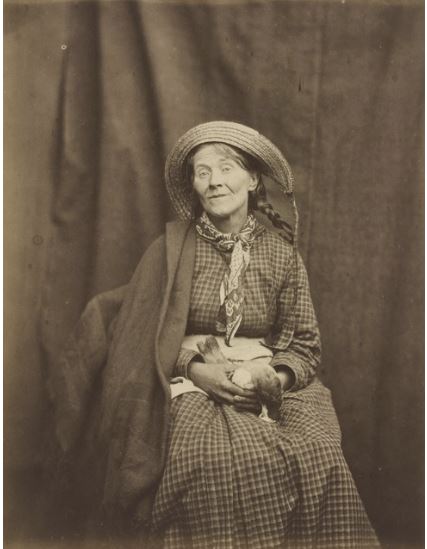
Dr Hugh Welch Diamond, Woman Holding a Dead Bird, Surrey County Asylum, c.1855. Courtesy: National Gallery of Art, Washington, DC.
Relevance to my practice
This night long seminar (as it was based in the UK) held valuable information for my Contextual Studies extended essay and research for this aspect of my course. It also provided links to other useful research areas for me to explore and consider. I have added these to my research area of this blog and data will be used in the essay and referenced and part of the submission.
Photoworks Digital Events 27th May 2020
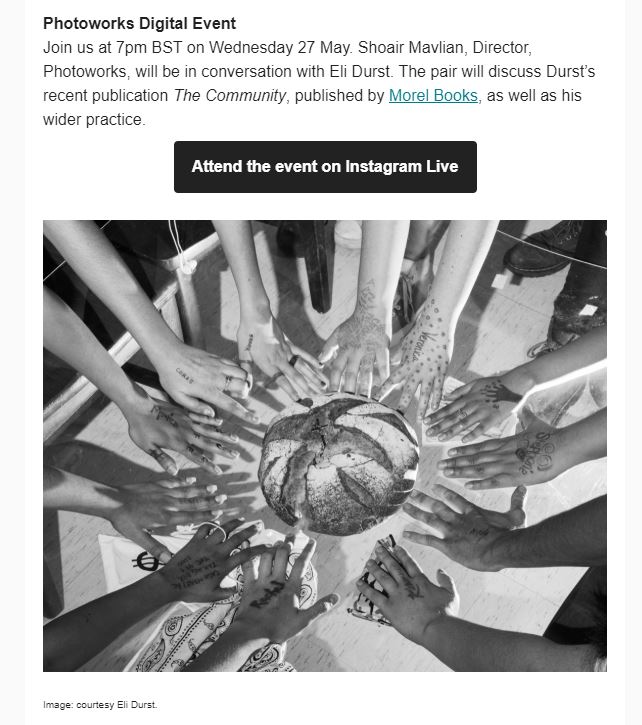
In conversation with Eli Durst on his project and release of his book ‘The Community’
This book project was based around the use of church community spaces and their multiple uses. All large black and white images without text. A lot is left to your imagination. This work took a number of years which started when he was a student (now teaches undergrade photography in Texas). They are a mixture of staged and captures of the moment. It seems odd to want to keep to the principles of documentary photography with the B&W images but place a bright colourful cover. He uses flash lighting as the locations didn’t have much natural light, the effective is very cinematic effect. There is a pull-out essay which is fantasy and not about the images but set in the scenes of the images. He doesn’t usually mix text and images. Images on the right-hand page which is traditional for photobooks but he uses an image on both pages which is used to conclude the section. Very simple and stylish.
Relevance to my practice
This talk provided me with an insight in to how to approach and photograph communities within their environment. I aim to photograph in a very spontaneous way and not staged like some of the images produced by Durst and use only natural light. I very much want to be an observer and not to affect the results. Once again the importance of taking your time, gaining trust came to the fore for this work and will be equally as important to mine.
Photo London 28th May 2020
Anna Sparham and Ann Marks: The ever-intriguing Vivian Maier
This talk covered the work by Photographer Vivian Maier who took the world by storm when over 14,000 images were discovered after her death. The images captured the human condition in all its rawness. Heralded as one of the most acclaimed photographers of the last century, Maier’s personal life and motivations have remained a mystery until Ann Marks discovers new information regarding her background and photographic development.
Bibliography
https://photolondon.org/video/anna-sparham-and-ann-marks-the-ever-intriguing-vivian-maier/
MACK Live Talks 29th May 2020
Aaron Schuman on ‘Slant’
Aaron Schuman spoke about his book SLANT which was based on the inspirations and influences of Emily Dickinson and Paul Strand. He detailed his approach and the relationship between text and image, and how the book was based on a series of unusual crime reports that took place in Amherst, Massachusetts and were reported weekly in the local free newspaper.
What started as a, tongue-in-cheek take on the small town came to reflect the disquieting rise of “fake news”, “alternative facts”, “post-truth” politics and paranoia in America following the 2016 election. In the book, the link between photography and text takes its inspiration from a poetic scheme called ‘slant rhyme’, notably espoused by the 19th-century poet Emily Dickinson, who lived and wrote in Amherst. In such a rhyming scheme, “there is a close but not exact correspondence of sounds, often using assonance or consonance; generally it is used in poetry to give variations and an inharmonious feeling.”
Bibliography
Relevance to my practice
More and more I’m seeing the use of text with images, little is left to the viewer. This is an area of my project I haven’t really considered, but in my research for my extended essay some photographers have been highly criticised for adding text at the end of publications or not using it at all, leaving the viewer to form their own opinion – which could lead to misrepresentation.
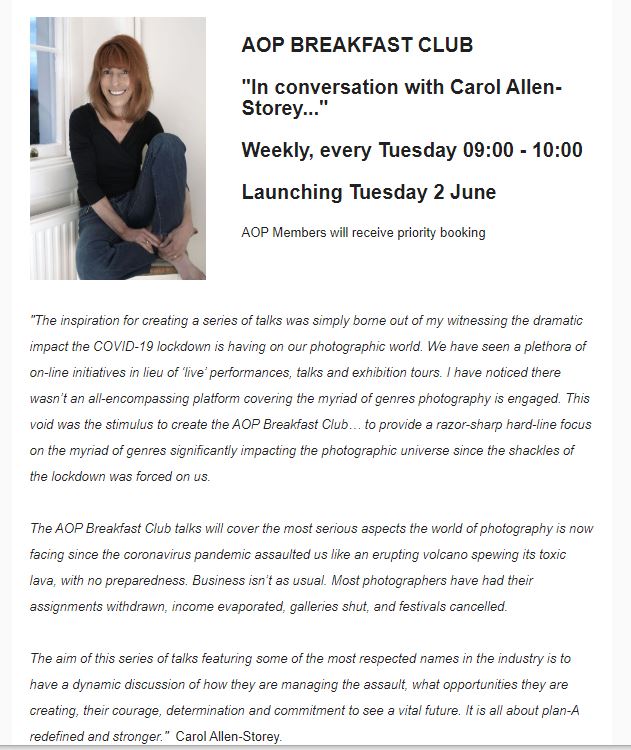
AoP Breakfast Club Meeting 2nd June 2020
This is a first in a series of discussions with photographers from around the world. I didn’t really get much out of this one, however I did find that one of the photographers – Carol Allen-Storey undertakes a lot of work with UNICEF and voicing the concerns of under privileged, so worth investigating for my Body of Work.
Photographers Guild Presentation by Charlotte Bellamy ‘Creating a Cohesive Body of Work’
4th June 2020
Charlotte took us through the process of how to create a cohesive panel of images, from what ‘cohesive’ meant, to how to review and critique images to find the links between the images and then how to apply this to our own work to improve presentation in books, websites, marketing. I’ve added more detailed notes to my Thoughts and Reflections page.
Relevance to my practice
I have always struggled with the selecting and editing aspect of work, finding that I become vert attached to certain images and want to include them even though they probably don’t fit the narrative. This talk although short in duration gave some valuable insight into how I should be editing for my final submission, which seems some time away but in reality, is only round the corner.
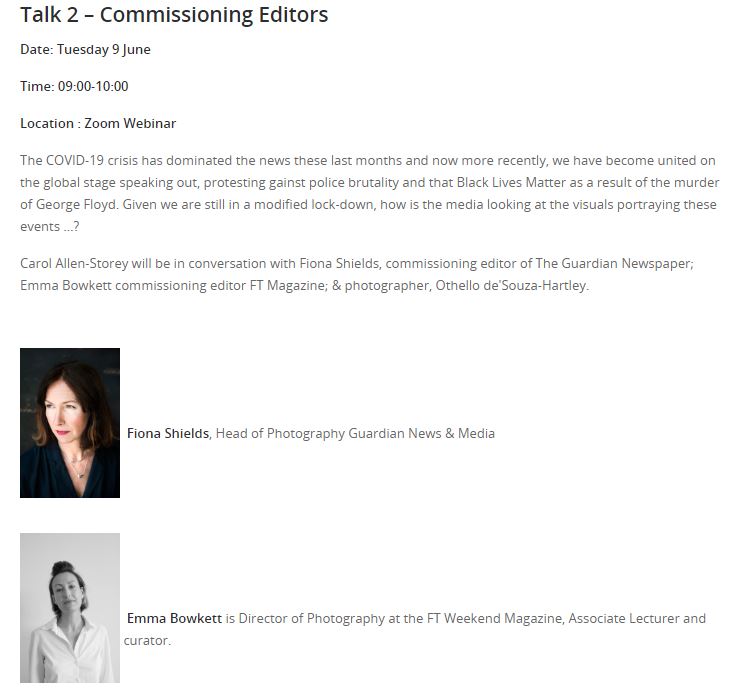
AoP Breakfast Club Meeting
9th June 2020
This was the second in a series of panel discussions which should have been around picture editing with two Commissioning Editors one from the Guardian and one from the FT, but due to the current world unrest and the growth in the movement ‘Black Lives Matter’ it became a discussion around the lack of representation of coloured photographers and the conditions under which they place themselves in order to report on a story or event. One of the most important questions raised for me was ‘Is there a loss of freedom of the press?’. For me I don’t think there is. Editors have the final say in what is released in their newspaper or magazine however, images find themselves on social media far faster without any ‘sanitisation’. Yes the photographer will find themselves in all kinds of situations and they understand the risks.
Distinction Live Talk RPS – Sarah Dow ARPS
11th June 2020
Dow spoke about the influences of strong women through all her troubles and health issues – from abuse by her father, through cancer and then mental health issues. Her main influencers were Margaret Bourke-White and Vivian Meirer.
Bibliography
Link to the talk: https://rps.org/qualifications/arps/catch-up-for-live-talks/
Relevance to my practice
It was clear though her work that these people had a strong influence/effect in her life. I often think how it is impossible not to affected by others in our work, be that photography, painting or writing. Our images are biased and can never be a true presentation of the situation, we can’t capture everything without feeling.
VII Photo Agency – talk by Ed Kashi
12th June 2020
Kashi discussed his work with the likes of UNICEF and other voluntary not for profit organisations throughout the world to support awareness and help raise money. Very thoughtful and powerful images.
Bibliography
Link to talk: http://viiphoto.com/event/vii-interactive-lecture-visual-storytelling-with-ngos-foundations-and-non-profits-with-ed-kashi/
VII Photo Agency – Episode 1: Climate Change and the Female Gaze
13th June 2020
To mark World Environment Day on the 5th June, this series of talks gathered a number of female photographers that are producing work that is challenging the norm of the visual images as used to represent the impact of climate change.
There were presentations from Nichole Sobecki from the VII Photo Agency, Eva Sajovic, and Corinne Silva from Picturing Climate and Maria Teresa Salvati from Slideluck Editorial.
The presenters discussed ways that both ‘creative and personal interpretations of the connections between the self, to others, to animals, to the world around us, the Earth, be inspiring and thought-provoking from a visual storytelling perspective? Is this new perspective of visualizing climate change opening to a softer, kinder, more empathetic gaze, moving from the stereotypes of landscape and environmental photography mostly depicted by men?’
Bibliography
https://www.facebook.com/VIIPhoto/videos/828867830982491/
Relevance to my practice
A very interesting perspective, the male v female gaze and reviewing my work and the ideas I have for my project and the final submission I can see that my work, the direction I take is with a very feminine perspective. The lighting is always natural, the gaze is non-confrontational. This is probably an area I need to experiment more with, but as my theme is isolation, mental health for both aspects of my course I think the female gaze is the best way to represent the people and community of Ngawi
Photo London: Alec Soth in conversation with Kate Bush
In this discussion Soth covers four of his projects, however my main interest with this talk was his work on ‘Broken manual’ which was a mixture of black and white and colour images as I’m considering applying this mix to my own Body of Work and was unsure if the mix would be successful. The whole aim of his project was to demonstrate the brokenness of males trying to hide from society, to find their ‘man-cave’ and how to cope with their own midlife issues. The book was hidden within another book and the structure was broken by mixing colour images with those of black and white to help show how life deals with these issues.
Bibliography
Link to talk: https://photolondon.org/video/alec-soth-kate-bush/
Relevance to my practice
I have always liked the work by Soth and completed his on-line course through Magnum Photos over the Christmas Holidays as I wanted to try and improve my approach to portraiture and the initial approach to working with people. But for this talk my main interest was his use of both black and white images with those of colour. I’m still in two minds with my project and final submission as to whether to use all colour or black and white.
I’m currently processing my images in both. I think the mood of isolation needs the stronger effect of black and white but at this early stage I will reserve judgement until editing starts and I have settled on a final theme.
AoP Breakfast Club Meeting 3
16th June 2020
In conversation with three photographers discussing how they have adapted to the current situation of the pandemic. Julia Fullerton-Batten moved from multiple large images using a team of people to just her and a camera. This took time to adjust as she moved out of her comfort zone of the studio to her local community. She started by just walking the streets and asking people to then placed an advert in the local paper to get volunteers. She photographed through windows adding props and lighting to add mood and effects. The work includes the interviews she had with her subjects asking then just six questions.
The second photographer was Othello de’Souza-Hartley, he lost his father due to the virus and in order to cope with the pandemic and his loss he used his camera, recording the room his father lived in through the last years of his life.
The final photographer was Lottie Davies, just prior to the lock down she was three weeks into a four month exhibition of her work. Her work involves the fictional character that travels up the country. These large format images show the character within the landscape and a diary of this fictional journey.
Each had a very unique and different approach to the current situation and it was interesting to see and hear how they coped with the isolation and how that affected their work and approach to future projects.
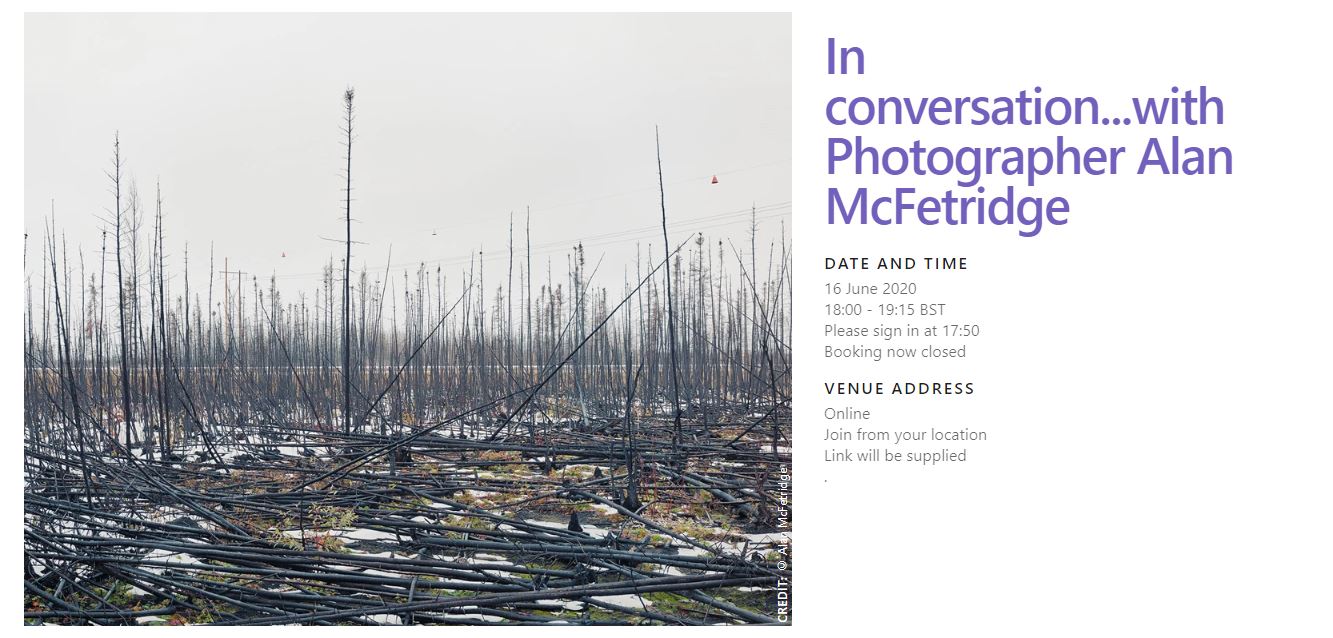
RPS In Conversation with Alan McFetridge
16th June 2020
McFetridge is a New Zealand photographer who has produced a book ‘On the Line’ which documents the effects on the community and the environment following the results of the Canadian wildfires (2016) in the Boreal forests in Fort McMurray, Alberta.
With the use of a grant from the RPS McFetridge travelled to the location of the start of the fire and spent over seven weeks recording the effects of human and climate change. The images produced on a large format camera form part of a book which has been created using materials that will have as minimal impact on the environment as possible.
Bibliography
https://rps.org/events/bristol/2020/june/in-conversation-alan-mcfetridge-on-the-line/
1854 Presents Artist Talk with: Aria Shahrokhshahi.
18th June 2020
Aria Shahrokhshahi is a British-Iranian photographer who also uses video to produce films of his projects. His work is based around the genre of documentary, covering diverse communities and the way people interact inside them and with their environment. Other areas of interest include social and human conditions faced in the likes of Gambia, Ukraine, Iran and in the UK where he lives.
Bibliography
Link: https://www.bjp-online.com/2020/06/1854-presents-aria-shahrokhshahi/
Relevance to my practice
Both my Body of Work and extended essay for Contextual Studies are based around communities, how they interact and cope with life in isolation. I want to be able to capture this through both my images and writing so this presentation allowed me to understand a different approach and develop alternative ideas and methods to my own work.
Photo London Talks from the Archives: In conversation with Jem Southam
23rd June 2020
Southam is a leading UK photographer. He is known for his series of colour landscape photographs which started in the 1970s and has continued to the present day. His projects are based around the observation of change usually at a single location which take months or even years. The subjects are often situated in the South West of England where Southam.
He documents the balance between nature and man’s intervention and traces cycles of decay and renewal. His images combine the personal, cultural, political, scientific, literary and psychological aspects of life. Southam uses a large format camera until an accident which meant that the weight was just not practical for him. In the publication ‘The Moth’, he has re-visited the mining landscapes of west Cornwall where he made The Red River during the 1980s. He also showed work from a trip to New Zealand and his work from his annual visit to a local lake each winter of the birds at dawn.
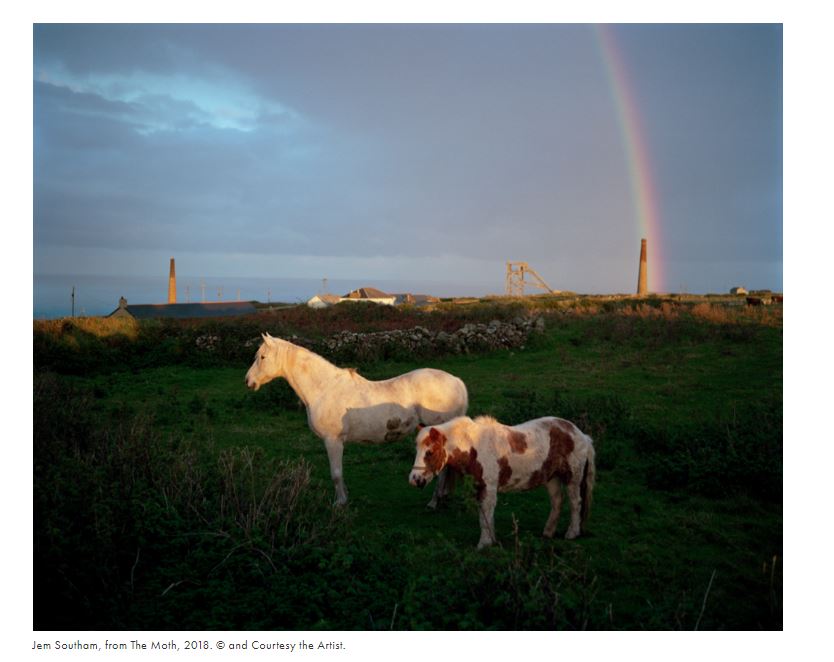
Link to talk: https://photolondon.org/video/jem-southam-susanna-brown-conversation/
VII Photo Agency Book Club – In conversation with Jocelyn Bain Hogg
23rd June 2020
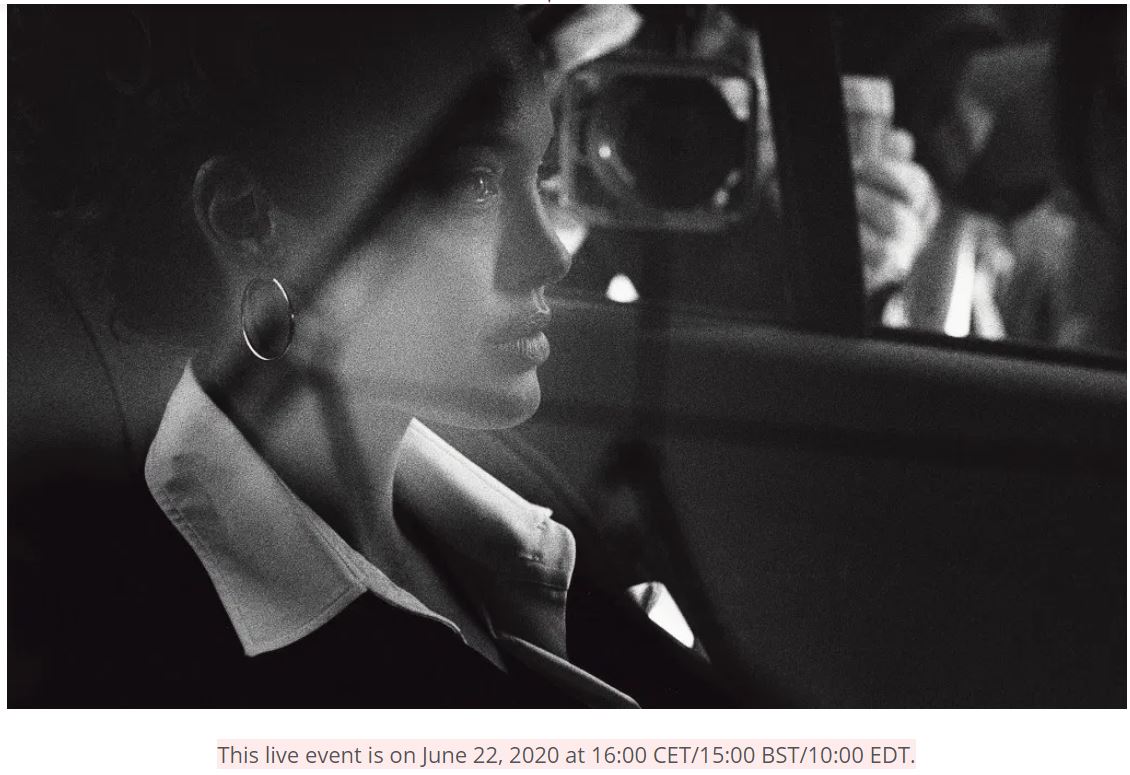
©Jocelyn Bain Hogg
“Bain Hogg’s stunning photographs serve as windows into the world of celebrity and pop culture. These behind-the-scenes portraits ooze glamour but also the raw and lonely flip side of fame.” — Harper’s Bazaar
The discussion was based around the years Bain Hogg has spent photographing the public and private events of the Cannes Film Festival and the Oscars. The book ‘Idols+Believers’ offers a mixture of colour and black and white images.
The images reflect on the insatiable appetite for all thing’s celebrity – from the paparazzi to fans with no subject left out: Producers, pop idols, supermodels, fashion designers, publicists, look-alikes, and even an up close and personal porn star shoot.
AoP Breakfast Club 4
23rd June 2020
Bibliography
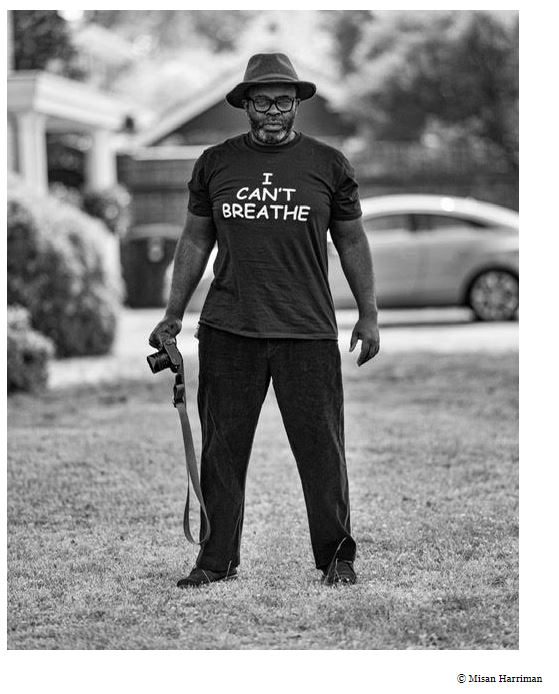
1854 Presents Misan Harriman 24th June 2020
Bibliography
https://access.bjpsubs.com/1854-presents-misan-harriman-live-non-membersju22ne/
‘Misan Harriman is a multi disciplined image maker, curator and cultural commentator. His photography ranges from Royal commissions to fashion portraiture and photojournalism documenting historic moments of our time. Following in his idol Gordon Parks footsteps he hopes to offer a fresh new voice to the photography world’.
The most important thing that came across in this presentation was his passion and drive. He cam late to photography but had been involved with visual media all his life. His advice of don’t follow the crowd and find a different angle for a story is important. He stressed that it was important to be truthful, don’t worry about the ‘likes’ on social media and focus on the passion.
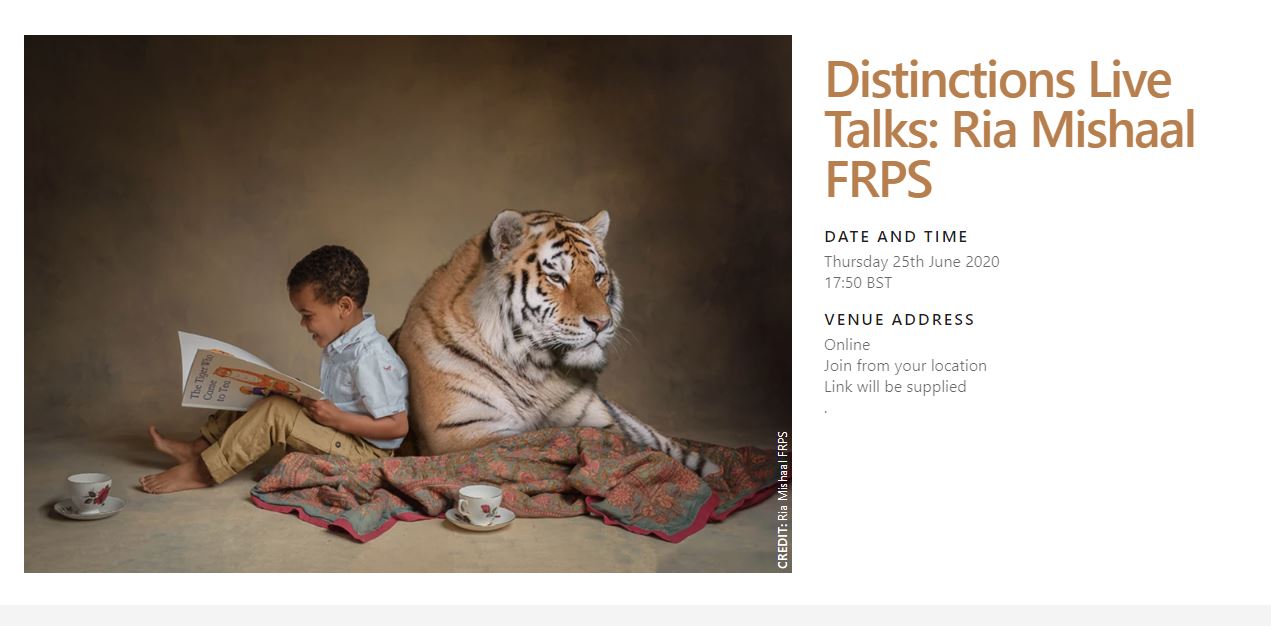
The Royal Photographic Society Distinctions Live Talk: Ria Mishaal
Lumix Photo Festival 28th June 2020
Talk with Ilvy Njiokikjien : https://www.youtube.com/watch?v=xf6IEsdHD0U
Details of a 12 year long project based in South Africa for white children that attend racist camps ‘“Born Free — Mandela’s Generation of Hope”, about South Africa’s post-apartheid generation. Learnt how to produce a more balanced view in her storying telling and how she didn’t always gain access to the people and groups she wanted. Safety was a major issue for her whilst in South Africa.
Bibliography
http://viiphoto.com/authors/ilvy-njiokiktjien/
https://www.lensculture.com/ilvy-njiokiktjien-2
https://www.youtube.com/watch?v=c-3rfc87fKc
Talk with Sanne De Wilde: https://www.youtube.com/watch?v=aIz1crvEKW0&t=32s
In this talk the topic was one of equality, or probably more likely inequality. De Wilde reflects on the medium of photography; her projects and how she examines the role of identity, perception and the question of how genetics can shape and influence communities.
Bibliography
https://www.lensculture.com/sanne-de-wilde
https://wepresent.wetransfer.com/story/sanne-de-wilde/
Royal Photography Society in Conversation with Nicholas White 1st July 2020
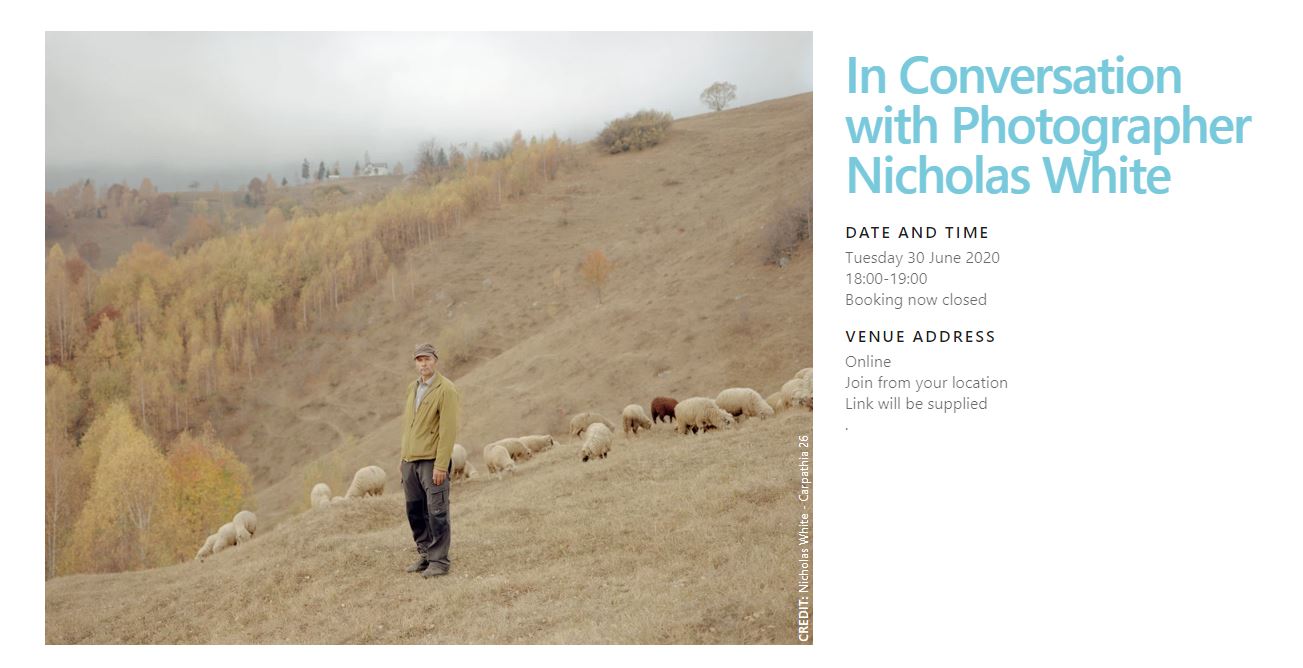
White is a photographer based in the South-West of England who’s projects consist of both personal and commercial work ranging from environmental studies to sports products.
The talk today covered his environmental work that examines the way humans interact and effect the landscape. The project ‘Black Dots’ explores the mountain bothies (small shelters) and bothy culture within Scotland. These shelters are often far from civilisation and usually only accessible on foot. These are dwellings are maintained by volunteers and remain unlocked and free to use as a means to provide refuge from the weather. The images show these shelters surrounded by the vast terrain and form an almost iconic feature of the Scottish landscape. This project took over three years to complete as he travelled to each remote location using a large format camera. White not only captured the location but some amazing portraits of the people who used these locations.
The second project discussed was ‘Carpathia’ which aims (as its still a work in progress) to document the formation of a new European wilderness reserve in the Southern Carpathian Mountains of Romania. This conservation project aims to be as big as Yellowstone in the US. The images shown during the talk and those that can be found on the link below consist of a series of landscapes and portraits of the work being undertaken, once again all on a large format camera. The details are amazing and show the vast landscape that they are trying to resort. White has also incorporated a number of digital images taken from fixed field cameras which only photograph when motion is detected. These have managed to photograph, deer, wolf and bear, which highlights the being of success in the project which still has a long way to go to educate local residents and promote future income from tourism.
Bibliography
Websites accessed 01/07/2020
https://www.all-about-photo.com/photographers/photographer/708/nicholas-white
https://www.lensculture.com/nicholasjrwhite
https://www.lensculture.com/nicholasjrwhite?modal=project-840184
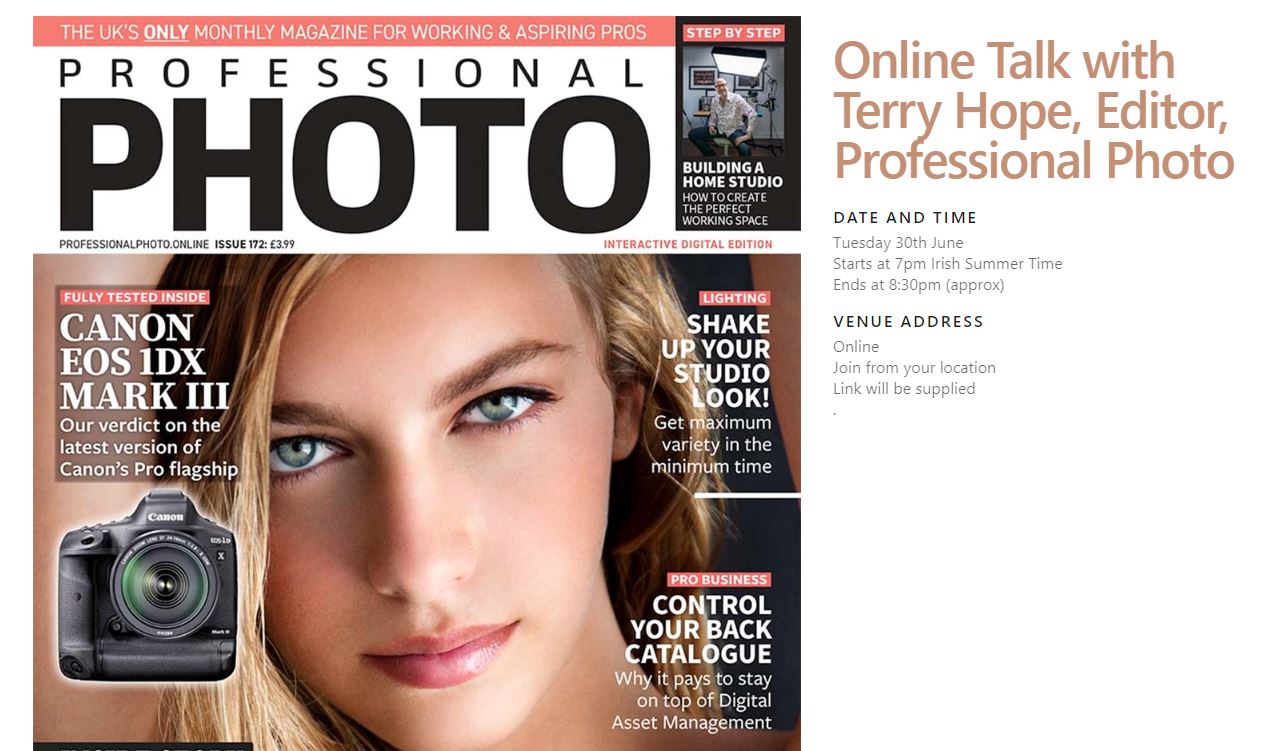
Online Talk with Terry Hope, Editor, Professional Photo, June 30th, 7pm IST
Terry Hope, is the editor of the UK and Ireland magazine “Professional Photo”. The market for the publication is towards the professional, and claims to have a ‘unique perspective on photography, and on the photographic industry’. Terry discussed the approach that the magazine had to implement due to the pandemic situation and the move to an on-line publication rather than printed. He highlighted the need to be progressive, move with the times and offer up-to-date material that was relevant to the times. On-line meant that they were able to keep editing right up to the point of publishing, which is not the case for print. The cost outlay is considerably less but quality has to equally as high.
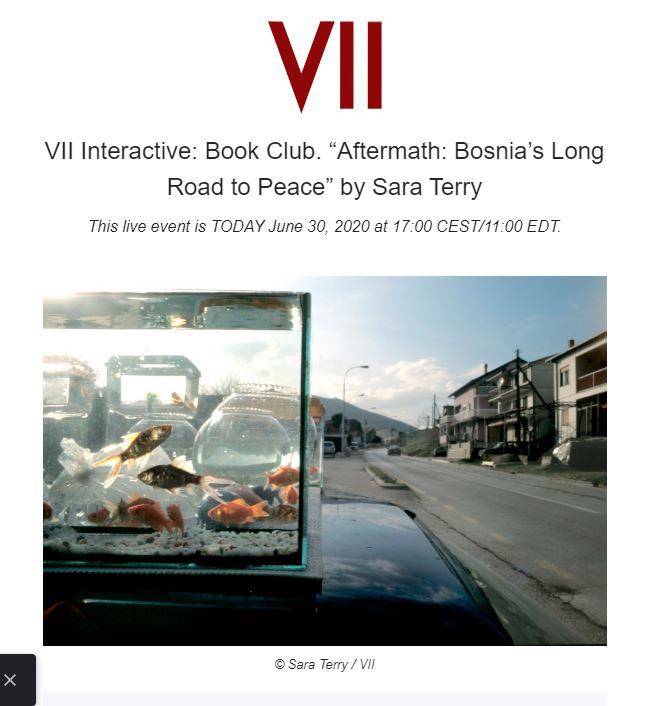
VII Photo Agency Interactive Book Club. ‘Aftermath: Bosnia’s Long Road to Peace’ Sara Terry.
1st July 2020
An extremely thought provoking and powerful set of images to accompany this discussion. Terry asks the questions and answers ‘so what happens after?’. This project is a combination of the social, political and economic effects of war and how the people struggle to come to terms with the so called ‘peace’. The war in Bosnia saw some of the worst cases of ethnic cleansing and genocide since WWII. The media published examples of this during the crisis but very little is reported post the negotiation for peace. The armies have moved on to the next situation around the world to leave those left behind to pick up the pieces and to form some kind of ‘normal’.
The war ended in 1995 but the country is still trying to rebuild. The images explore how the Bosnian people are trying to keep things stable and build a future. The images include the powerful reminder of the mass graves and the effort to try and identify the victims of the massacres by the Serbs. Terry tries to explore the whole story, with the promise of life after this crisis.
Bibliography
Website accessed 01/07/2020
http://saraterry.com/aftermath–bosnias-long-road-to-peace/
https://www.lensculture.com/books/5226-aftermath-bosnia-s-long-road-to-peace
https://www.movingwalls.org/moving-walls/11/aftermath-bosnias-long-road-peace.html
http://www.theaftermathproject.org/project/bosnias-long-road-peace
Link to talk: https://www.facebook.com/VIIPhoto/videos/692521444638683
Head On Photo Festival (re-runs) 2nd July 2020
Artist Talk – Paula Bronstein
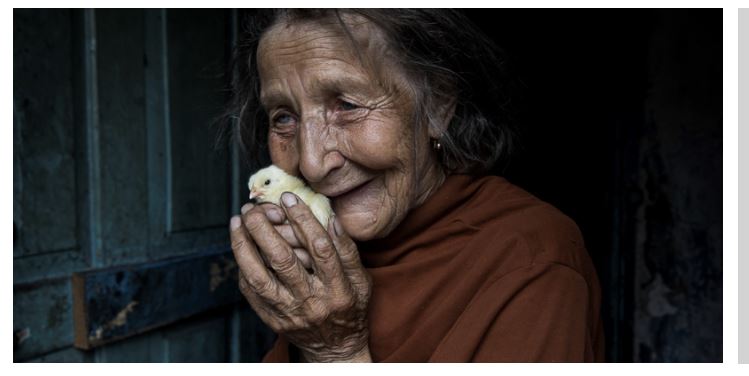
©Paula Bronstein
It’s great that the Head On Photo Festival are offering re-runs of the talks as I wasn’t able to see all the ones I wanted. In this talk Paula Bronstein working in collaboration with a local guide documents the post war conflict in the Ukraine. So many times, we see the effects of war first hand as it happens, on social media, tv, magazines, newspapers, but not what happens when the sides are ‘at peace’. In this work she looks closely at just one aspect, that of the elderly. The Ukraine has the world’s highest proportion of elderly that have been affected by war. The images show the vulnerability, the conditions under which they are living, especially in the winter when it is often -30 degrees, and how they are trapped in these conditions. The youth of the areas were able to leave when the fighting started but the elderly were not, often just left as they were reluctant to leave their homes; they were left impoverished with little or no support living in dilapidated homes or even in an old WWII tunnel.
Bibliography
Link to talk: https://www.headon.com.au/civicrm/event/info?reset=1&id=194
1854 Presents: Lee Shulman
3rd July 2020
Shulman is an avid art and slide image collector and curator. His slide collection consists of thousands of examples from amateur photographers from around the world but mainly the UK and USA. The talk was based around his recent exhibition where he reproduced a whole house within the exhibition space. Individual rooms were constructed, kitchen, lounge and a garage complete with a 1950s car. The lounge include a large number of old tv units each containing a printed image from his collection in the screen, in a way pay homage to how most peoples lives revolve around this form of media – it would be interesting to see a look back on this time and the mass use of iPads and tablets, don’t think they would have the same appeal as an old 1950’s tv set with its aerial and dials. In the kitchen the fridge door was open and an image fixed inside.
Relevance to my practice
A unique concept to show images that would have been either lost or discarded, a great record of the time and I think this is the main aim of his collection, to hold and catalogue the times. A way of creating new art out of old, recycling in the art world. One thing that did stick with me was Shulman’s comment that editing was just as important as the taking/making of the images, that you should know the end and then produce the images. My aim for my Body of Work is an exhibition and possibly a book. I see a number of my peers looking at on-line/digital presentations which may work for them but I want physical prints. I know I may have to rethink my ideas if I’m still not able to submit prints next year.
Bibliography
Link to the talk: https://www.bjp-online.com/2020/07/1854-presents-lee-shulman/
Websites accessed 04/07/2020
https://www.huckmag.com/art-and-culture/photography-2/the-anonymous-project-photography-lee-shulman/
Documentary Photography Reconsidered Webinar held on 30th June 2020 but watched 9th July 2020
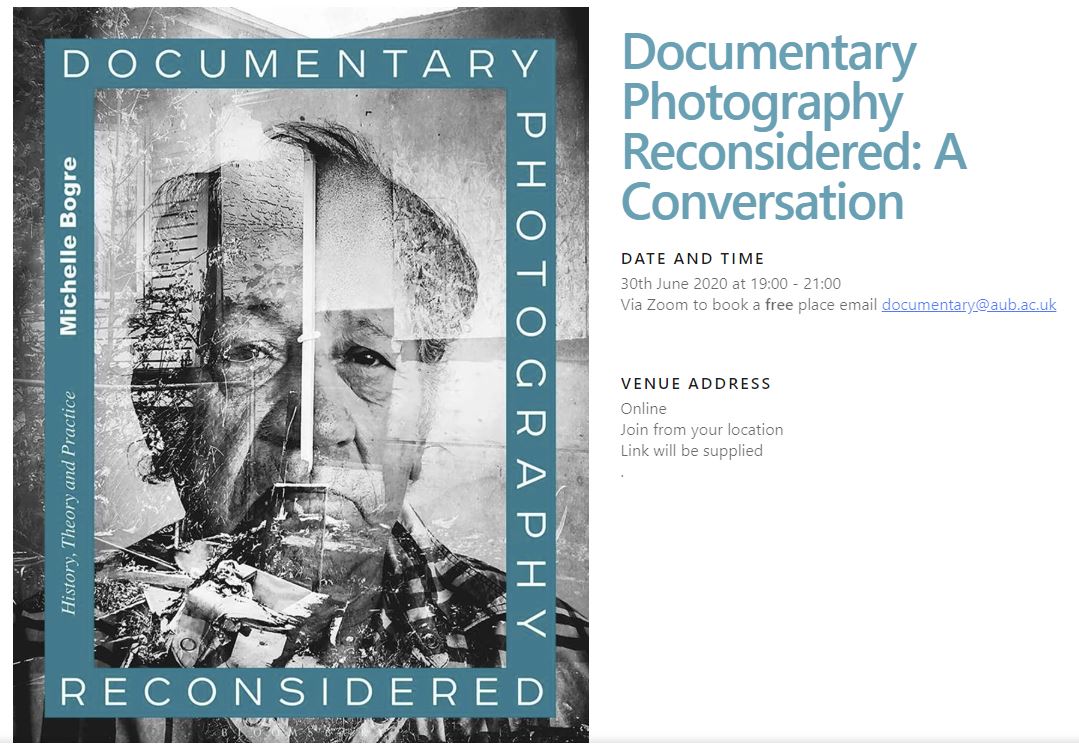
This webinar was recommended by another student (Lynda Kuit) prior to its release but due to the time difference and other commitments I have had to watch the recording and I’m so glad I have and will probably repeat the viewing as there was so much covered and some I did find hard to follow.
The webinar covered over two hours with a really extensive Q&A section at the end. The session was moderated by Michelle Bogre who wrote the book ‘Documentary Photography Reconsidered’ (I have to admit I have ordered this following the webinar). Other panel members included:
- Stephen Mayes;
- Paul Wenham-Clarke;
- Nina Berman; and
- Ed Kashi
Bogre started with her definition of what documentary photography is and how this differs to photojournalism, with its different rules.
‘Documentary photography begins with “documentation” onto which we layer the idea that the documentary image is not constructed, although it may be slightly staged or directed; that it can be poetic; that it bears a degree of witness and provides some evidence; that it seeks truth and touches on reality; it involves storytelling; it is often intensely personal; it is democratic; and that the photographer’s intent is the substrate upon which the image is constructed’
She discusses the cross over from documentary to fine art and if there is a need for that line or not. Documentary can cover a wide range of techniques and processes. Bogre goes on the highlight the work by Laia Abril as an example of documentary that fits her definition. The project discussed ‘The History of Misogyny’ Chapter One “On Abortion” Abril uses a mixture of colour and black and white images with written text, articles from research, video and sound. Each chapter can stand alone but together highlights the social issues that are occurring. It was important to Abril to link the text with the image and to ensure that the two are not separated if shared across deferent medium. This ensures that the meaning always remains true.
Bogre then moved on to the work by Misha Friedman and ‘Project 51 Never Remember’. The covers the social corruption in one of the largest countries in the world – Russia. Looking beyond facts, hints at the situation but its not in your face and you have search for the story. It sits between art and documentary.
The second panel member Stephen Mayes was difficult to understand and follow and I will probably return to later and will undertake separate research as to his arguments.
Nina Berman is a documentary photographer, a filmmaker, an author and also an educator. Her covers a range of genre and subjects and looks at American politics, militarism, post violence trauma and resistance. She is a member of NOOR.
Berman spoke extensively about a very personal project which covered the life of a young girl, Kimberly Stevens (‘An Autobiography of Miss Wish’), that she met on the streets of London. They formed a very strong relationship and she even supported her when she moved to New York. It was a very powerful and emotional presentation as this project meant a lot to her. She was very close to her subject and at one point stopped photographing her until she thought that she might lose her due to her drug habit and then she picked up her camera again. The project and book includes; drawings, images, text and interviews, but it was clear throughout that there was never any abuse of power in the relationship. Kimberly had a say in the final image selection. Berman advocates the need for respect of your subject and if possible, collaboration to get the best results. To work within agreed rules and to make the viewer work to understand the narrative, if it’s too easy they skip over and don’t bother to really read the image.
Bibliography
Video Link to the talk:
https://aub.cloud.panopto.eu/Panopto/Pages/Viewer.aspx?id=d232a5bc-0058-4472-bfd2-abed00e42582
Royal Photographic Society (2020) Documentary Photography Reconsidered: A Conversation. https://rps.org/events/groups/documentary/2020/june/documentary-photography-reconsidered-a-conversation/
Laia Abril: https://www.laiaabril.com/project/on-abortion/ [accessed 09/07/2020]
https://imrussia.org/en/news/356-photo-51-project-is-corruption-in-russias-dna
https://photoworks.org.uk/nina-berman-homeland-insecurities/
http://www.ninaberman.com/an-autobiography-of-miss-wish
SheClicks Webinar: Capturing Life with Documentary Photography with Karin van Mierlo
9th July 2020
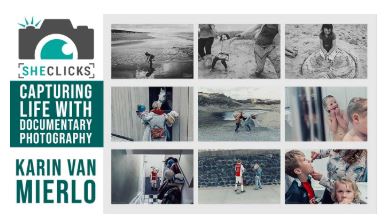
A documentary photographer born in the Netherland but now based in Lisbon with a career spanning over 30 years. Started with film with the amazing motto of: “It’s not about the camera, it’s about your vision.” She showed a number of projects to start ‘Day in the Life’, ‘Sister’ and ‘Uganda’. All very personal and power thought provoking projects.
Relevance to my practice
She asked the question of the viewers – ‘What is the reason you photography?’ and offered a number of insightful pointers:
- Finding the story – who you are, the ability to go with the flow, let the story flow and unfold and be open minded. Its ok to feel out of your comfort zone but don’t let it stop you
- The story that matters to you – the trick is to listen to the pull, listen to your heart, that pull will keep your interest and reflect in your images. Start small, maybe something close to home and stick with it
- Research – access, proximity. Find the go/no go point and set the boundaries, understand the need for permissions and access. If necessary, conduct research and get a contract.
There are five areas for making that great story:
- Connection – with your subject, make sure you feel connected as this shows in your images, don’t pick your camera up straight away, talk and take part. The fly on the wall is not the most powerful way to tell the story;
- Lighting – not always possible but make the most of what you have, move about and remember to look at shadows;
- Composition – direct the frame, this is your point of view, use the composition to direct where you want the viewer to look, change your view, work the scene but show respect
- Moment – be ready to be in position, to keep chasing, don’t stop even if you think its in the bag, shoot a lot. Stop looking at the back of your screen and know your camera
- Story telling – always has a beginning, middle and end. If its in the frame then it needs to say something.
Editing is just as important as taking the images, selecting should be undertaken with ethics and respect. You need to be aware of the power you have as the story teller and stay connected. You shape the story with the images you use and select and the way they are processed. Editing should not be an afterthought.
Bibliography
Websites accessed 10/07/2020
https://www.karinvanmierlo.com/index
https://www.udemy.com/user/karin-van-mierlo-2/
https://www.lensculture.com/karin-van-mierlo
Head On Photo Festival Artist Talk: Ian Bickerstaff (replay)
9th July 2020
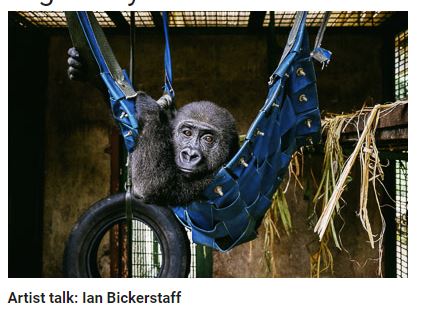
©Ian Bickerstaff
Bickerstaff is a Melbourne based photographer who volunteered to work at the Mefou Primate Park in Cameroon. This was back in 2007 and for the last thirteen years he has returned to help care for and record the progress of the camp and lives of these beautiful mammals. The chimps are often there due to the act of violence and illegal slaughter for ‘bushmeat’.
The project called ‘Sanctuary’ tells the story of the rescue and rehabilitation for several hundred primates. It is clear from the images that he has formed strong bonds with the other carers and the chimps. He has also tried to expand on the stories and shown the deforestation and the lives of the surrounding camps, but it has taken years for these people to learn to trust him and for him to get their stories.
Bibliography
Link to talk: https://www.headon.com.au/civicrm/event/info?reset=1&id=198
https://ianbickerstaff.com/head-on
1854 Presents Sunil Gupta
10th July 2020
Sunil Gupta’s work explores race, migration and queer issues through the use of constructed documentary images. He started taking images in New York and then London. His career has spanned over 40 years and produces work that have a very social and political meaning. This first project was based around Christopher Street in Manhattan. The series reflects the openness of the gay liberation movement at the time, and as he said it was a time for his own “coming out” as an artist. The images reveal a community that resulted in Gupta dedicating his career to and with the aim of portraying the people who have been ‘denied a space to be themselves’.
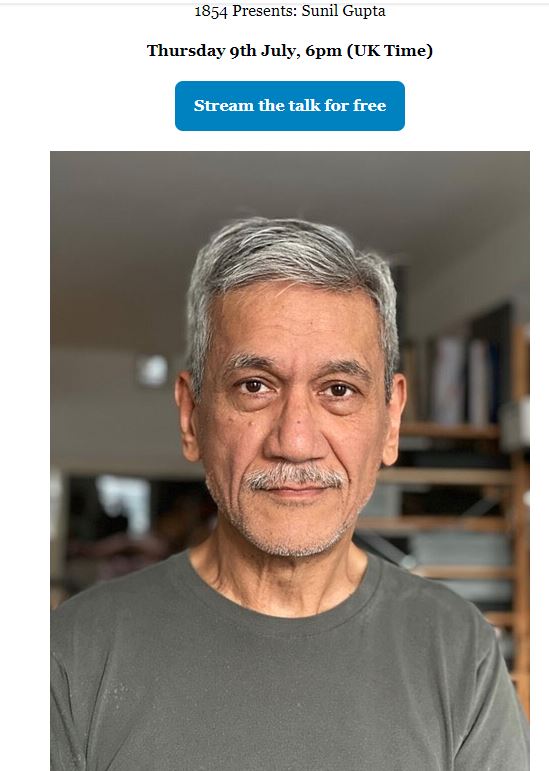
Bibliography
Websites accessed 10/07/2020
https://www.bulgergallery.com/artists/25-sunil-gupta/biography/
https://visualaids.org/artists/sunil-gupta
https://visualaids.org/artists/sunil-gupta
https://autograph.org.uk/exhibitions/from-here-to-eternity-the-photographers-gallery
Mackbook Live: Artist Talk with Rosalind Fox Solomon
10th July 2020
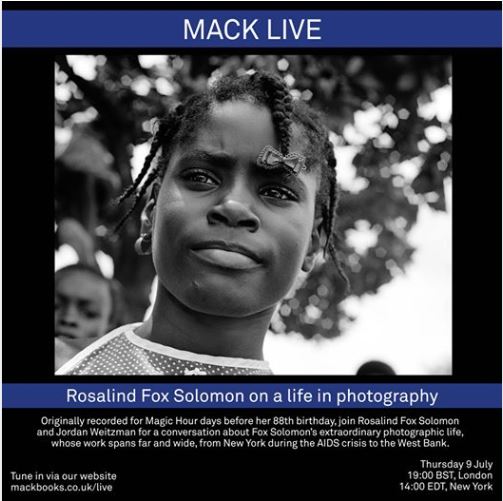
This was a pre-recording with Fox Solomon just prior to her 88th birthday. She came late to photography and has been compared to Diane Arbus throughout her career. She doesn’t make her subjects comfortable during their sessions in fact she rarely talks which deliberately makes the subject uncomfortable and on edge and you can see this in her images. Born in 1930 in Illinois which she seemed reluctant to admit to. She originally trained as a secretary, married and had two children and became involved with the ‘Experiment in International Living’ and that seems to be were the photography started on a trip to Japan where neither could speak the same language, so she took pictures.
When she returned to the United States, she continued to photograph setting up a darkroom in her garden however she wasn’t getting the results she wanted so on a trip to New York she became introduced and started to study with Lisette Model. This was probably why there is a link to Arbus. The following has been taken form an interview with Aperture (no date on site but link added below)
FP: How did you start working with Lisette Model?
RFS: Modernage lab led me to Lisette Model. Though I worked in the darkroom, I didn’t know what I was doing. So when I got to New York, I took my film to the Modernage photo-lab and had prints made. I went to their Christmas party in 1971 or ’72, and I met a photography agent, Henrietta Brackman. She made an appointment with me, saying, “Bring everything you’ve ever done.” I said, “I can’t. There’s too much.” She said, “You have to bring everything you’ve ever done.” I brought two huge suitcases full of things, and after she looked at my pictures, she said, “You have talent but you need help. You should study with Lisette Model. She was Diane Arbus’s teacher.” Diane Arbus and Ansel Adams were the only photographers I had heard of at that time. I got in touch with Lisette and she said, “The next time you come, meet me and bring everything you’ve ever done.”
Her work includes; the Baroness Erlanger Hospital in Chattanooga, Tennessee; William Eggleston and his family and friends in Tennessee and Mississippi, and the Guatemalan Highlands. The latter was where her interest in how people cope with adversity started leading to the witness of the shaman’s rites and a funeral and made photographs in Easter processions.
In 1980s, saw her began the work in Ancash, Peru where she has returned intermittently for over 20 years. Her images focus on the damage from the 1970 earthquake. She continued photographing shamans, cemeteries, funerals and other rituals.
In 1987 and 1988, Solomon began photographing people with AIDS, their families, and with their partners. The project resulted in the exhibition, Portraits in the Time of AIDS at the Grey Gallery of Art of New York University in 1988.
She has produced many books and she says she has many more to come if publishers are interested. She combines images (all square format) with text from either the subject or her own work.
Bibliography
Websites accessed 10/07/2020
https://www.rosalindfoxsolomon.com/
https://www.newyorker.com/culture/photo-booth/rosalind-fox-solomons-color-line
https://aperture.org/blog/interview-rosalind-fox-solomon/
Royal Photographic Society ‘The Indestructible Lee Miller’
10th July 2020
This talk was given by Lee Miller’s son and grand daughter who own and run the Lee Miller Archives which is a small privately run organisation dedicated to conserving, publishing and cataloguing the life’s work of Lee Miller. The archive currently holds work by Miller but also that of her husband Roland Penrose. They have some 60,000 negatives, mainly black and white, most of her manuscripts, captions, notes, letters and ephemeral material, her cameras, and some of her personal effects such as her US Army uniform. It also holds approximately 3,000 photographs by Roland Penrose and photography by David E. Scherman, Man Ray, Antony Penrose and Andrew Lanyon.
Elizabeth “Lee” Miller, Lady Penrose (1907 – 1977), was an American photographer and photojournalist. She was a fashion model in New York City in the 1920s before going to Paris, where she became a fashion and fine art photographer. During the Second World War, she was a war correspondent for Vogue, covering events such as the London Blitz, the liberation of Paris, and the concentration camps at Buchenwald and Dachau.
Royal Photographic Society In Conversation with Ioanna Sakellaraki
15th July 2020
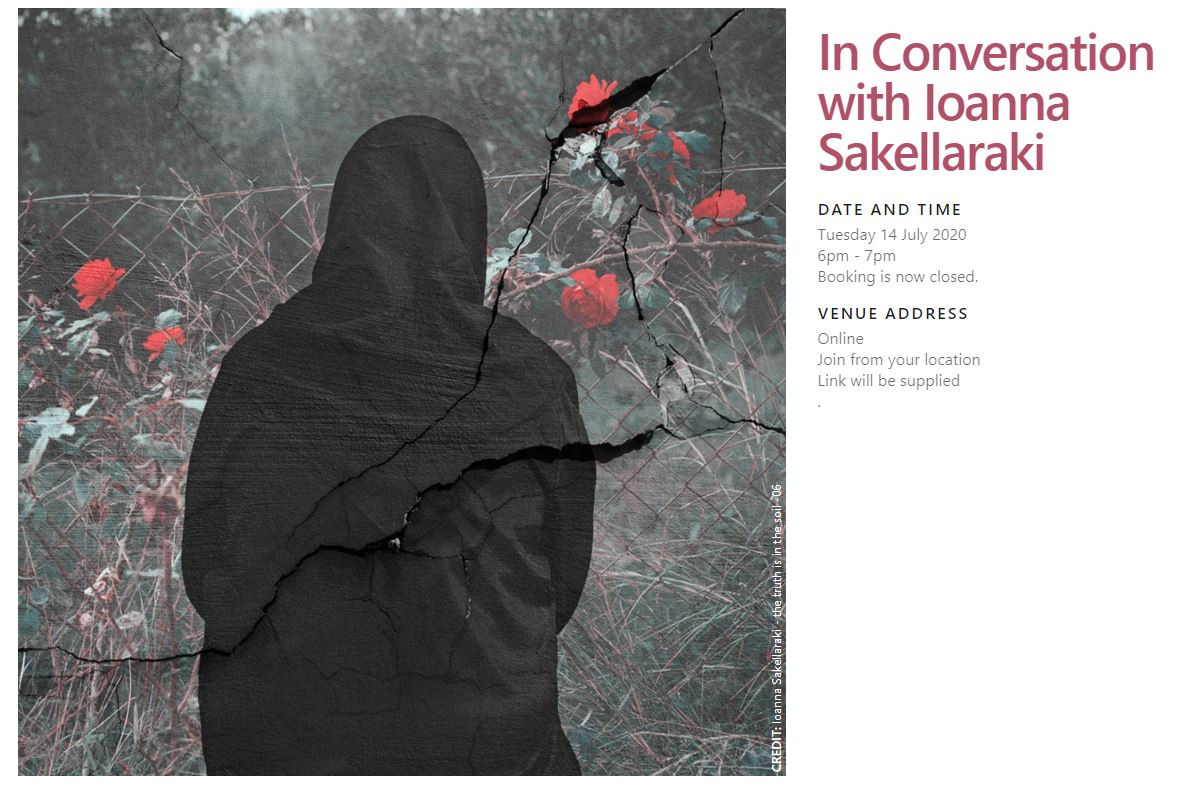
Sakellaraki is a Greek photographer based between Brussels and London who was the recipient of both a RPS bursary (2018) and a Sony award winner (2020). The main discussion of her talk was the personal project ‘The Truth is in the Soil’ for which she used the bursary. Her work is based around memory, place and identity. She originally studied media and journalism and came to photography later in life.
Her initial project ‘Aidos’ focuses on the themes of place, memory and the loss of, identity with a heavy influence of Greek mythology and history of traditions. She used photography to explore mourning following the loss of her father and how her Greek heritage dealt with the act of mourning following this loss. This initial project and with the help of the RPS resulted in the project ‘The Truth is in the Soil’ which caused her to ask lots of questions about herself, the loss of a relative, the process of dealing with death, mourning within her culture, identity and land.
Relevance to my practice
She researches a lot, both reading and writing and uses that within her work. She discovered the process of building small chapel like boxes within the landscape to remember the people who have died, simple boxes that contain artifacts from the person.
The project consists more of constructed images, using analogue processes and modern technology. She develops/designs landscapes and adds the silhouettes of people she has photographed which seems to imply a relationship between the person and the land.
Bibliography
Link to talk: https://rps.org/events/bristol/2020/july/in-conversation-with-ioanna-sakellaraki/
Websites accessed 15/07/2020
The Truth is in the Soil: https://ioannasakellaraki.com/
https://www.lensculture.com/ioanna-sakellaraki
Aidos: https://www.itsnicethat.com/articles/ioanna-sakellaraki-aidos-photography-290618
VII Photo Agency ‘The Republic’ by Seamus Murphy
15th July 2020
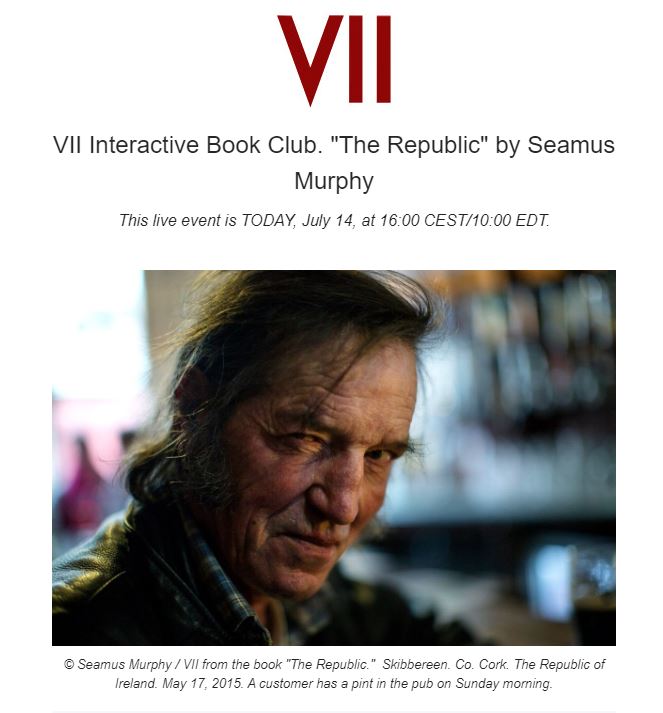
Murphy discussed his project around the situation within Ireland one hundred years following the 1916 uprising, a revolt that ultimately led to the independence of southern Ireland from the British. The aim of the project was to answer a number of questions; who are the Irish? what has become of the Republic? What has it become?
All the images were from Southern Ireland, documenting the importance of the 12th July which is a key date in the Orange Order. Murphy uses a combination of digital and analogue to capture the streets of Dublin to the West Coast, the suburbs, the culture and the humour. There are no captions with the images as he relies on the viewer to form their own opinion, but he does include a simple location. Each image has a standalone story but, in some way, its linked to the next.
The book shows a diversity of the country now with the mass influx of immigrants for work, the acceptance of same sex marriage and the legalisation of abortions. There has been a loss in the class structure and the introduction and acceptance of different religions across the country.
Relevance to my practice
Murphy highlighted the difficulty he had of completing the final edit, with thousands of images it was hard to undertake the final selection with the theme changing but he kept coming back to ask ‘does this image show/represent ‘Republic’? if it did then it was in. This maybe the way for me to try and complete my selection.
Bibliography
Accessed 15/07/2020
https://www.facebook.com/VIIPhoto/videos/631856797450964
https://www.huckmag.com/art-and-culture/photography-2/pictures-ireland-youll-never-find-postcards/
https://time.com/4258613/st-patricks-day-irish-photographer/
Head On Photo Festival (Re-play) Panel talk: Australian Photojournalism
15th July 2020
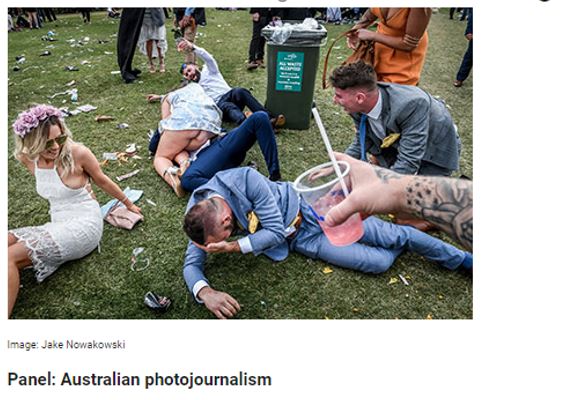
A panel discussion which is a replay from the original festival. The panel members included:
- Moshe Rosenzveig
- Alison Stieven-Taylor
- Meredith O’Shea
- Ben Bohane (via phoen)
- Jessica Hromas
- Tracey Nearmy and
- Brian Cassey
Each member provided one image from their career which meant the most to them. These were varied but all based around the genre of photojournalism. There was a following discussion on the need for truthfulness within journalism and how this is even more critical in current times of the pandemic.
1854 Presents: Teresa Eng and Kalpesh Lathigra
17th July 2020
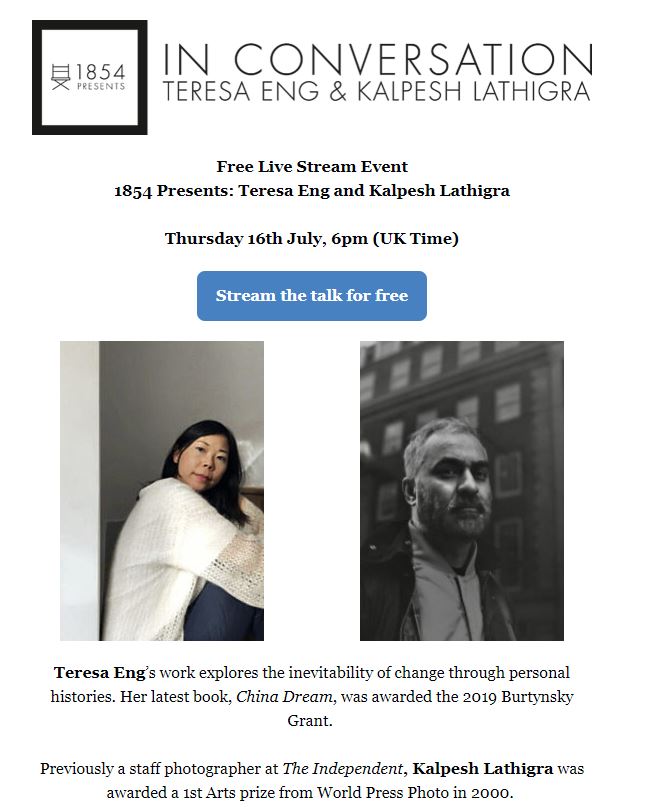
Eng a 2nd generation Chinese photographer explores her feelings of being between two spaces. The Chinese v Western culture and the difficulties she has faced not conforming to her Chinese up bring of a standard career. The projects she creates are concerned with identity and self, looking at her cultural traditions, trying to offer a multi-layered message.
Lathigra was a photojournalist who experienced war and conflict zones in an attempt to avoid his heritage. It took him a long time to find his place, space asking ‘where do I belong?’ His work is based around memory and how they shape what we are today. He started to explore his heritage and looked back on his time in India.
VII Photo Agency: Symposium, Visualising Climate Change: The Environmental Sublime Part 2
17th July 2020
This was the second part of the panel discussion on the current impact of climate change and how the use of photography can not only record the effect but help motivate action. The first part took place in June and I have provided a brief overview earlier in this blog.
The panel consisted of: Paul Lowe (chair of the discussion), Maria Teresa Salvati, Klaus Thymann, Simon Norfolk, Daniel Schwartz and Solmaz Daryani.
The discussion started with Salvati who is the founder and editor-in-chief at Slideluck Editorial, online platform for contemporary photography and multimedia. Her presentation was broken down into definition and brief history of ‘sublime’; the sublime in the landscape; and beauty and truth. She started with a definition of ‘sublime’ as follows:
‘In aesthetics, the sublime is the quality of greatness, whether physical, moral, intellectual, metaphysical, aesthetic, spiritual, or artistic. The aesthetic of the sublime revolved around the relationship between human beings and the grand or terrifying aspects of nature. The term especially refers to a greatness beyond all possibility of calculation, measurement or imitation’.
This formed her discussion on the work by John Dennis who claimed that the ‘experience of the journey was at once a pleasure to the eye as music is to the ear, but “mingled with horrors, and sometimes almost with despair’. A very true fact is one looks at the effect man is having on the environment. She also mentioned Edmund Burke, Immanuel Kant, and Jean-Francois Lyotard.
The second part of her discussion addressed the shift in representing the ‘sublime’ in landscape photography and how until the mid 19th century, landscape photographers took photographs of landscapes that documented the beauty or that of the ‘benign human influence’. However, from the 1960s photographers have moved away from that to focus on the damage being inflicted due to industrialisation. She claims that in the second part of the century there’s been a shift in sensibility of landscape photographers in ‘wanting to challenge their viewers rather than provide comforting, aesthetically pleasing images’. I think this is what is needed however this needs to be undertaken in the right way, most humans are immune to the shock factor, it needs to affect them personally before action is taken in most cases. When it affects someone’s livelihood that’s when they normally take action.
Klaus Thymann was the next presenter. He is a scientist and photographer and the founder of ‘Project Pressure’. The project is to visualise climate change through the use of art as a ‘touch-point’ to inspire human action and behavioural change. Their projects are based around the changes seen in glaciers around the world. He claims that unlike the wildfires, floods and other extreme weather events around the world, glacier mass loss can be directly attributed to global changes in temperature and as a result one of the key indictors of climate change. The project works with key organisations such as the University of Oxford, NASA and World Glacier Monitoring Service.
Simon Norfolk, the third presenter and part of the Project Pressure team, described how he used the techniques and experiences from his time in war zones and post conflict. He claimed that if you don’t fall in love with something you will never wan to save it. You need to be passionate about a subject to fight for it. In his project called ‘Shroud’ he used a type of helium balloon to shine a light on areas of the landscape to help draw attention to the situation. The area is a small glacier in Switzerland and details how one person would go to such great lengths to protect the last remain portion and their livelihood.
As a continuation of this Daniel Schwartz provided his work on the same glacier in his project ‘Below Darkening Peaks: The Agony of Glaciers’. This project was continuation of his father’s work which started over sixty priors. Shows the documentation of the effects and changes over the years. He has recorded the artifacts that have been discovered as the glacier has receded. He has walked the tracks and tried to find his own angle on the story.
The final presenter was Solmaz Daryani and for me the most powerful as it highlights similar situations to the issues here in New Zealand. She is a self-taught photographer and shows her very personal project ‘The Eyes of Earth: The Death of Salt Lake Urmia’ which was once the second largest saltwater lake in the world. Her documentation uses personal family images and compares the lake of her childhood to that of today which is now less than 20% of its average size.
It is claimed that this was due to declining rainfall, increase in temperatures, inefficiencies in agriculture, over use of ground water along with the introduction of new dams which have redirected the water flow.
The use of before and after was a powerful way to demonstrate the effect that man has had on the environment. The mood portraited in the soft tones make you look more closely to understand the story she is trying to tell and when you do the effect is one of devastation.
Bibliography
Accessed 17/07/2020
Simon Norfolk ‘Shroud’ viewed at https://www.klausthymann.com/projects/shroud/
Shroud Video viewed at: https://vimeo.com/364340928
Project Pressure website: https://www.project-pressure.org/
Solmaz Daryani website: http://www.solmazdaryani.com/
Head-on Photo Festival (Re-play): Matt Palmer: The power of Personal Photography
22nd July 2020
Palmer is an award winning Tasmanian photographer who covers a range of photographic genres. His aim is to show the natural world through image story telling and communication. He started the presentation by asking – ‘What makes a good project?’ For him it was a subject that creates and maintains your passion, that offers a point of difference and is consistent. He went of to offer 7 steps to fleshing out a project:
- Passion and interest – if you are not passionate or interested in the subject that will come across in your images;
- Dig deeper – research and connect to those involved, expand on the story, communicate and look for a point of difference, something unknown, is there a social angle to be explored?
- Telling the story – standalone or series of images, the final edit is key to this so don’t rush it. Think about the end result and plan
- Set it apart – what will set your story apart from others
- Link it to you – build your profile, develop your skills, print and sell. Network and exhibit the work, don’t just leave it on your hard drive – the story should be told
- Collaborators – people or organisations, get to know people for funding or exhibition space
- Share your work – start simple such as a ‘zine’ free on-line space, blog etc
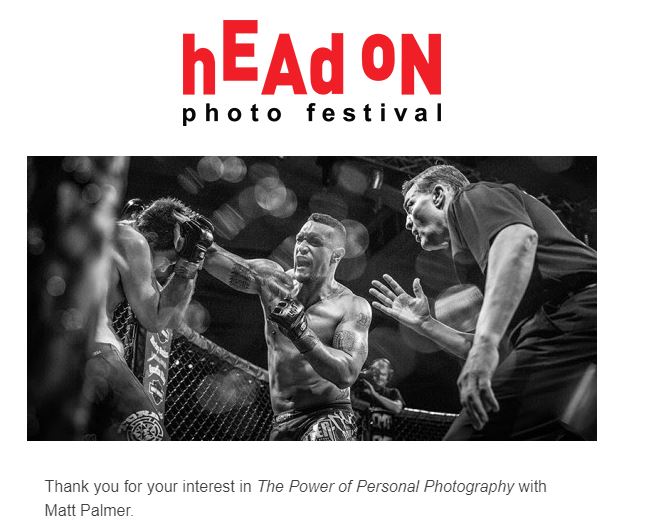
Head-on Photo Festival (Re-play) Artist Talk: Renata Buziak
23rd July 2020
Buziak is a fine art photographer and lecturer with a major part of her work drawn from natural sciences where she has studied the local Australian healing plants significant to the Quandamooka Peoples of Minjerribah/North Stradbroke Island. Her images include edible plants such as Rubus parvifolius (native raspberry), and tea trees such as Leptospermum semibaccatum used as insect repellent and antiseptic for treating various health conditions.
The images are created by fusing organic matter and photographic material during the process of natural decomposition, a technique she calls ‘biochrome’. The image is generated through the bacterial micro-organic activity, and arranging the plants on light-sensitive photographic papers and left to decay. The process reveals what is ‘usually invisible to the eye; the biological chemical progression of decay and degeneration. It also highlights that selected plants have therapeutic properties and were used for thousands of years’. The images show a kind of beauty throughout the whole decay process which she captures through time lapse photography. No two images are the same. The following taken from the presentation shows the various stages. Most images take 4-8 weeks to produce, depending on the plant being used. She did highlight the safety issues associated with this process, both gloves and masks should be used, as there may be unknown bacteria present.
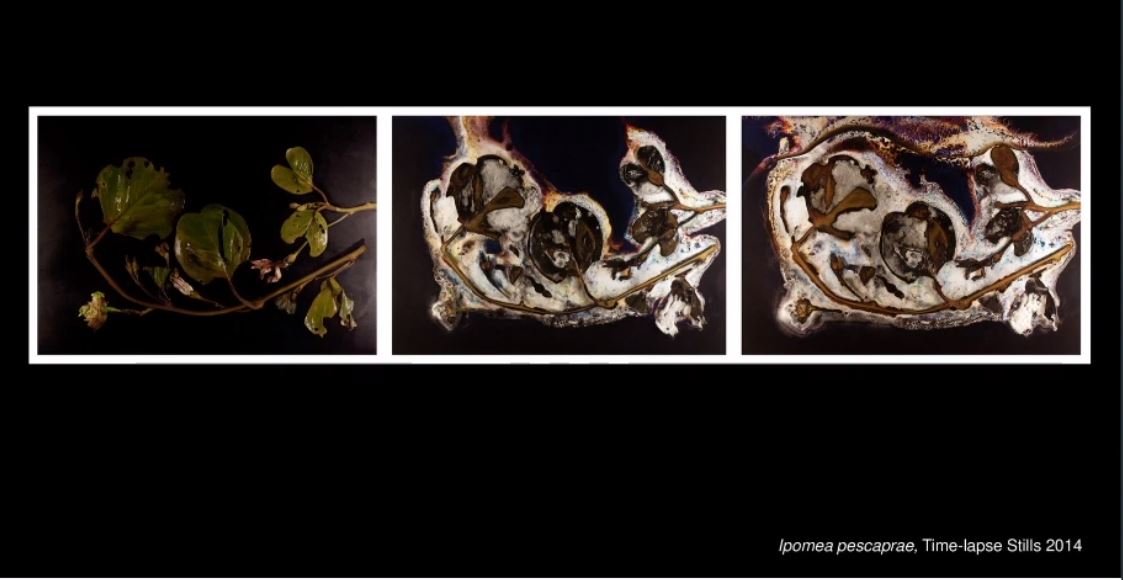
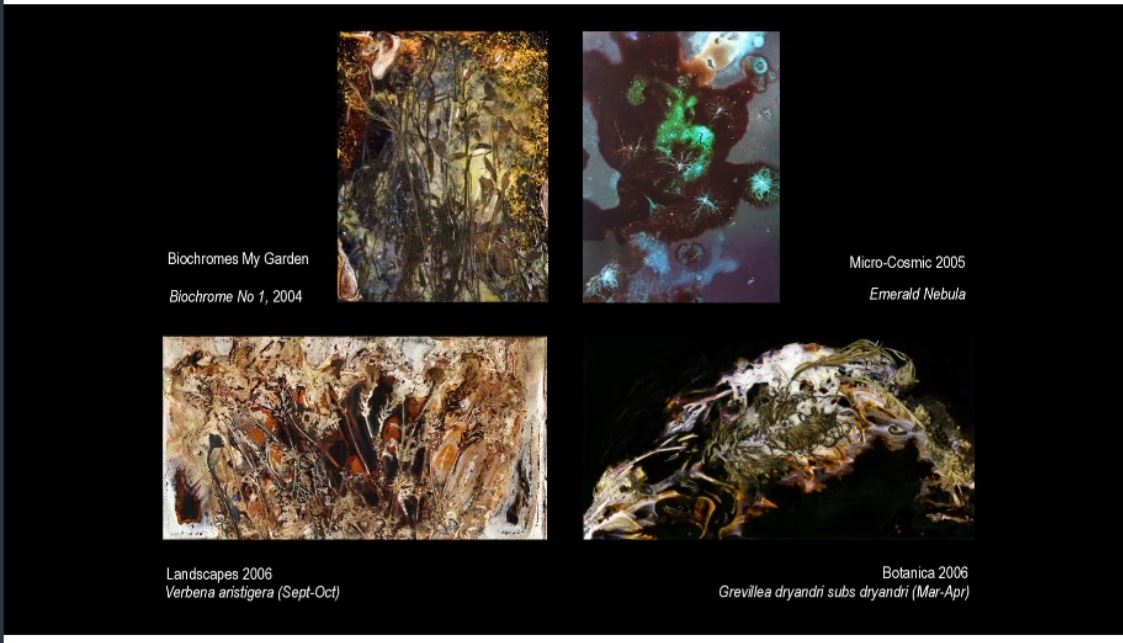
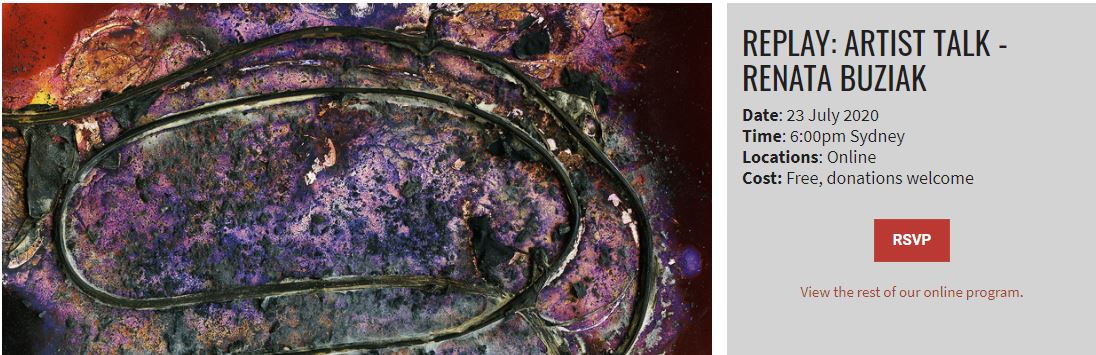
1854 Presents Artist talk: Rory Lewis
©Renata Buziak
23rd July 2020
Lewis is a British photographer who is best known for his portrait work with some of the best know actors, political leaders and celebrities. He claims to combine history and fine art in his work and you can see this in his simple approach to each subject. There are no distractions, the lighting is soft and the emotions are seen on the faces he photographs.
He has been a professional for over a decade and states his successes is down to research, research, research. He often only has 10 minutes to capture the image so keeping it simple and portable is key. The process is 20% lighting and 80% direction to get the image and get out. He says that to understand portrait photography you need to develop an understanding of fine art, to study lighting, and form. He suggested research into artists such as Caravaggio, Hans Holbein the younger and Gustare Dore.
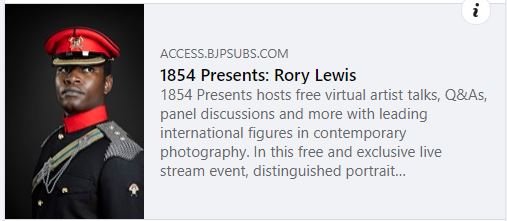
Link to talk: https://www.bjp-online.com/2020/07/1854-presents-rory-lewis/
Artists website accessed 23/07/2020: https://www.rorylewis.studio/
VII Photo Agency Book Club: Maggie Steber ‘Dance with Fire’
28th July 2020
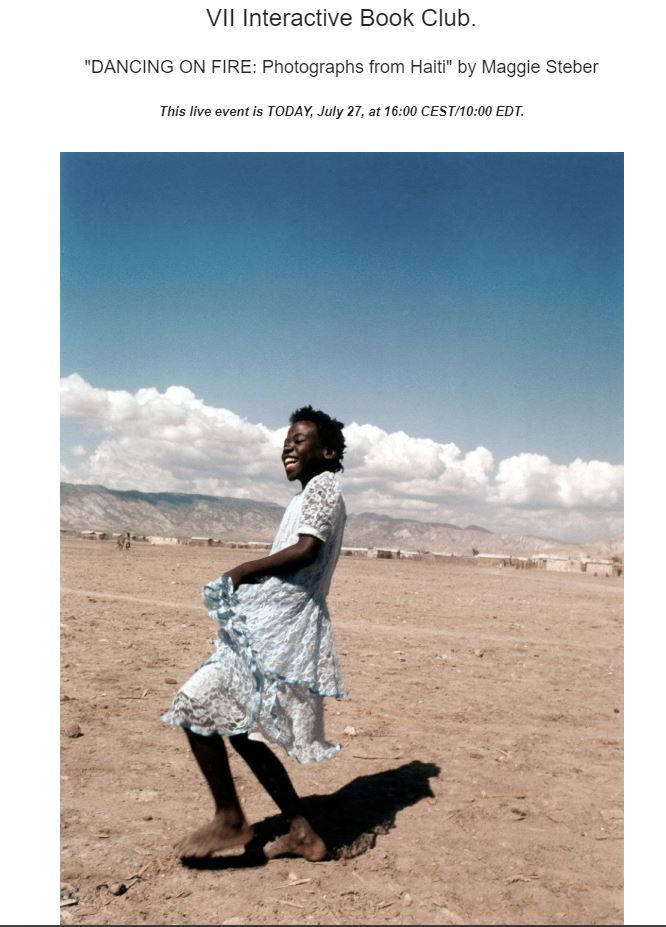
Link to talk: https://www.facebook.com/VIIPhoto/videos/925349514651501
Head On Photo Festival (re-play) Artist Talk: Emmanuel Angelicas
30th July 2020
This is another of the talks/presentations I didn’t manage to see first time around and I think we are really lucky that the organisers have offered these re-runs and two time during the day. This was a pre-recording of a discussion between the curator of the exhibition (of Angelicas work) and the artist. At the end there was a Q&A session with the artist on the phone.
Angelicas was first given a camera for his seventh birthday and started by photographing his family, friends and the neighbourhood of Marrickville – the subject of his Exhibition. His website which contains an ‘adult content’ warning before you enter also covers other projects from his travels to Thailand, Japan, Greece and Bali. The themes are based around a personal journey and expose all aspects of life, nothing is ruled out, hence the warning. The majority of his images are square format black and white. They lay bare the facts of life for all to see without excuses.
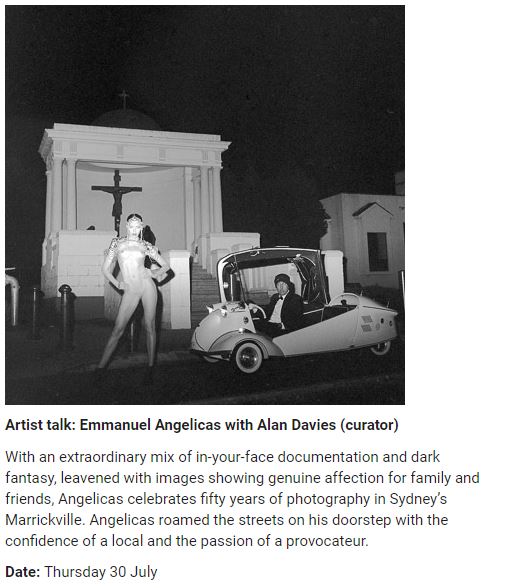
Artists website accessed 30/07/2020: https://emmanuelangelicas.com/portfolios/
https://www.featureshoot.com/tag/emmanuel-angelicas-photography/
https://i-d.vice.com/en_au/article/9k7ep3/photos-inner-city-suburbia-marrickville-emmanuel-angelicas
1854 Presents In conversation with: Enda Bowe and Susie Lavelle
31st July 2020
Lavelle is an award wining cinematographer with her latest work being the resent adaptation of the book ‘Normal People’, set in Ireland. As part of this project she worked with stills photographer Enda Bowe who’s work is based around the study of people, culture and capturing the emotions of everyday life. The two discussed the films that first influenced them and how they have used that in their work.
Both stated photography at an early age but only Bowe has a formal education in still photography. There has been a strong influence of American film culture growing up but they both seemed to migrate to a more mature cultured style in the form of ‘The Colours Blue’ and ‘Ida’.
Relevance to my practice
They rely strongly on the use of light, angle of camera and framing to set the mood. The use of large open spaces and cropped portraits to give a feeling of isolation. Both agreed that to produce great images or films you need to be inspired, you need to look at form, shapes and to question what to include and what to not – don’t give the reader too much, let them work for it.
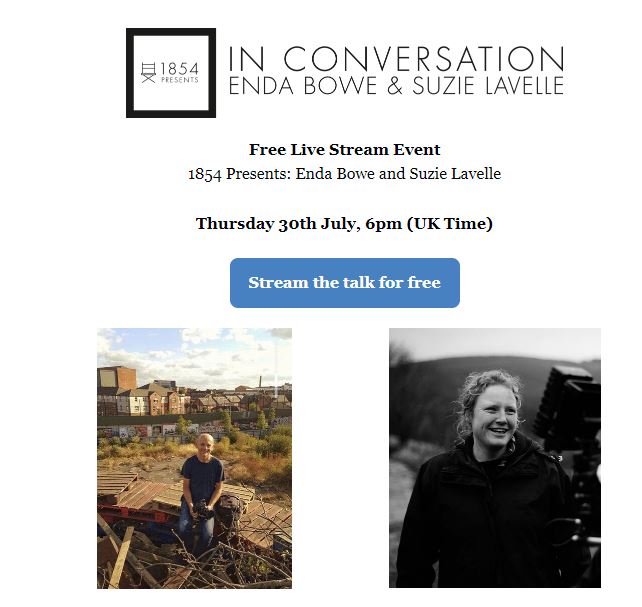
SheClicks Webinar: A project from Idea to Book; Carolyn Mendelsohn
5th August 2020
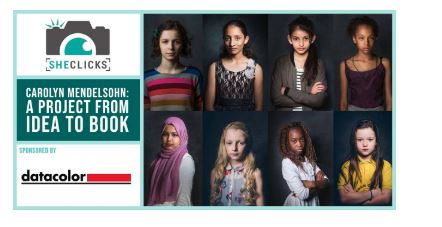
I wanted to watch this presentation as I hoped to gain some insight into how to progress my Body of Work to maybe include a book or for the final submission to be a publication as trying to gain exhibition space will be a challenge in my local area.
Mendelsohn started her career in theatre first as an actor and then as a director. She was always interested in storytelling. She introduced images and film into live performances. With no formal training she moved into photography, even though as a child her life seemed to be fully documented, she hated having her photograph taken, always covering herself with large clothes to almost hide. When she undertakes a project, she starts with research. With the project discussed to day ‘Being Inbetween’ she looked at the work by Sally Mann, Rineke Dijkera and Hellen Van Meene. To gain interested she produced a blog, called out to locals, developed a questionnaire, release form and decided on the approach for the project.
The project consists of 90 portraits of girls between the ages of 10 – 12, that age between childhood and finally becoming a teenager. Each image comes with text from the subject: their hopes and dreams.
Relevance to my practice
The talk was interesting but I didn’t really gain any insight into how to move my project along which was disappointing
Bibliography
Accessed 05/08/2020
http://www.carolynmendelsohnphoto.com/
https://www.lensculture.com/projects/232442-being-inbetween
Head-on Photo Festival (re-play) Artist Talk: Pierre Dalpe
6th August 2020
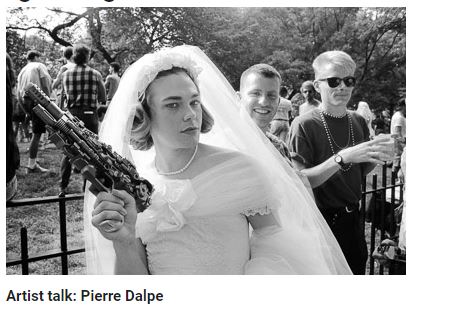
Dalpé is a Montreal-based photographer whose work is a mixture of both analogue and digital. For the past ten years or so his focus has been on the production of a series of portraits, entitled Personae. This series questions the notion of a predetermined or ‘fixed’ identity and explores the idea that individuals potentially embody a multitude of personae.
The talk also covered his work he documented at ‘Wigstock’ over a period of four years. Wigstock was a festival for the LGBTQ scene. These black and white images show the start of a new revolution within New York. The images demonstrate the hope and freedom of those attending the festival
Bibliography
Accessed 06/08/2020
https://www.headon.com.au/civicrm/event/info?reset=1&id=113
https://loeildelaphotographie.com/en/personae-interview-of-pierre-dalpe/
1854 Presents: Bradley Secker
7th August 2020
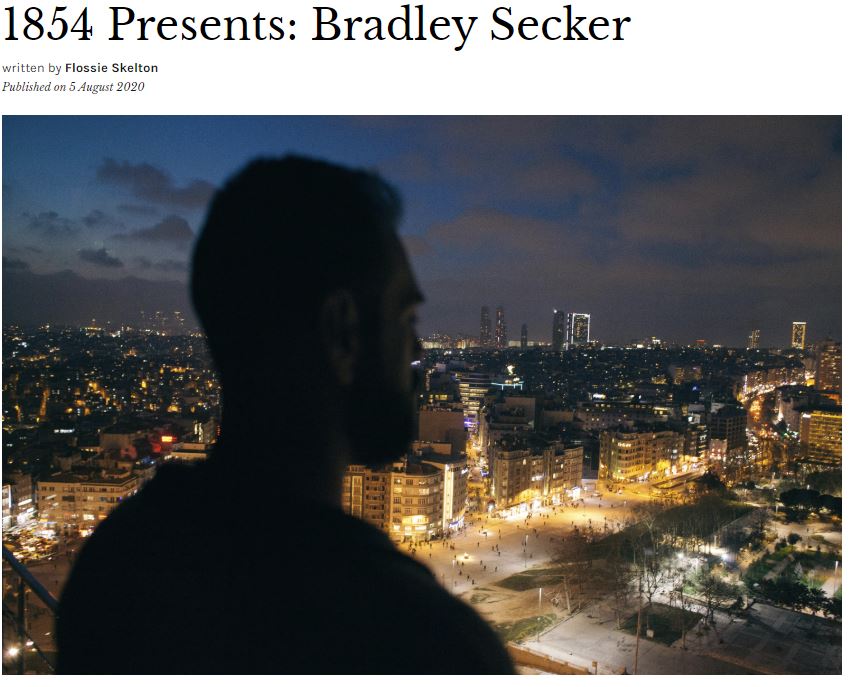
Secker is a photojournalist and portrait photographer based in Turkey but covering projects and commissions in the Balkans, and the Middle East. He has a number of personal projects which focus on identity, migration and social and political actions. He is currently undertaking a very personal project which has lasts over nine years on the situation of LGBTI culture within asylum seekers. The project addresses the situation of persecution, with the series beginning all those years ago in Damascus, Syria, in 2010, and incorporates a number of side or sub-projects; SEXugees, Kütmaan, Mr Gay Syria, LoveWins, and the current iteration, Gayropa.
Relevance to my practice
The images are powerful and have a strong narrative but in order for the full story to be told each image has a caption. The images show every aspect of life from the mundane to the horrors of scars from selling a kidney to escape. It was noted that his project show very few women and he explained that it was often difficult for a gay man or in fact any man not married or related to the woman to be alone with her.
Bibliography
Access 07/08/2020
Link to the talk: https://www.bjp-online.com/2020/08/1854-presents-bradley-secker/
https://www.bradleysecker.com/
https://pulitzercenter.org/people/bradley-secker
MACK Presents Book Talk: Teju Cole ‘Fernweh’
7th August 2020
This presentation was based around the photobook ‘Fernweh’. Cole is a Nigerian-American writer, photographer, and art historian who started this project in 2014 based around the Swiss landscape. The presentation started with Cole reading the opening essay from the book and then moved through the images. Each image looked like a single post card on the right-hand side page. The book taking a poster like format with lots of negative space around each image. Your eye is naturally drawn to the image as the page is turned. The text, written on the left page is from a book called ‘Baedeker’ (1827) which is over 150 years old and is claimed to be one of the first documented travel guides. Cole has tried to match text from the book which describes the location or is very similar.
Relevance to my practice
The images show the remoteness of the locations, but within each there are links to human activity so show that you are never truly alone. This project was completed over several return trips to the same location, in some cases he spent weeks documenting the same space from every angle, in every light – giving the impression of a crime scene.
Bibliography
Access 07/08/2020
http://www.tejucole.com/photography/
https://en.wikipedia.org/wiki/Baedeker
https://www.lensculture.com/articles/teju-cole-another-way-of-telling-teju-cole-s-blind-spot
http://www.stevenkasher.com/artists/teju-cole
Head-On Photo Festival (re-play) Panel Talk: Photography, Trauma and Healing
11th August 2020
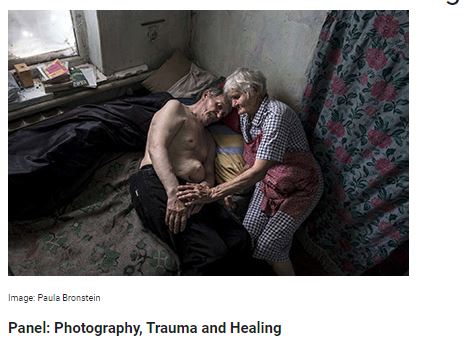
After not receiving the link through for the 2pm session I was so glad they also offered the opportunity to listen to this discussion again at 8pm.
The group consisting of Alasdair Foster, David Dare Parker, Erika Diettes and Tom Gross was chaired by Dr Helen Vatsikopoulos a journalist and documentary film maker from Sydney.
With the current crises dominating on-line media and the effect this is having on work by photojournalists the panel discusses the obsession that viewers have for images that contain evidence of trauma and disasters. The role photography plays in how issues are portrayed and how important matters are documented – it informs how we see the world from our arm chairs.
The first panel member to speak was David Dare Parker – a photojournalist for over 35 years who discussed his approach to some of the most traumatic situations he had been sent to. He stated that it was to always approach people with care and respect. On the whole people want their story to be told as they often hear the wrong side being published. It is important to document the truth and to follow through, don’t just leave a situation because you think you have the next award-winning image. Capture the whole. He stated that these people have survived such trauma and they are survivors not victims. Your images need to show this and to be used to make a change.
Erika Diettes was next who has spent over seven years documenting the survivors of the Columbian gangs. She completed interviews and gathered the belongings of victims and formed memories for their loved ones in resin blocks. These along with photographs were exhibited in the national gallery. Each block tells its own story and is a way for families to remember who they have lost. Like Parker she wanted to gain the trust of the people she was working with. She documented over 167 stories, but this is just a small sample of the thousands that have been affected by these gangs.
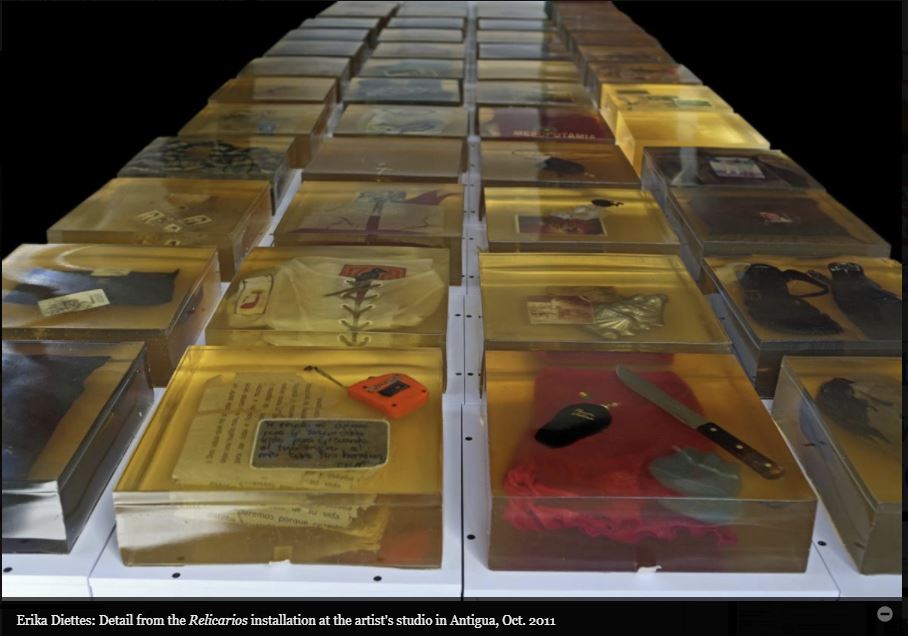
As part of her project she worked with Alasdair Foster a Professor of Culture in Community Wellbeing based in Brisbane. He discussed how the process undertaken during the project helped the family’s grieve. It is important that the victims are not forgotten and the world needs to know about these events. The country needs to recognise and deal with the situation by acknowledging it and helping to provide some form of recognition – memorial, of the victims. Foster also covered the work by Paula Luttringer who was abducted over 40 years ago but didn’t start photographing or using photography to heal until twenty years after the event. Her video and images have helped others to heal and bring justice for the victims and survivors. I tried to find the video that was shown on line but it doesn’t seem to be available.
The world as a viewer needs to feel the situation within the images, know that they are true representations and form an empathy in order to move into action and help move towards a change.
Bibliography
Access 12/08/2020
http://www.daviddareparker.com/
https://gurushots.com/daviddareparker/photos
https://www.erikadiettes.com/bio
https://www.lensculture.com/articles/erika-diettes-drifting-away
http://lenscratch.com/2012/10/latin-american-week-erika-diettes/
https://prisonphotography.org/tag/paula-luttringer/
https://ray2018.de/en/ray-magazine/interview-paula-luttringer/
https://www.thedailystar.net/news-detail-76300
Foto Festival Talk: David Levi Strauss in conversation with Roberto Tajada
13th August 2020

Image from FotoFest Creative Conversations
I registered and booked time out of my usual work day to listen to this discussion. It took me awhile to follow the presentation and pick up on the structure of talk and the book. The talk started and was based around the recently published book by David Levi Strauss which is based on the event running up to the election of Donald Trump. It has been described as a political crisis that snuck up on America-that result in the rise of Trump and Trumpism revealing the’ rot at the core of American exceptionalism’.
Strauss described the changes in the way the use of words and images have been produced and received via mass media that have made the current surrealist possible. He detailed the facts around communication through social media, and how by design this has maximizes attention and minimizes scrutiny, how people have accepted everything Trump has said without question.
In the book ‘Co-Illusion’, Strauss witness the events to what he has called the new “iconopolitics” in which words and images lose their connection to reality. The collusion that fuelled Trump’s rise was ‘the secret agreement of voters and media consumers–their “co-illusion”–to set aside the social contract’.
Strauss covers the 2016 Democratic and Republican conventions and the campaign. Following the election, he switches to write as the voices of the regime including the thoughts of the President himself (“I am not a mistake. I am not a fluke, or a bug in the system. I am the System”) and then onto the reflections of a nameless billionaire tech CEO. The final section, Strauss offered ideas on how we might repair the damage to the public imaginary after Trump exits. The images used are by Susan Meiselas and Peter van Agtmael accompany who attended the events and documented mainly in black and white.
Link to the talk (accessed 13/08/2020): https://www.youtube.com/watch?v=C7tRWYrh0Xw
Head-on Photo Festival (re-play): Artist talk: Mark Forbes
13th August 2020
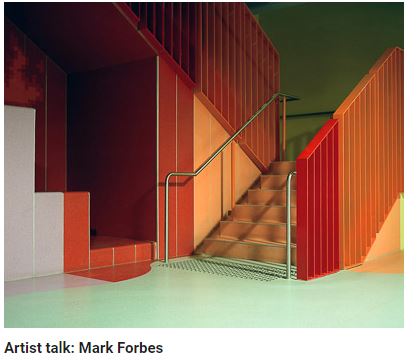
Forbes is a self-taught photographer and has only been photography for the last seven years. He undertakes a mixture of commercial and personal work, but unlike most he uses film rather than digital (well apart from the paid commercial projects).
His personal projects started with images of the street and nearly always included people. He loves to capture the ‘moment’. He uses a ranger finder camera and enjoys the limitations and challenges of film, something I love as well. The anticipation of waiting to see the results when you develop the film. In his trip to Japan he was often shooting in low light and the images he produced have a real dark mood to them, the effect you wouldn’t really get with digital. The use of colour shows the impact of the image rather than the content. In his latest project ‘Beautiful Solitude’, he has moved away from images containing humans to those that show the evidence of them. There is a beauty in every scene, each one makes you stop and look for the evidence of life.
Bibliography
Access 13/08/2020
https://www.markforbes.com.au/
https://www.life-framer.com/photographer/mark-forbes/
1854 Presents: Giya Makondo-Willis
14th August 2020
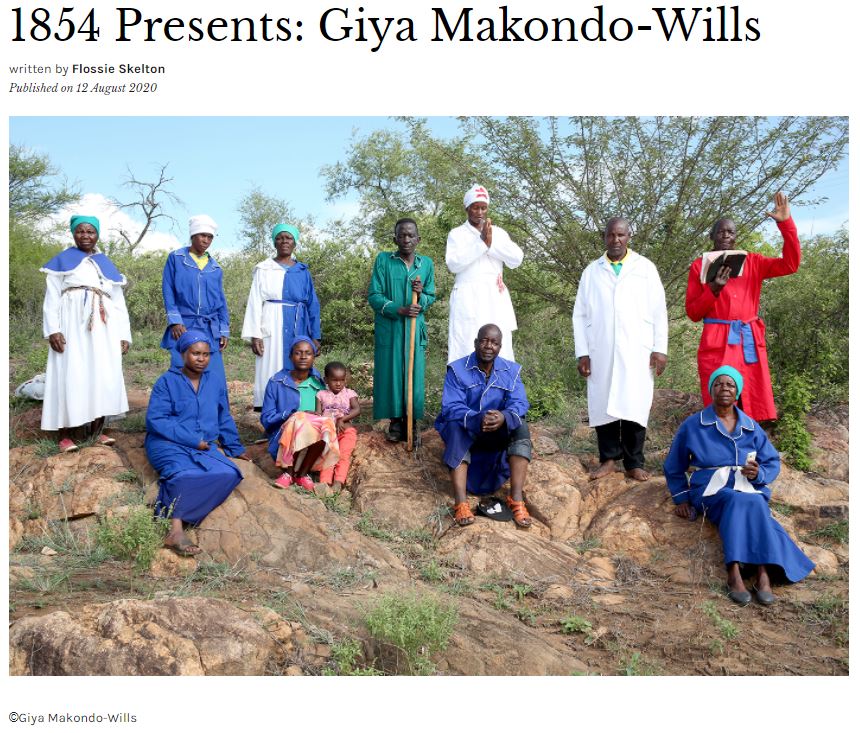
Makondo-Willis is a British/South African Photographer who is based in both the UK and the Netherlands. Her resent work ‘They came from the Water While the World Watched’ explores her race, the colonialization and the power struggles within South Africa. The original project was for her degree and based around her grandmother, but like most project the subject grew. She visited SA four times to complete the project and worked with a number of organisations both within the UK and SA form a complete story.
Her images show the links between how and why Christianity has such an important role to play in the history of the country. This very personal project highlights the resilience of local culture in the form of ‘witch doctors’ and the practices that still continue today and how they are being ‘modernised’ for the 21st century. Her images are a mixture of portraits and portraits within the landscape.
She spoke about the importance of documentary photography and the role as photographers have to play in this and provided the following quote which I think is very true:
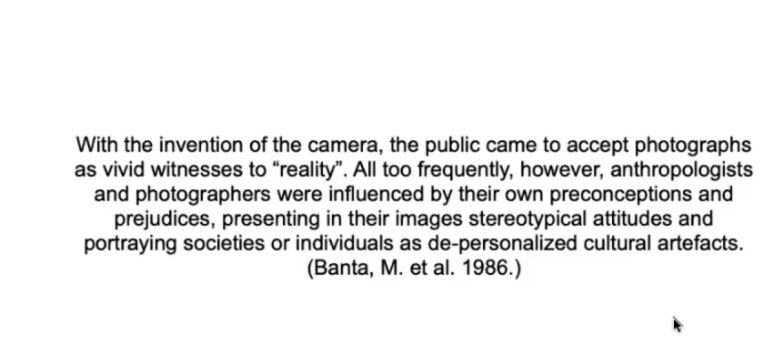
Relevance to my practice
As photographers, regardless of our bias we should be documenting the facts as these will affect how people see others. The speed with which data spreads around the world and the affect it has is very powerful and as documentary photographers there is a code to show the facts.
She has also used a large amount of archive material, something that I’m trying to do in my Body of Work (not easy when the location is so young). She discovered how the Missionaries took items from the locals and sold them to fund their work, these artifacts were often stored in museums and never seen, so she has photographed them so the records are not lost – giving them a second life so to speak and a memory.
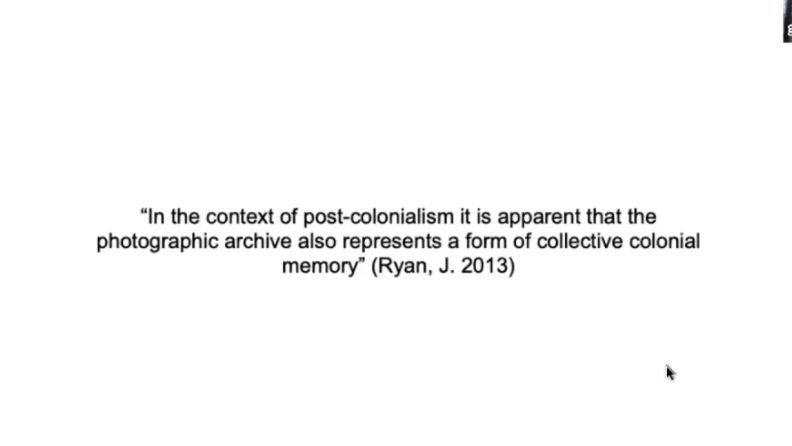
Bibliography
Access 14/08/2020
Link to the talk https://www.bjp-online.com/2020/08/1854-presents-giya-makondo-wills/
https://www.giyamakondo-wills.com/
https://www.giyamakondo-wills.com/they-came-from-the-water-while-the-world-watched#0
https://www.itsnicethat.com/features/giya-makondo-wills-photography-the-graduates-2017-060717
SheClicks Webinar: Creating Compelling Portraits; Carolyn Mendelsohn
20th August 2020
I usually find the SheClicks webinars interesting and informative, gaining lots of hints and tips to take away but I’m sorry to say this one was a little disappointing. I had attended a previous talk by Carolyn and had enjoyed that, where she spoke about her project ‘Being Inbetween’ (5th August 2020) and this was just a copy of that. She did mention a number of artists that influenced her work and recommended research your favourite ones to help improve your skills.
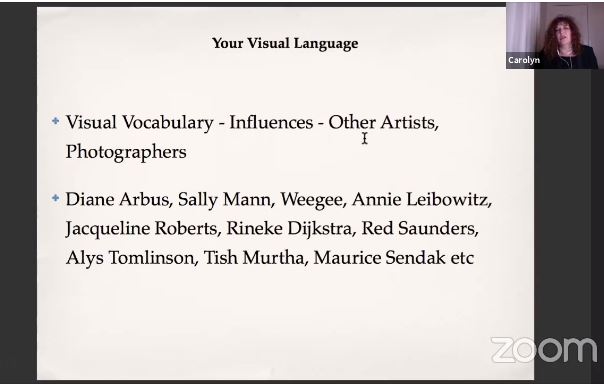
Screen shot from Zoom session
Head-On Photo Festival (re-play) Artist Talk: Susana Giron
20th August 2020
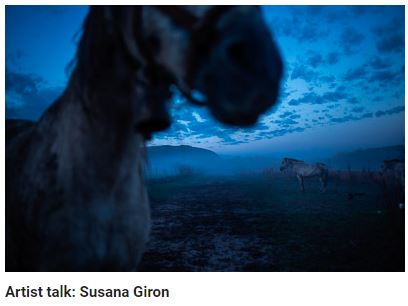
Image from Head-On Festival
Giron is a Spanish photojournalist, working for a number of major organisations, but this was a pre-recorded presentation in Spanish as English is not her native language and story needed to be told in Spanish. This made it a little difficult to read, watch and take notes, so my review of the presentation is probably a little light and so I have completed some additional research following the talk to gain a better understanding.
The project which started in 2014 is based around the last nomadic families of Spain. These are families of shepherds that migrate by foot with their animals in search of better pastures, climate and living conditions. They travel along what are called the royal roads which is the title of her project – ’90 varas’ which references the width of the track. These journeys take 8 days and over 200kms, but the tracks are under threat by development and the loss of young to higher paid jobs in the city as they don’t like the hard life on the road.
Relevance to my practice
She has travelled and worked with these families in order to document every aspect of their lives. She has gained their trust and as she has said by being part of their lives your project takes on a different aspect, ‘you are part of the experience’ and that for me clearly comes across in her work. She is not just reporting she is living it. The way these people live helps the environment, the land is not over stressed through over grazing, the land is able to recover and grow.
Bibliography
Access 20/08/2020
Link to talk: https://www.headon.com.au/learn/replay
http://internationalphotomag.com/susana-giron-90-varas/
https://phmuseum.com/susanagiron
https://www.thestoryinstitute.com/90-varas
VII Photo Agency Interactive: The Aftermath Project Lecture Series: Conversations with Grant Winners about their Winning Work: Nina Berman and Sara Terry
21st August 2020
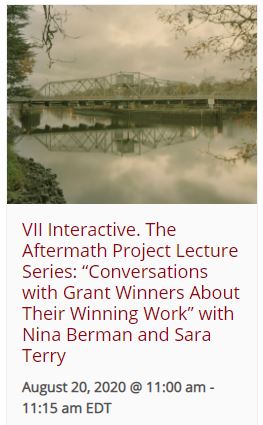
The first in a series of talks with the winners of grant applications to fund projects entitled ‘the aftermath’. This has been one of the most thought provoking and emotional talks I attended. Berman’s project ‘Knowledgement of Danger’ is one of a number of her very personal projects based around the US Military. In this one she uses a 4×5 camera to document and highlight the effects of the US Military on the landscape and environment.
The project started with large amount of research but the first known effect was that of the testing of the first nuclear bomb in New Mexico. The site is only open twice a year as the levels of radiation are still too high. She documented this site and managed to locate one of the first witnesses to the test who was 17 at the time. As a result of the testing he has not been able to have children and the majority of his family has been affected by cancer in one form or another. The effects have never been acknowledged by the Government and are still been seen today. The local native Americans have been also affected with their land polluted and now unusable.
The mining of Uranium from the local mountain has caused pollution of waterways. The government provides bottle water to the locals if they are lucky, most are not. Berman found hundreds of examples of old military basis that are used and then left to local conservation organisations to clean up, but they are so highly polluted that the cost is too high to undertake the decontamination process.
The talk started with one of the most powerful images I have seen – a set of conjoined twins on a hospital bed. These twin girls live in Vietnam and are the effects of the use of ‘agent orange’ a pesticide manufactured in the US and used in the war. These effects are still being seen today in Vietnam but also along the river in New York where the manufacturer just dumped the other production into the local river.
Her project highlights how governments seem to think they are above the law, how they can just pollute and walk away to the next so called ‘conflict’ and not face the consequences.
She spoke about her original project brief to gain the grant – keeping it simple and to the point, a clear plan of what she wanted to achieve and the end goals. She was one of the only ones to receive a grant on examples of her previous work and not the started project, probably a good lesson to learn. She also recommended to review the work by Carole Gallagher: ‘American Ground Zero: The Secret Nuclear War’
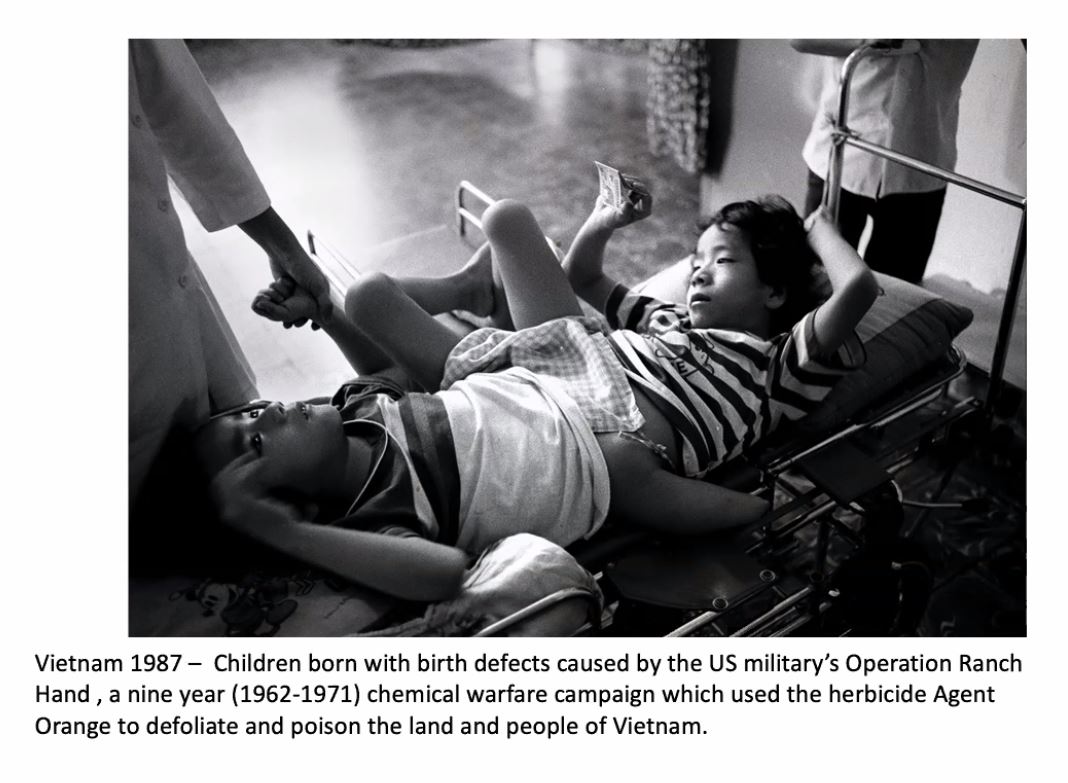
Bibliography
Access 21/08/2020
Link to the talk: https://viiphoto.com/event/vii-interactive-the-aftermath-project-lecture-series-nina-berman/
https://www.noorimages.com/nina-berman
http://www.theaftermathproject.org/project/acknowledgment-danger
Carole Gallagher: ‘American Ground Zero: The Secret Nuclear War’ https://atomicphotographers.com/photographers/carole-gallagher/
1854 Presents: Open Walls Arles Special; Osceloa Referoff, Gregg Segal and Andrei Farcasanu
21st August 2020
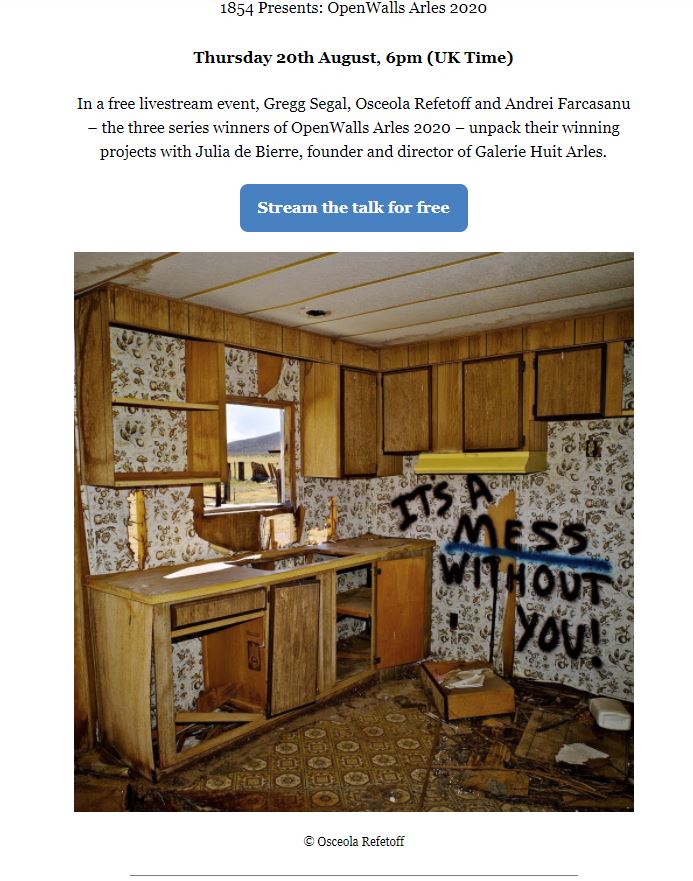
Three very interested and different projects
Gregg Segal project ‘Daily Bread’ started following his last project where he asked people to save their rubbish for a week and then photographed them with it, highlight the incredible amount of packaging that is returned to landfill. In this project he asked children from a range of backgrounds and cultures to keep a food diary for a week and then photographed them surrounded by the food. It was amazing to see the difference in quantity and the level of processed food in some of their diets. Segal tends to use photography to examine aspects of culture, identity, behaviour and beliefs.
Osceola Refetoff is a US photojournalist and fine art photographer. In his landscape project, ‘It’s a Mess Without You’, could be considered as a survey of man’s presence in the deserts of the American West. The project has taken over 10 years with him travelling to the location each year to see the effects of the environment on a series of properties that have long been forgotten. The images are a story of their lives, the space they occupied, the land and the history. Each image seems to tell its own story.
Andrei Farcasanu was the most difficult to follow due to the poor internet connection, but his work consists of a series of black and white analogue photographs and each result in a small handmade print. His work explores and challenges how we understand time and the present.
Bibliography
Access 21/08/2020
Link to the talk: https://www.bjp-online.com/2020/08/1854-presents-openwalls-arles-2020/
Conversations at MOCA: Two Voices, One Vision
21st August 2020
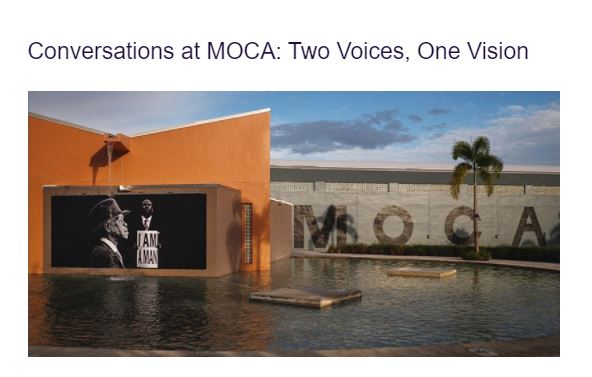
This lecture meant an early rise for me with a 2am start due to the time difference and I suppose with hindsight I could have watched the recording but some are not so I settled in to watch this presentation by Art Historian and Curator Liz Shannon, PhD
Shannon started her talk by discussing the events of 2008 (which I later discovered was also a talk provided by MOCA), while working on a newspaper story with Leonard Pitts, Jr., Carl Juste captured the image of Memphis sanitation worker Elmore Nickelberry and his son, Terence, with a placard that read, “I Am A Man.”. This iconic image is now installed as a public artwork on the walls of the MOCA building.
Shannon discussed a large number of collaborations between photographers and writers, highlighting where the image and text combine to create new meanings, often the text adding to the story. She used the work by James Agee and Walker Evans’ Let Us Now Praise Famous Men (1941), Roy DeCarava and Langston Hughes’ The Sweet Flypaper of Life (1955), Richard Avedon and James Baldwin’s Nothing Personal (1964). Her own PhD was based on the work by Paul Strand with several examples showing how he used text throughout his work. She highlighted the first-time text was added after the image in the form of ‘mugshots’ and how some photographers such as Helen Levitt captures illustrations on buildings, and streets. Other photographers mentioned included:
- Beatrice Abbott
- Walker Evans
- Margaret Bourke-White – The Louisville Flood
- Garry Winogrand – central Park Zoo
- Robert Frank
- William Cline – fills the frame with text when he photographed NY
- Susan Meiselas – ‘Carnival Strippers’ – one of the first to photograph and interview, giving the women a voice when they don’t on the stage
- Dawood Bey – portraits of high school children, interviews and their own words, once again giving them a voice
- Walker Evans and writer James Agees – text can be found at the front and nothing else with the images, leaving the viewer to try and understand the images
Bibliography
Access 21/08/2020
Link to talk: https://www.youtube.com/watch?v=Ws2W0s9PxRI
Link to the Talk with Carl Juste and Leaonard Pitts Jnr: https://mocanomi.org/2020/06/conversations-at-moca-carl-juste-and-leonard-pitts-jr/
Head-on Photo Festival (replay) In Conversation with Sarah Ducker
27th August 2020
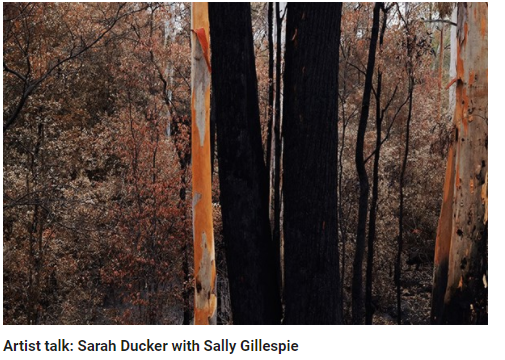
Another in the replay list and one that was really enjoyable and an eye opener to the aftermath of fire. This was based around a conversation between Sally Gillespie and Sarah Ducker no her emotions following the terrifying Australian bush fires of 2019/2020, the mass evacuation of families and the stress of not knowing what or if they would return to anything.
Ducker travelled back to the scenes of devastation and stood within the bare earth and has produced a project of such beauty – the signs of life amongst the burnt remains, the signs of regrowth and new colour is quite amazing.
Ducker presented a video of her work – six minutes of powerful, beautiful images. Simple in composition, thought provoking that out of such damage there could be renewed life. She discussed how she expected to see nothing but black stumps of trees, but was amazed by the amount of colour. She states that we can’t continue on this ever-increasing cycle of heating the planet and not see the consequences.
Her exhibition is based around grief, being within the landscape, space and drought. The fires were difficult for her to cope with and she started to question everything, which resulted in a change to her original project and the exhibition. She travelled to the most effected areas, but became surprised by the beauty, she expected nothing but burnt trees but found life and colour and a feeling of peace. She hopes that her images will help the community to come together and change the way they live and their approach to the land, to take action both political and personal. As she says ‘we can’t stay living like this, keep abusing the planet’. In a way her images and the exhibition is a form of ‘Photovoice’ study, for both her and for the community that have lived through the event. I do think that somehow as people rebuild and move on they will be too busy to even think about what they are doing. As Gillespie reminded us, our education has lost its base – that of the land and looking after it, we only have one planet and we need to take action now and not leave it for someone else to clean up.
Link to talk: https://www.headon.com.au/civicrm/event/info?reset=1&id=227
Photospace Gallery Wellington: Precious Landscapes by Stuart Clook
31st August 2020
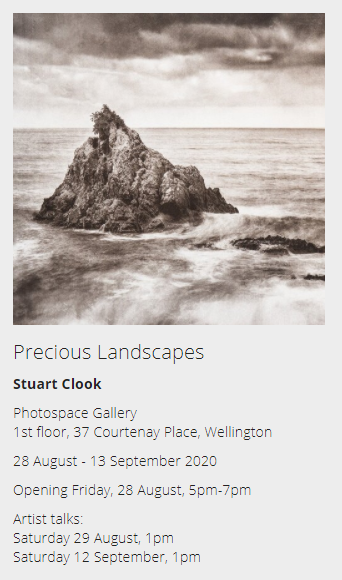
This is the first walk around exhibition since the pandemic and lockdown in New Zealand. Clook’s photography and his printing methods are well and truly based in the latter part of the 19th Century. He uses the printing techniques of the time – platinum, cyanotype, carbon transfer and gum bichromate which give his landscape images the most amazing range in tones and texture. He is self-taught and lives in the South Island and I’m really lucky that I will be attending a workshop in November to learn just one of these processes with him. Will provide an up date following as I would really like to apply these methods to my final images.


Bibliography
Access 31/08/2020
https://www.onlandscape.co.uk/2019/07/stuart-clook/
PhotoForum Live: Interview with Poppy Lekner
2nd September 2020
The talk started by discussing the controversy that erupted following her prize winning submission to the Parkin Prize. The art work entitled ‘Forward Slash’ was claimed to be too close to that of the work by Joel Swanson. Her work retained the prize and was created by using a typewriter and the repeated production of the forward slash key and a white piece of A4 paper. According to the article I found the competition is known for ‘pushing the boundaries of what defines a drawing’, and I can see why.
Lekner claims that her work is experimental, with projects that never seem to end. She enjoys the old physical contact between objects, paper to achieve the final results. She has always enjoyed ‘making things’. Her work is influenced by the many cultures she grew up in as she moved around the world due to her father’s science career. Science is where she started, working in computers but soon realised that office work was not for her, became an art teacher and then moved into sole work.
She has been influenced by a number of artists (most of which I will have to research as they look really interesting but probably not for either of my Body of Work or Contextual Studies elements); Agnes Martin, Alyssa Minahan, Len Lye, Bauhaus and Kawara to name but a few.
She claims that her images are representations of the truth as they are not processed via chemicals or computer, there is no manipulation. There is a direct relationship between object and photographic paper – Photograms. The objects she uses are linked back to her grandmother, using objects (books) left to her. She makes contact prints by placing light sensitive paper between the pages and then exposing them for long periods of time. The resulting images are single prints, never to be reproduced. . The results are soft, delicate and abstract:
Image from Poppy Lekner website
She uses ‘cameraless’ techniques, by placing objects directly on the paper and exposing to light, resulting in some amazing abstract and unique images.
Bibliography
Access 03/09/2020
https://www.nzherald.co.nz/nz/news/article.cfm?c_id=1&objectid=12355322
http://www.poppylekner.com/p/works-2010.html
Hume City Council and MAV (Multicultural Arts Victoria). Panel Discussion: The Colour of Absence, an Exhibition by Miream Salameh
2nd September 2020
I joined this on-line panel discussion between the artist Miream Salameh, Nur Shkembi and Dr Safdar Ahmed. The discussion was based around Salameh’s work entitled ‘The Colour of Absence’ where she explores the themes of loss from leaving her country, relatives and close friends, her identity and how she relates these events into her art work.
The presentation was a little disappointing mainly due to the poor internet connection which kept dropping out and freezing so I only managed to follow a limited section of the discussion. From the parts I managed to follow, Salameh was born in Homs, Syria. During the 2011 Syrian revolution Salameh was persecuted as a revolutionary and her involvement with the magazine ‘Justice’, which documented Assad abuses around the city of Homs. She had to flee the country in 2012 and arrived in Australia in 2013.
The work that was shown was a mixture of paintings, photography and sculptures, with the exhibition including performance pieces. The theme is strongly based around her identity, displacement, memory, loss and the conflicts within her home country. There is a two hour video which is reflective and explores the feelings she has of not being in her home land.
Images taken during the presentation
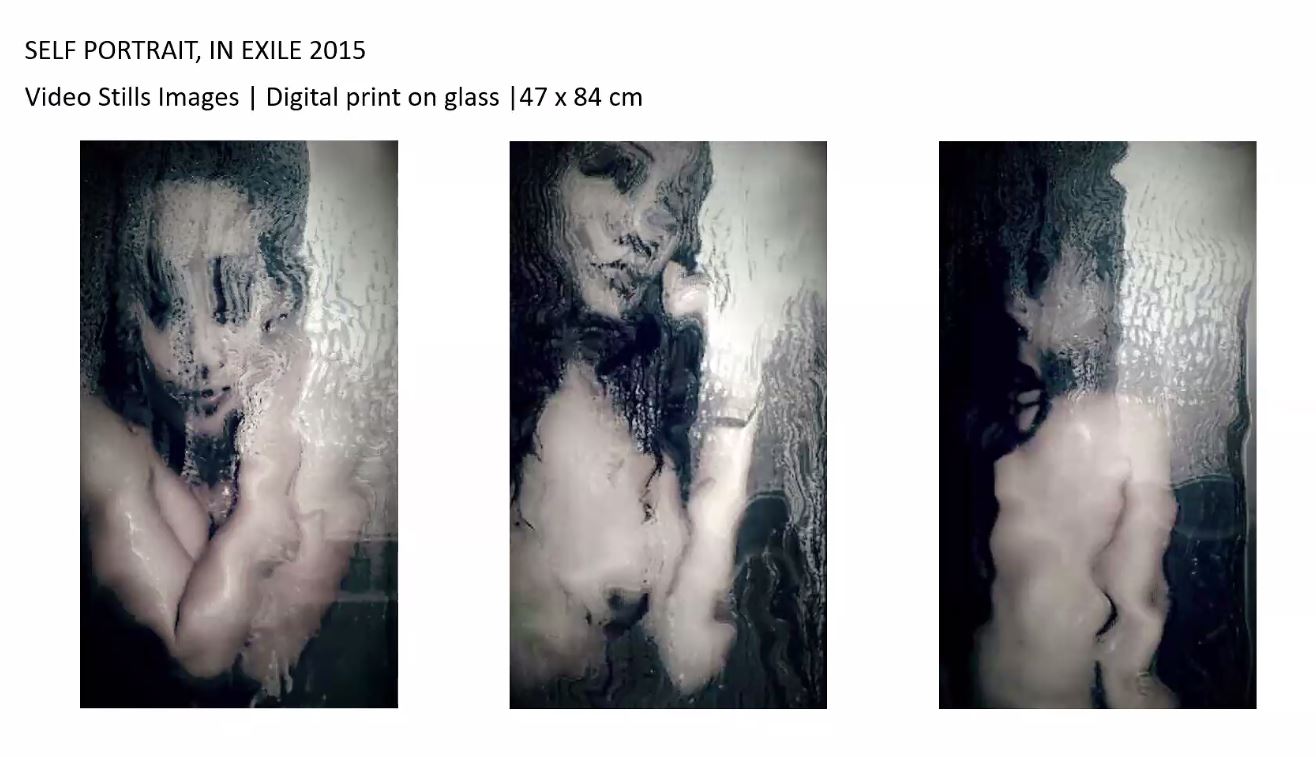
Bibliography
Access 03/09/2020
Exhibition: https://www.mav.org.au/the-colour-of-absence-by-miream-salameh/
The Photographers Gallery: Talk with Lindokuhle Sobekwa
3rd September 2020
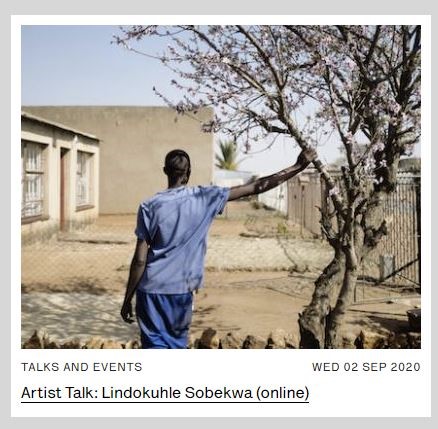
Sobekwa a South African photographer born in the township of Thokoza south of Johannesburg. His passion for photography started in high school where he would take images of his friends and himself. He gained access to the local townships and the trust of those living in them to produce a major piece of work called ‘Nyaope’ which has been divided into two chapters. The first (Chapter 1) a series of black and white images showing the young people who he got to know. He photographed all aspects of their lives and relationship including their dependency on a drug called Nyaope, which seems to be a combination of chemicals including rat poison which they mix and either smoke or inject. The images are dark and powerful and extremely emotional, they show the drug use and the effects.
Chapter 2 shows life after the drugs, where he has followed up on his original subjects to find out if they have revived. Some haven’t, others are going through rehab whilst others have stopped taking and are moving on with their lives. These images are more hopeful and the mood changes with the use of colour rather than black and white. The work consists of both images, text by himself and that of his subject. Images and text is presented in a notebook form and the subject is allowed to write over the image and detail their story, giving a very personal account as to the reasons behind the drug taking and why they have stopped.
His next project ‘Daleside’ was a collaboration with a French photographer Cyprien Clement-Delmas. In an interview I found with the Guardian News Paper (2019) Sobekwa says ’For me, when I’m with Clément-Delmas – my white, French, collaborator – it is easier to work there. But when I’m alone – when he goes back to France – it is a bit challenging for me. I have to constantly be careful how I approach people and their personal spaces’. Daleside was a location that his mother would work as a live-in help, a white dominated area which over the years has changed to be mixed race.
Relevance to my practice
The last project he discussed was obviously a very personal and emotional one – ‘I carry her photo with me’, covering the disappearance of his sister. The project retraced her steps, how she changed her identity, her space. In each image there are images or links to her. Through these images and his writings/text, he has been able to start to discuss this loss with his family, helping them heal and keep memories of her. This work/project links well with my Body of Work and Contextual studies as a form of photovoice which highlights the issues of drug abuse, poverty, racism, social issues, gangs and mental health. His image link words and images, black and white with colour in a powerful narrative.
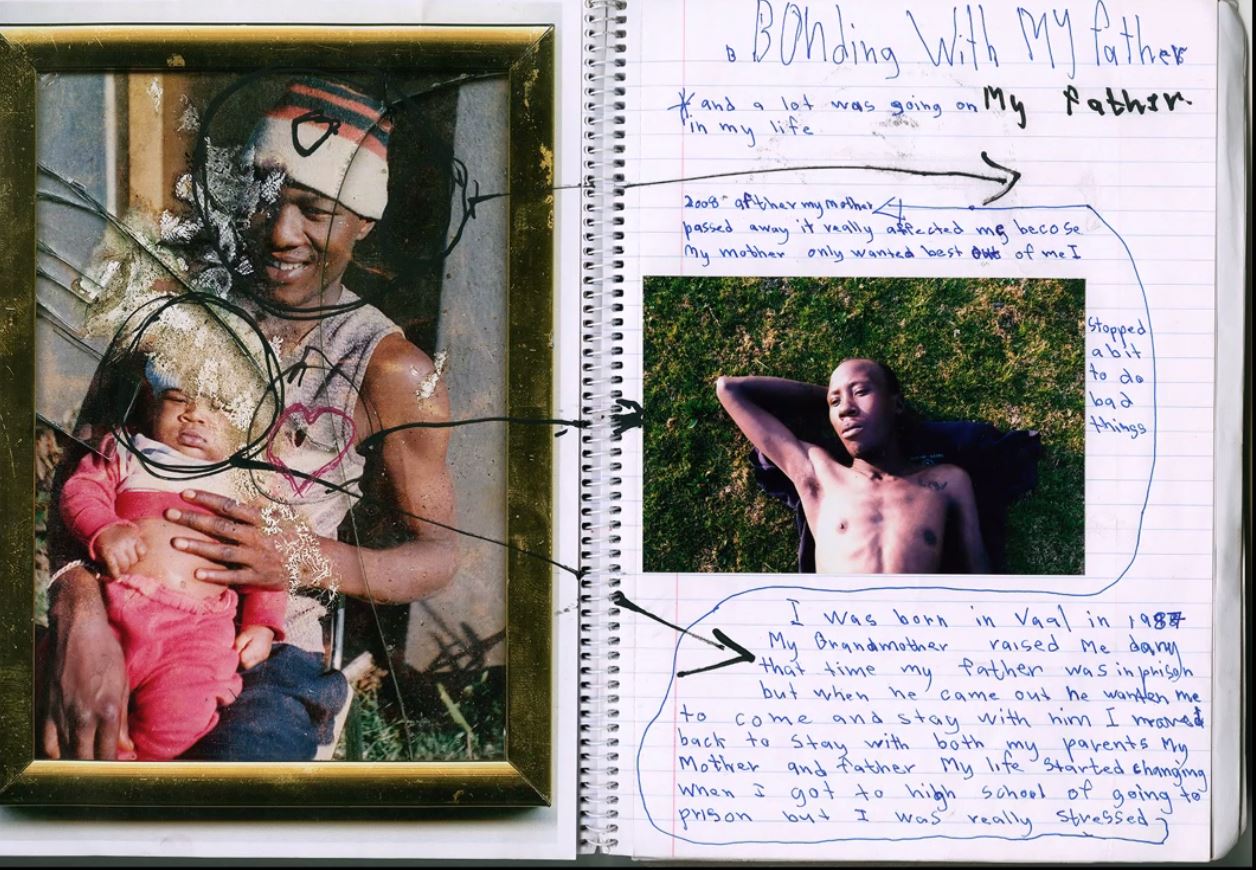
Bibliography
Access 03/09/2020
https://www.magnumphotos.com/photographer/lindokuhle-sobekwa/
https://aperture.org/blog/introducing-lindokuhle-sobekwa/
Link to talk: https://www.youtube.com/watch?time_continue=2&v=kF7N5xQcWlY&feature=emb_title
1854 Presents: Serena Brown
5th September 2020 (re-run due to technical issues)
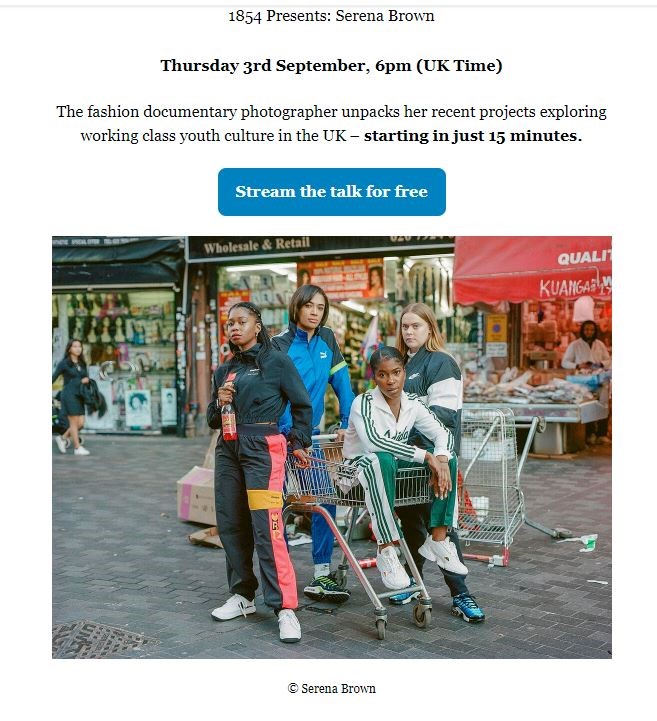
The second accept to view this presentation after a few major technical issues in the UK resulted in the rearrangement to the following night – the joys of Zoom and the internet.
Brown is a London based photographer after gaining her degree in Cornwall. Her work sits between fashion and documentary. The discussion was based around two projects – ‘Back a yard’ and Class of Covid-19’, both addressing the issues that affect the working-class youth of the UK.
Brown went full time as a freelance photographer in February – just before the lockdown in the UK and the rest of the world, but this gave her time to address personal projects. The first ‘Class of Covid-19’ was based around her sister who was about to sit her A Levels which were cancelled and the effect that would have on the whole of the UK. She detailed how she used social media, her sister’s friends, and community groups to find other 16-year olds to interview and photograph that were going through that situation. Using her allotted one-hour exercise she photographed her subjects at the doorstep. This project continued through to when they received their results and later when they get out and about to shoot on the streets.
The second project ‘Back a yard’ was based around the image of working class and the iconic fashion item the ‘tracksuit’. This was a collaboration with a friend who designed and made the tracksuits but as she explains in an interview with Fused magazine ‘attempt to highlight the influence that the working class youth in London hold over the fashion industry, reclaiming a look that they are often negatively defined by. Back a Yard is as much about the authenticity and character of the subjects and their culture as it is about the fashion industry, it demonstrates the re-appropriation of streetwear by the people that influence the culture the most,” she says. “By creating and designing high fashion tracksuits and using a young and diverse group of subjects from London to model them, it displays the influence youth and particularly people of colour have on the fashion industry despite the fact it often goes unrecognised.’
Relevance to my practice
She has produced an interesting set of images with I think a strong narrative. The images show everyday life in a straightforward, no frills way. The subjects are relaxed and engaged which I find hard to achieve, but as she says ‘keep taking photos’.
Bibliography
Access 05/09/2020
Link to talk: https://access.bjpsubs.com/1854-presents-serena-brown-live/?submissionGuid=a94a0ac3-26b1-4c59-bc3e-70a90d485efe
https://www.serenabrown.co.uk/
https://www.creativereview.co.uk/serena-brown-photography/
https://www.fusedmagazine.co.uk/the-social-documentary-fashion-photography-of-serena-brown/
MACK Book Live: Ron Jude
4th September 2020
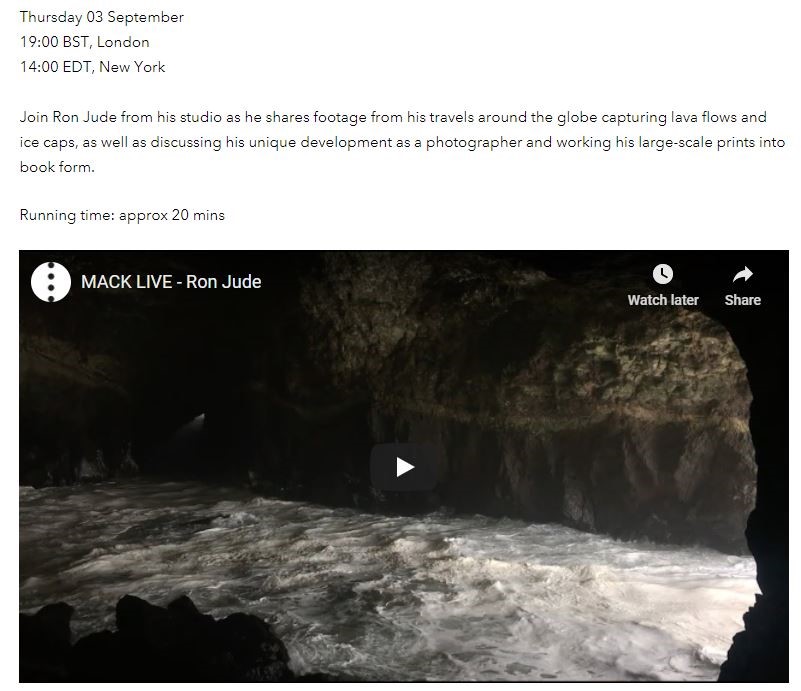
This talk was by Jude was based around his work for the exhibition and then the book 12Hz. Jude explained that when he starts a project he doesn’t research or plan – which goes against everything I been taught so far on this course!
He explained that in 2015 he moved from New York to a rural location in the west of the US, his father died and then the whole political situation with the new president really affected his mental health. He felt that he had come to a crossroads in his career and his work and he needed to find a focus and reassess his direction. When he undertook a project, it was always with a book in mind and so for this work (12Hz) he decided to not work in that way, but to produce for an exhibition, to work large, to produce images that were individual, self-contained narrative, size would be important.
He developed an idea of landscapes and geological forms and forces, tidal currents, lava flows, coastal erosion etc. An exhibition was conducted in 2018 on work that ranged up to 42”x56”. Work that would not fit into a book, however people started to ask for the work to available as a book. As the originals depended on size he needed to rework and expand his range of images for the series to work as a book. This he explained was not an easy process and after a number of false starts the book was eventually produced.
It was interesting to hear the level of control he had over the whole process, from image selection through to the printing and binding. Such a labour of love.
Bibliography
Access 04/09/2020
Link to talk: https://mackbooks.co.uk/pages/live
VII Photo Agency: Editing a Documentary during the Pandemic – Working with an Editor via Zoom
4th September 2020
There were a number of reasons for me to watch these not the least of which was the fact that I need to start to think about editing for Assignment 3 of my Body of Work. I really need to stop adding new themes to work to and focus and submit.
I knew that this was going to be focused around film production however what is film if not a series of still images just linked together. I want to understand some of the processes they used and to see If I could apply them to my next assignment.
The discussion was between Sarah Terry, documentary film maker and her editor Victoria Chalk and the challenges they experienced during the start of the pandemic in the US and how they over came them.
Chalk stated how as a documentary editor she is more of a script writer for the documentary, how she needs to listen to the film maker/producer (or photographer) and produce their vision. She made no excuses for the fact that in some cases her own vision comes through in the final result but this should not overrule the producer/photographer.
Some key points raise:
- Start with a story board (copy of an example used during the session is pictured below), these should detail the emotions, themes, characters etc that are to be light lighted in the final result;
- Need to keep in constant conversation, working together keeps the ideas flowing
- The editor needs to ensure the photographer is heard, they need to listen and respect you and your ideas, making sure your project shines not theirs
- Communication is king, be open and honest if its not working;
- Be prepared to change and let ideas evolve
- Prepare for and gain feedback
- Review and refocus
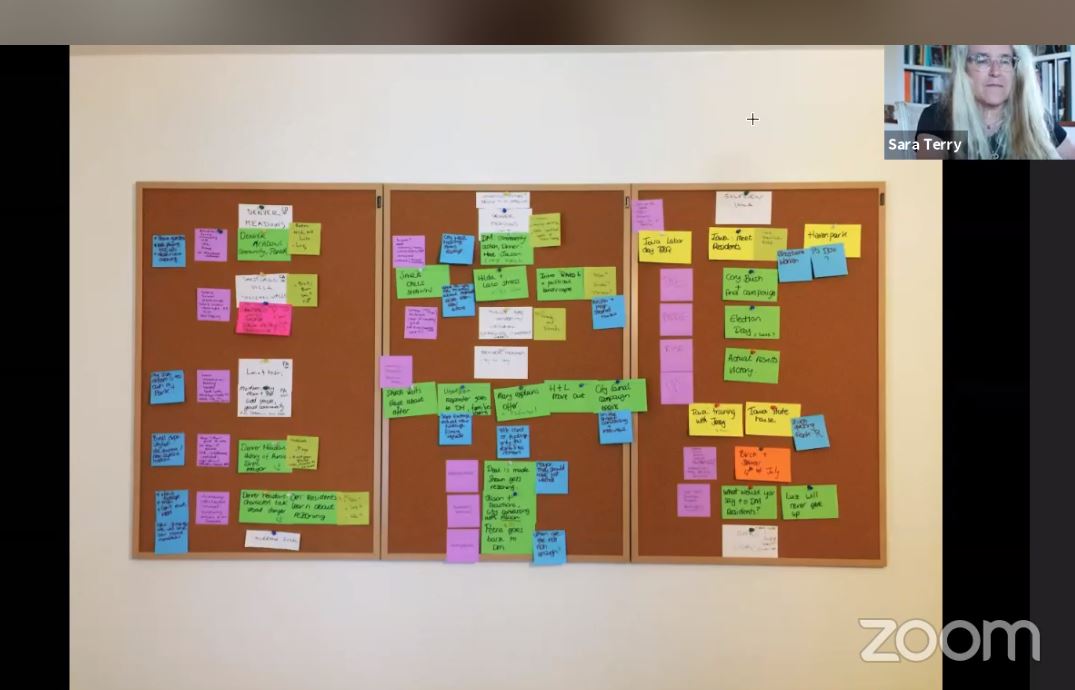
Storyboard from the Zoom session
There were a number of ideas that I can develop and work with from the above list as I move towards assignment 3 and my final submission. The reviewing and gaining feedback from others is probably going to be one of the hardest for me.
Bibliography
Access 04/09/2020
Link to talk: https://www.facebook.com/VIIPhoto/videos/651288002457377
New Zealand Portrait Gallery. Shed 11: Marti Friedlander: Portraits of the Artists
9th September 2020
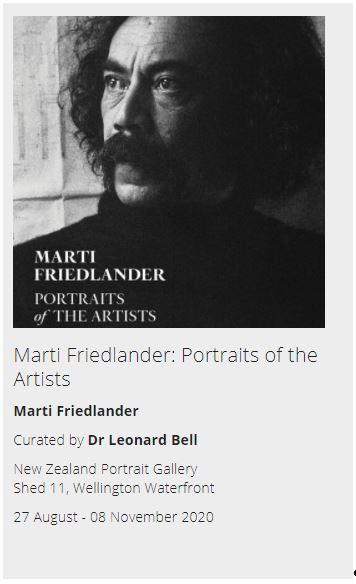
I managed to grab an hour whilst in town to visit this live. The gallery full of the most amazing black and white (and a few colour) prints. Friedlander (1928-2016) is probably one of the most well-known portrait photographers within New Zealand. Her work depicts both the social and culture aspects of New Zealand life.
Relevance to my practice
This image needed more than the hour that I had and I will return for a second viewing. The images are of both well known and ‘forgotten’ artists, writers, and actors from the 1960’s to the end of her career. She has captured them all with natural light and in their environment, their comfort zone, such as studios, theatres or at their desks. This is how I’m trying to portray my subjects of Ngawi and so I think this is really relevant to my Body of Work.


1854 Presents: 3 winners of the Portrait of Britain 2020
11th September 2020
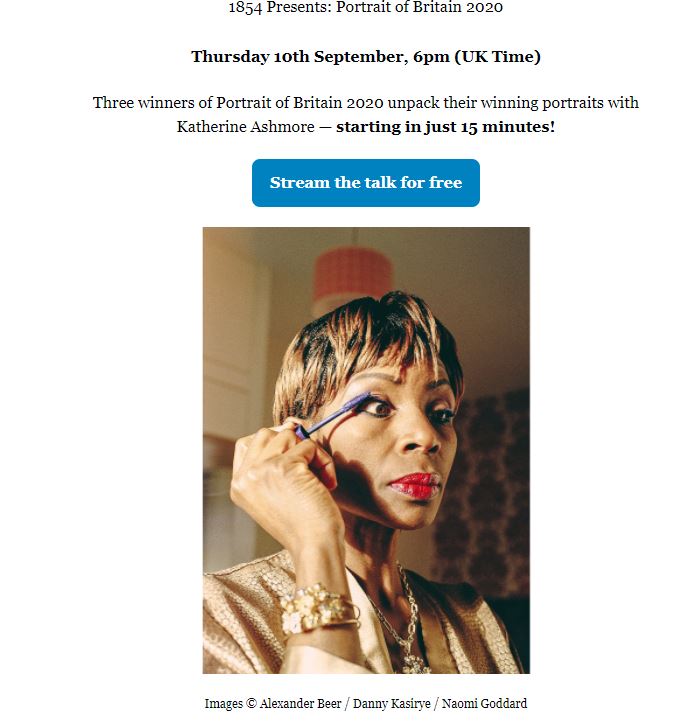
In todays presentation we are introduced to three of the winners of this year’s ‘Portrait of Britain 2020’ winners. This is just a very small selection. Images have been posted around London and across the country by JCDecaux who sponsored the competition.
Alexander Beer presented an image of a group of female Muslim fighters. The image shows a strong aspect of love of the sport, each other as a group and life in general. He spent several weeks with the group before he produced this and it wasn’t part of his original set, but it just captures the spirit of the country.
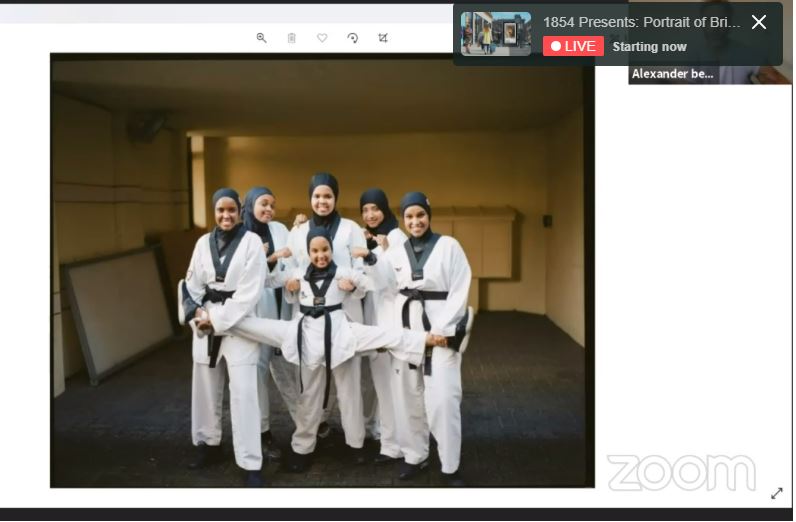
Danny Kasirye was next, his images are based across fashion and documentary. His work was an image of his best friend’s mother whilst she got ready for church. She is a Nigerian who’s husband is back in Nigeria. She always dresses in her best which highlights her way of living – ‘dress you best and you feel good on the inside’. His aim was to show diversity and use an older subject to the beauty and strength that is there throughout life. In a similar way to my Body of Work project. I really like the light on her face as she applies that final touch to her make-up.
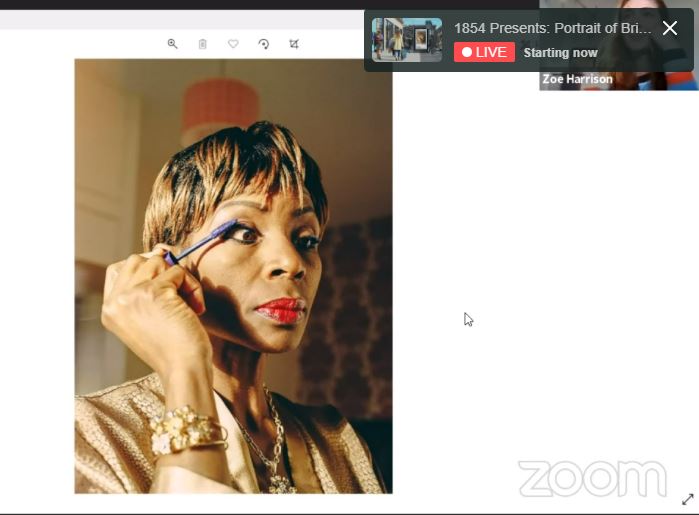
Naomi Godard was last with her image. Her subject not only danced, but sang and was also an artist. This image is about the hidden story, the viewer would never know what the subject had lived through to get to this point of her life. You wouldn’t know that she had this invisible illness and had needed a blood transfusion. For me the image shows that you should never judge a book by its cover, until you’ve walked that mile in someone’s shoe you will never know what they are going through. The image shows strength, determination, and resilience of the human spirit.
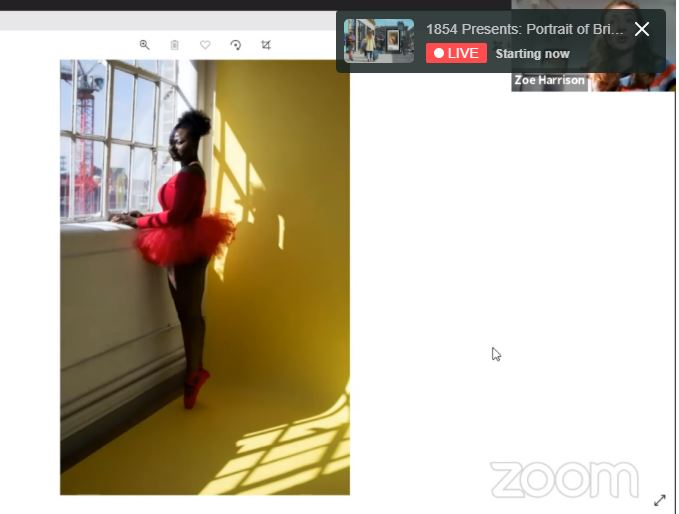
Bibliography
Access 11/09/2020
Link to talk: https://www.facebook.com/BJPhoto/videos/754751805425151/
MACK Live: ‘Portraits and Dreams’ Wendy Ewald
11th September 2020
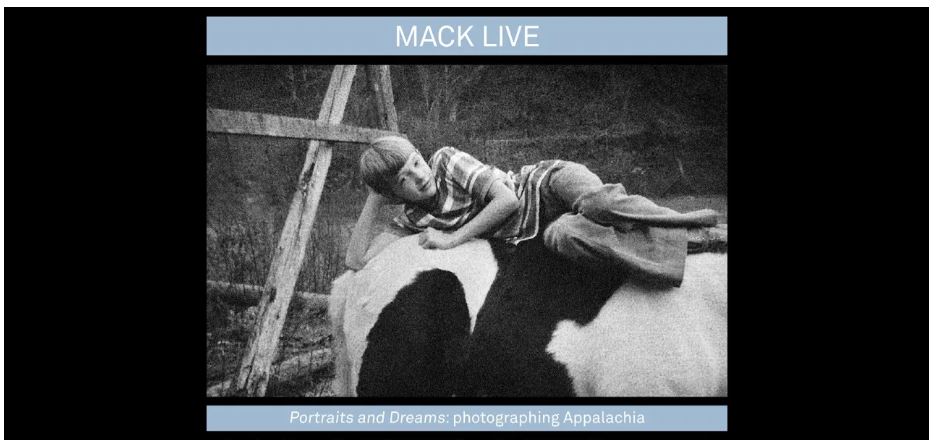
The discussion was based around the republication of Ewald’s book ‘Portrait and Dreams’. An example for me of photovoice in action, which links with my Contextual Studies and Body of Work project (the latter in a very loose way).
After gaining her degree Ewald soon realised that the big city was not for her and headed out of town to teach at a small rural community ‘Appalachia’. Here she gave the children cameras to document their lives, to show what was important to them, to capture the moments. The book was originally printed in London, but the quality was very poor and Ewald was disappointed as the publisher was used to printing photobooks. Not other agencies had turned her down because the images were made by children and they didn’t understand the concept.
She has been trying to republish for several years and then an opportunity arose to make a film of her work and as part of the deal they would reprint and revisit her original work and try and find some of the students. This second book includes the feelings of these students – eight in total, additional work, interviews and work they have continued to produce over the years.
Kim Boling and Gary Crase were two of the original students. They explained their first introduction to photography through Ewald, how she offered a safe environment. They didn’t realise how important their images would be. Looking back on the images as adults they saw their lives in completely different ways, it opened their eyes to understand their situation, what their parents were going through and how it was affecting other students.
Relevance to my practice
The work raises the argument – do you have to be part of the place to know it and to be able to capture the real place? This project ahs been a labour of love and taken over a decade and I think this shows in the images. She was able to provide the right environment for the children to feel relaxed, safe and comfortable to share their thoughts and emotions thorough these images. The most important thing was for them to feel empowered and not for the viewer to feel sorry for them. A vital aspect of photovoice and its methodology.
Bibliography
Access 11/09/2020
Link to talk: https://mackbooks.co.uk/pages/live
https://www.youtube.com/watch?v=fFG8tjWOtSQ&feature=emb_logo
VII Photo Agency: Aftermath Project Lecture with Glenna Gordon
11th September 2020
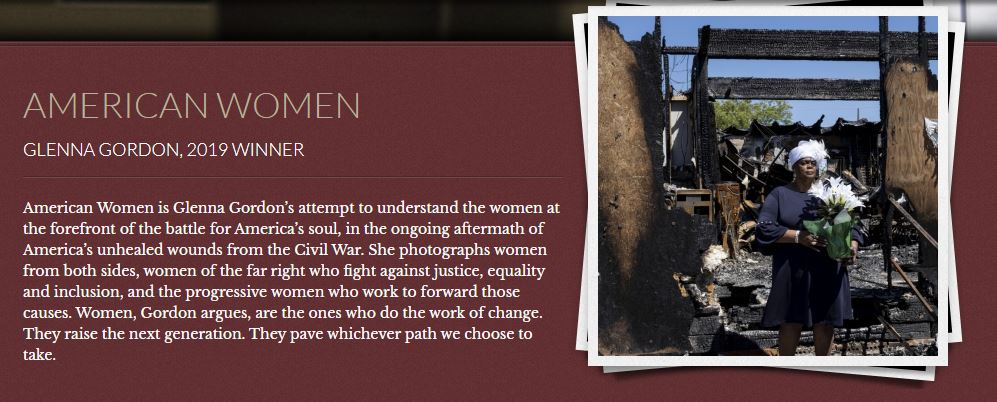
This is the second in the series of talks with past grant winners by Sara Terry. In this one she talks to Glenna Gordon, who began her career in Africa following her concern of the representation of the country and its people in western media. Her project ‘American Women’ was based around understanding the drivers behind why women became involved in the ‘far right’ political movement. She documented the landscape, who was involved, why, and the consequences, trying to understand the drivers.
Her initial attempts to gain access to one of their conferences resulted in her being removed, but that didn’t seem to deter her, she tried other avenues to gain access and a year later succeeded. By working with a local pollical figure she obtained a very different experience from the year before and managed to photograph first hand the scenes of the far-right movement. She has been highly criticised for giving them a platform, but as she says ‘we can’t understand them if we don’t document them, and what they stand for’. It’s a fine balance between the need to visualise, confront these people and their beliefs and to not idolise them. People need to understand the consequences of these groups, by hiding them away they just get more powerful.
Relevance to my practice
Her aim is not to judge, her images show the facts, the evidence in a simple and straight forward way. The project and the book show pairings of images, showing the opposite sides of the US ‘a shared landscape’ but not a shared belief.
Its important to know a person’s history as well as now, where did they come from. In a similar way that is what I’m trying to achieve with my Body of Work project. Small isolated communities with New Zealand are being forgotten and I hope through my images I can capture and document local life and how they cope. Its important to document our history.
Bibliography
Access 11/09/2020
Link to talk: https://www.facebook.com/VIIPhoto/videos/319487192668033
http://glennagordon.com/?fbclid=IwAR1_2QG6ZUnmtHydmp14cStyJV5Vc0pOtn3aPCzKdiGNzwGEuBf9ZkzUrvM
Head-on Photo Festival (replay): Julia Coddington & Rebecca Wiltshire
17th September 2020
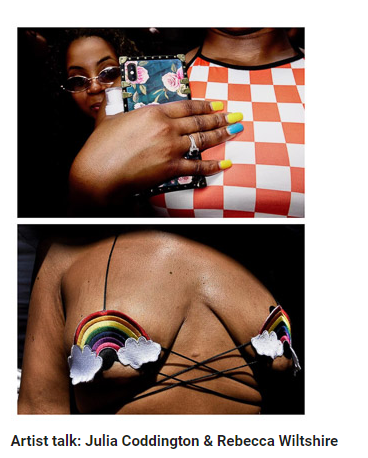
‘Women in Street’ is a global community of female street photographers which started in Minnesota US by Casey Meshbesher, whilst the ‘Unexposed Collective’ are a group of mainly Australian women, non-binary, inter sex street photographers that was started by Coddington and Wiltshire. Both organisations promote the work of female street photographers through photo walks, exhibitions and on-line events which give a safe and on-line forum for women to show their work that’s supportive and non-judgemental. Other on-line forums include Double X on Flickr.
The talk covered a series of diptychs ‘Double Trouble’ – not necessarily from the same photographer. They highlighted their on-line and final editing process which helpfully they explained was by printing and moving the images by hand to pair them. They tried Lightroom but due to the number it just became impossible. Starting with over a thousand images which had been submitted by 380 artists to Facebook, Instagram and email to ended up with 60 diptychs from 120 artists.
The use of diptychs offered an alternative to just the single image, hope to provide a move complex and in-depth narrative with each image offering a connection to the next to give a flow through the video and the exhibition.
The following are a few examples taken from the presentation:


Links to the two organisations [accessed 17/09/20]
https://www.unexposedcollective.com/
Mack Live: Alan Huck: A Visual Mixtape
18th September 2020
Huck’s latest book ‘I walk toward the sun which is always going down’ was presented in a fifteen-minute video that details the book which is a combination of both images and text from an unnamed narrator that walks around a city in the southwest of America. The book details their findings and thoughts which are the starting points for a whole range of other subjects. There’s a combination of imagery and text, some of which cites work by W G Sebald and Annie Dillard, neither of which I had experience of. The project has been described as a ‘metafiction’, an exploration of a person’s first experiences of a location. I’m not sure I get that impression but I like the use of both text and images in this context. I don’t think that it would work for my Body of Work project. The film covering the work gave a very dark mood to the project and for me I needed to research the book more to obtain its meaning.
Bibliography
Access 18/09/2020
Link to Talk: https://www.youtube.com/watch?v=tSHc5alL6Gg&feature=emb_logo
https://cphmag.com/images-and-text/
Photoville: The Seed of an idea with Lynn Johnson & Elizabeth Krist
18th September 2020
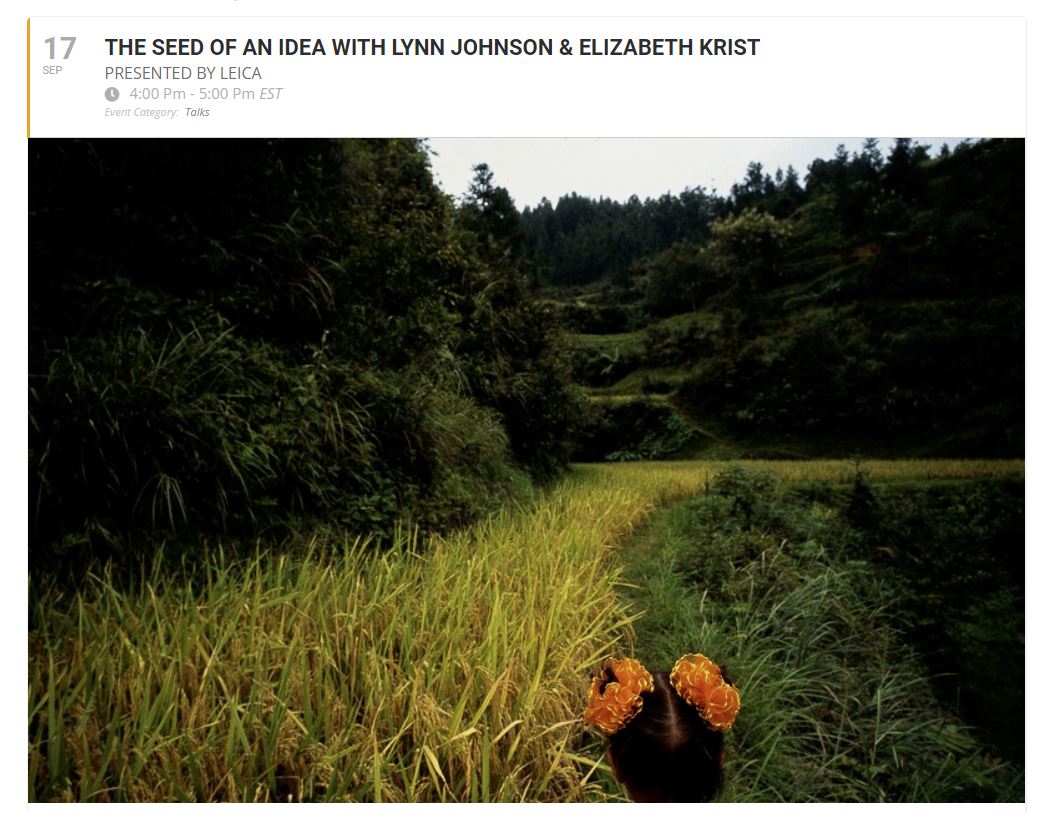
This talk was between Elizabeth Krist, a National Geographic photo editor and founder of the Visual Thinking Collective and Lynn Johnson a photographer who has contributed to the publication for many years during her career. Her work centers around the human condition, of finding beauty in very difficult situations, such as death.
The first project they both worked on together covered the aftermath of landmines. Lynn had previously been working on a project of weapons of mass destruction and so it seemed a natural lead to cover this project for the National Geographic. As she said, its these projects that change your life, they affect you in so many ways. The publication offers resources that cover the majority of the pre-research to the project, but both highlighted the fact that it wasn’t until you got to the location that the real research started and this often led to other avenues in the story. I have found this to be the case with my own Body of Work, my original project has changed so much from my initial thoughts and understandings. I have the advantage of not working under the same conditions or restraints as a commercial photographer who as Johnson says has both time and cost limitations. My own limitation is one of time and hitting the submission dates.
Both presenters highlighted the importance of negotiating and working closing with the editor to ensure the story is told correctly. The editor is responsible for ensuring the photographer has the correct brief and information prior to arriving at the location, this ensures that they hit the ground running as time is money. They have to work closely together; they need to be able to communicate on a number of levels.
The discussion progressed onto two other projects: ‘Crossing over: How science is redefining life and death’ and ‘Cannabis Kids’. Both very powerful and thought-provoking projects. The short extract from a longer six minute video of her best friends mother’s death was very moving and still seemed to effect Johnson.
Bibliography
Access 18/09/2020
www.visualthinkingcollective.com
Looking Death in the Face: https://www.nationalgeographic.com/photography/proof/2016/03/29/looking-death-in-the-face-and-finding-a-blurry-line/#close
Kathryn Carlon Films: https://www.kathryncarlsonfilms.com/death
Photoville Exhibition – Curated by: Elizabeth Krist: A Mother’s Eye – https://photoville.nyc/mothers-eye/
Photoville: ‘Behind the reporting: Pablo Albarenga and Ana-Maria Arevalo
20th September 2020
The discussion was presented by the Pulitzer Center on Crisis Reporting and started with brief introductions and details around each of their projects which addressed different issues in South America.
Albarenga is a documentary photographer who has dedicated a large part of his career to the investigation and documentation of the issues within Latin America. His project ‘Seeds of Resistance’ shows the effect of colonization within one of the largest rain forests on the planet, the resulting loss of land and the communities threatened by the removal of their natural resources.
Relevance to my practice
The images, a series of diptychs which show the subject within their natural environment against the effect of western influence. For me they show in the most graphical form the effect of large global organisations on the planet as they stripe for palm oil plantations, wood, coal etc. The deforestation is having a major impact on the climate and the local tribes. This is their territory, their culture and history. The loss of land is also causing an increase in crime, drug abuse and violence.
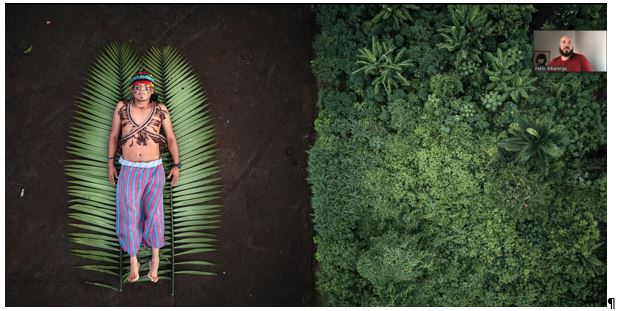
The above image taken during the presentation, is a simple but powerful representation of deforestation. The subject lies on the resource that is most important to him. These plants are used extensively in their everyday lives, for shelter, cooking. The removal of the rainforest means the loss of these resources.
Albarenga believes that he has a huge responsibility to represent the truth and remove the stereotypical representation of these people. For him the relationship between subject and photographer is more important than the image and in a strange way I feel the same as I have got to know each of the ladies within my Body of Work project. Like Albarenga, I think it’s important to stop, listen and build relationships with your subjects. This will make for a stronger story. I have found that I get better results when I leave my camera in the bag to start with, explain my project and to listen to their story. An approach echoed by Albarenga. He managed to live with the local community, to form bonds and to gain trust.
The second photographer in this presentation was Ana-Maria Arevalo, a Venezuelan photographer who’s aim is to focus on women’s rights. In her project that started in 2017 ‘Dias Eternos’ addressed the conditions of women in preventive detention centers and prisons in Venezuela. She worked with an NGO to document the conditions, some of which consisted of just five rooms to detain over 500 women. The women are often raped and end up pregnant whilst in detention. Despite these conditions she found that there was a strong feeling of community and support between the detainees. The system favoured the rich, those that could pay for better conditions and food.
She started with interviews in a similar way to the approach I take, gaining trust before taking the camera out. For both of us it is important to form those relationships to get the best story. Her images are raw and show these women in their most vulnerable state. My project how’s to show the strength in my subjects and not their vulnerability.
Museum of Contemporary Art North Miami ‘Havana, Haiti: Two Cultures, One Community’
24th September 2020
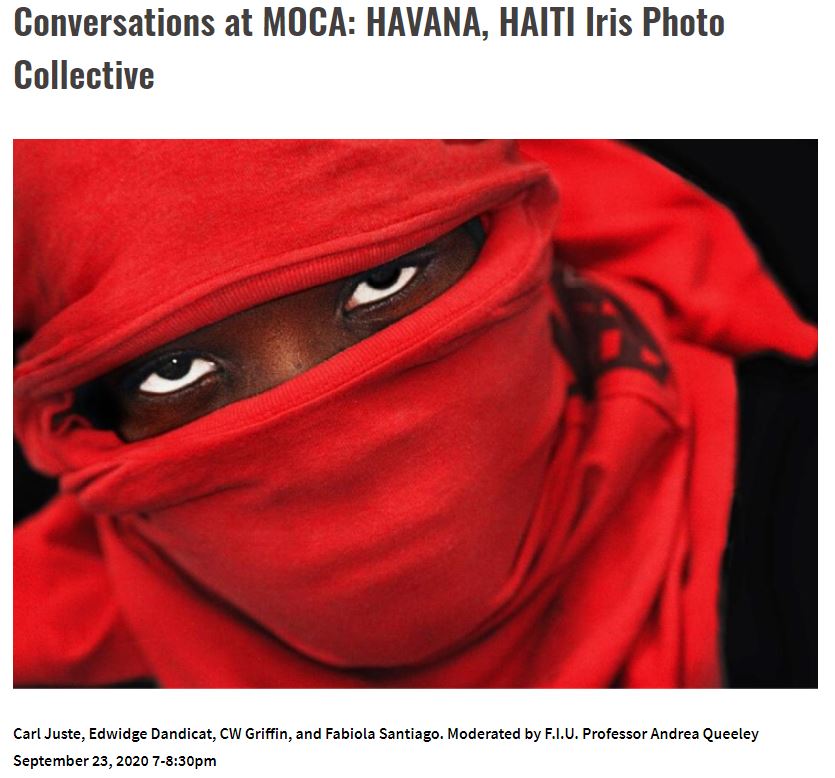
The third part in the series. A panel discussion covering the exhibition and book of the collaborative project ‘Havana, Haiti: Two Cultures, One Community’. This project started back in 2007 with the book finally being printed sometime in 2021. The work is based around the crossovers between the two cultures especially as a large number now reside in the Florida area of the US. Here they have created their own communities. The cultures have been known to clash and are unable to live harmoniously.
The work consists of both images and text from dozens of photographers and writers spanning 14 different themes, including ‘religion, labor, love, hope, joy and hunger’, which try to identify the bridges between the cultures. The panel discussed the collective ties based around the common traumas, the meaning of family and common information. They highlighted how the two communities were treated differently when they tried to enter the country, exposed early to the aspects of racism within the US.
Relevance to my practice
The panel was heavily discussion based and I would have like to have seen more of the images from the exhibition and discussion around those as they paired the images together and then sent them to the collaborators who were providing the text. This part was very much left to the writers to form their own response based on the two images, one from Havana and one from Haiti. Without context I would image it would be extremely difficult not to have a biased option, something that they aimed to remove through the whole project.
Bibliography
Access 24/09/2020
https://irisphotocollective.com/projects/
Head-on Photo Festival (re-play) Artist talk: Bob Newman
24th September 2020
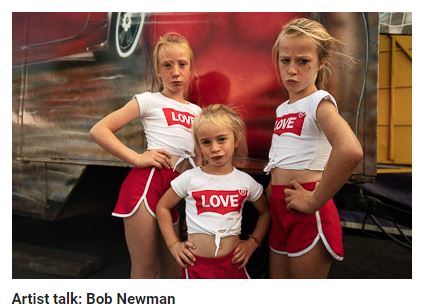
Newman didn’t really start photographing on a regular basis until he retired as a physician in the US. This was a pre-recorded presentation until the end when there was a Q&A session. The talk and images were based around the travellers community of Ireland. This community of more than 40,000 spread over Ireland the UK are marginalized from so called normal society. They are unable to attend school, gain medical treatment or employment. 10% of children die before the age of two and the rate of suicide is high.
These families have been forced to give up their nomadic life and live in makeshift housing at the road sides, often without power or standard facilities. Newman completed several trips to gain their trust before he started to photograph and this shows in his images. They show how the community is resilient and pulls together and supports each other against the discrimination and racism.
Bibliography
Access 24/09/2020
https://www.all-about-photo.com/photographers/photographer/994/bob-newman
VII Interactive. Imagine: Reflections on Peace – Nicole Tung in conversation with Ron Haviv
25th September 2020
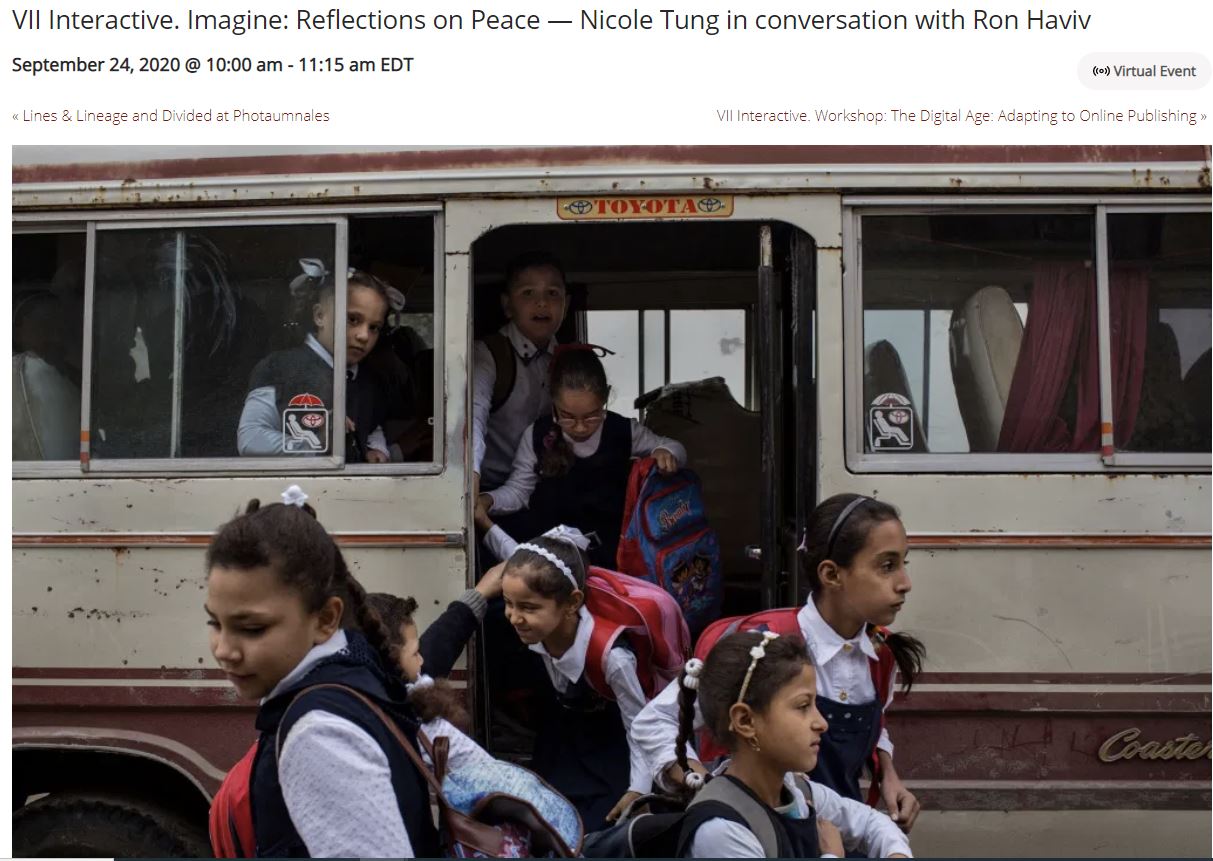
This discussion asks the question – ‘what happens at the end of war? When the final bullet is released and the photographers leave? What is the true definition of peace? Is it when there are no more bullets?
Over the last 20 years the VII Agency has obtained funding to send photographer to post war zones to document the after effects. This was originally US, European photographers but now they rely on local photographers, this they found gained a better understanding, they were able to report on the true situation.
Tung covers the Arab states both during and after conflict. Her images show the full impact of conflict but also how people start to rebuild, and move on with their lives. She states that it is important to capture every aspect, using local contacts to show the full story. She says it is important to keep the effects of war in the pupil eye, these things don’t go away just because the US army has moved to the next conflict – they never cover the clean up, the mental health issues, the rebuild of peoples lives and infrastructure. In a similar way to the issues within New Zealand, there is this image of 100% pure but in fact the country has its own internal wars with mental health, farming and pollution.
Relevance to my practice
As people become immune to the images of war – how do you find away to have a visual impact? It takes time to build up a story and to show all the aspects of the subject, to look behind the initial scene and find the human connection, show how this is important to the general public. In a similar way as to my efforts with the people of Ngawi for my Body of Work, it has taken me months to gain access and their trust. Its important the story I present portrays the right context, to not shoot and go. To stop and communicate, take my time and to listen.
Bibliography
Access 25/09/2020
https://www.facebook.com/VIIPhoto/videos/343463080330349
https://www.annenbergphotospace.org/person/nicole-tung/
https://www.iwm.org.uk/history/photojournalist-nicole-tung-on-covering-conflict
Royal Photographic Society: In discussion with Paul Hill MBE
29th September 2020
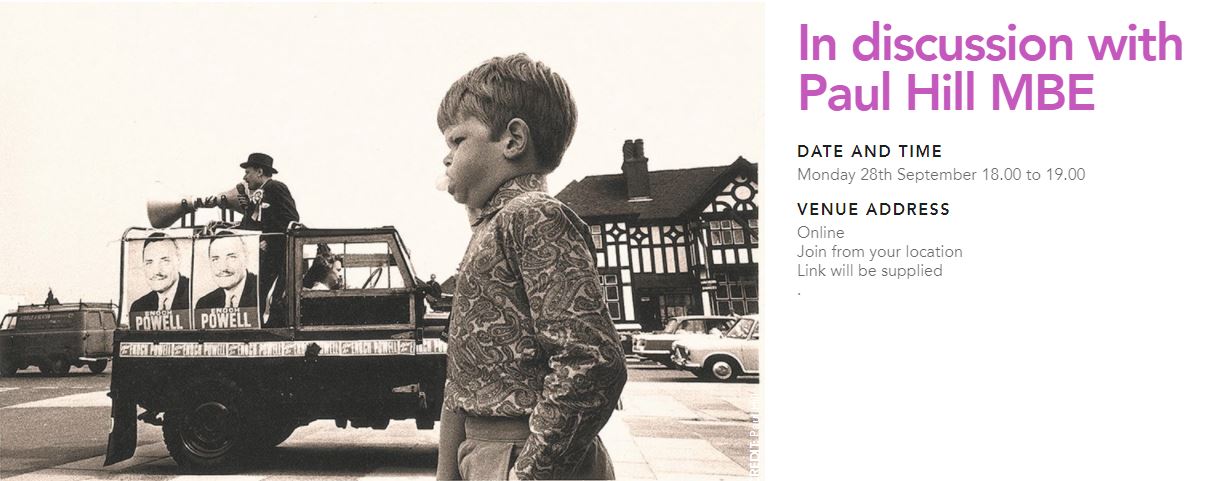
Hill started as a writer and in journalism with a strong interest in music. He picked up a camera to combine his love of music, story telling and images. He now uses multiple platforms to ‘transform the ordinary’, by showing emotions through his camera. Form is always an important aspect of his images with a need to consider content and dissemination.
He expressed the importance of light and the frame. The way the subject is framed will alter the whole meaning. He stressed how important it was to engage with the subject and to keep it simple. He spoke about a number of his projects but stated that he had produced only five books over a career of 50 years. He has moved from the traditional B&W documentary image to colour and now to the iPhone. His work on the Peak District was the project that inspired me to start my Cray Fish project (see Body of Work).
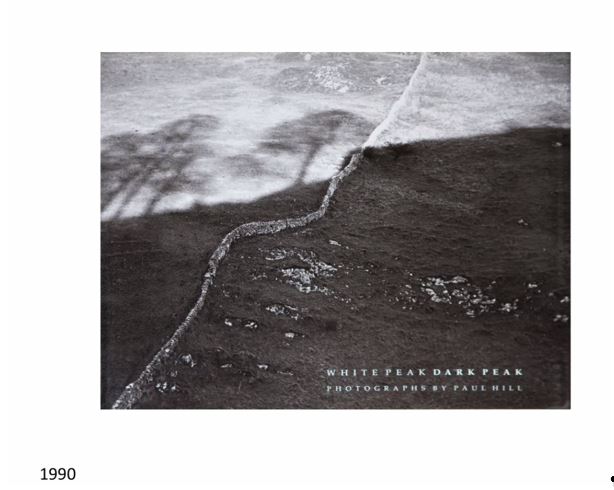
Bibliography
Access 29/09/2020
http://www.hillonphotography.co.uk/index.php
Head-on Photo Festival (replay): Workshop: Improving your writing for creative industries with Carla Erdmann, Megan Bentley & Chris Round
29th September 2020
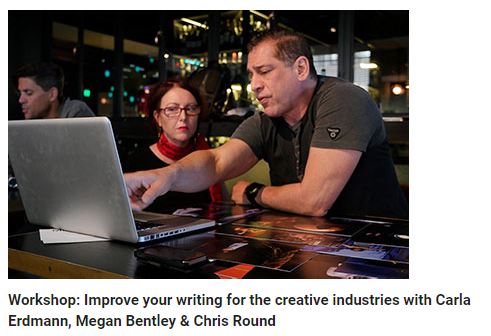
This workshop will be more useful for the next stage of my studies as the three panel members discussed the artist statement, personal Bio, engagement with magazine editors and exhibition publications.
Chris highlighted the need to keep things simple, leave out all the art speak and think about your audience. Keep things short, relevant and engaging. We are all unique, tell your story but keep it short.
Carla discussed working for a magazine and the importance of connecting words to images. As an editor she builds the bridge between the two. Translating the image to text to help tell the photographers story. The more information you can provide the easier her life is. The editor should work closely with you as the photographer to understand your project and the story behind it.
Megan as a writer highlight the importance of gaining the right pitch, presenting the information in the right format and the right location, but once again stressed the importance of being succinct.
Head-on Photo Festival (replay) Artist Talk: Paul Harman
1st October 2020
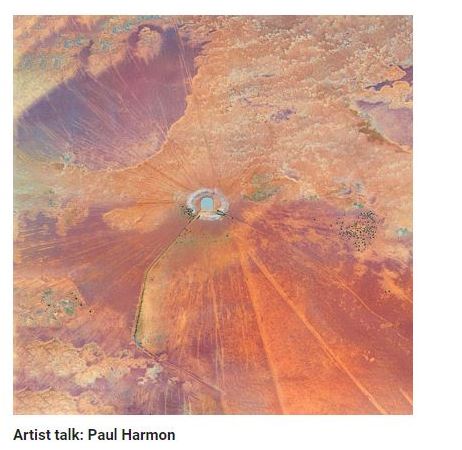
Harman describes himself as a politically engaged art photographer whose career has moved from film maker to journalist to documentary. Covering areas of advertising and then into fine art. This project ‘Watermarks’ started by him noticing the simple beauty from the air but it wasn’t until he got closer to the ground that he realised the complete devastation that had taken place through the over use of water by cities and agriculture.
These images are taken by drones and consist of over 150 images stitched together. All images are related by water, and start with a simple ‘google map’ search of areas. As Harman states there is beauty in the air but the ground holds the ugly truth. The project has progressed onto working with the first nations to highlight their loss of water rights.
They are amazing beautiful images. I was thinking of using a drone for my Body of Work as a form of experiment, but not sure it would be powerful enough to produce or hold 150 images.
Bibliography
Access 01/10/2020
https://www.ignant.com/2018/10/04/paul-harmon-on-the-ugly-truths-of-stolen-land-and-water/
https://www.theearthissue.com/artists/paul-harmon
http://internationalphotomag.com/paul-harmon-watermarks/
https://www.lensculture.com/paul-harmon
https://plainmagazine.com/paul-harmon-waterworks-drought/
Photo London Fair: Heather Agyepong on Black British artistry, mental health & navigating the art sector
6th October 2020
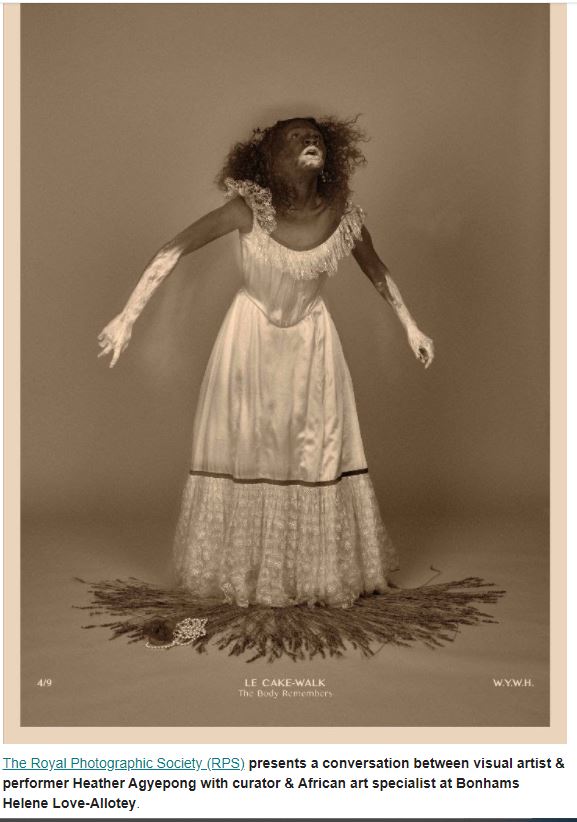
This talk was advertised as a ‘conversation will centre around their personal journeys within the art world navigating was women of colour. The conversation will also unpack Agyepong’s latest project ‘Wish You Were Here’ that focuses on the work of Aida Overton Walker, the celebrated African American vaudeville performer who challenged the rigid and problematic narratives of black performers. Agyepong embodies Overton Walker as a guide, ancestor and advocator. The series uses satirical commentary and depictions of radical self-worth in an attempt to disrupt the roadblocks affecting our collective mental health’. All of these elements would have been useful to course work but instead it was a very disappointing unprofessional chat about the pandemic and the poor state of the educational system in the UK and how it didn’t cater for the individual.
Photoville: Reflecting on Culture and identity: Photography talk with Deborah Anderson
11th October 2020
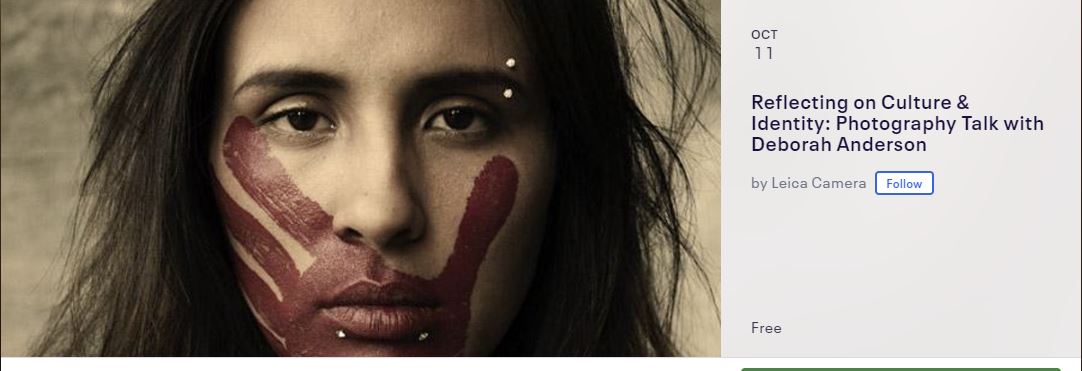
This talk was the last given by Leica for the Photoville festival of photography and covered the project by Deborah Anderson on the ‘Women of the White Buffalo’. Anderson started her career in the studio and has captured a number of very famous people in her sixteen year career but for this project she moved away from her natural environment of fixed studio work to use natural light and only a small crew of 4 – welcome to my world but there’s only me I thought.
Just like me she went with a number of preconceived ideas about the people, culture, location living conditions but came away very much changed. She undertook a large about of research looking at images from the turn of the century which were captured with the intent to document a culture and people that were dying out, but what she found was one that was still very much involved with its history, beliefs and culture and that it what she wanted to capture. She found a strength in the women there and wanted to give them a voice for the things they were facing – loss, addition, abuse, abduction and suicide.
Relevance to my practice
In a similar way to my Body of Work project I want to give the women of Ngawi a voice, true they don’t face the same issues as those of the women in the Lakota tribe but they are forgotten in a number of ways. As Anderson says ‘as an artist there is an opportunity to show the issues that wouldn’t normally be heard – to give a voice, to wake people up with the images you produce’
Bibliography
Access 11/10/2020
https://womenofthewhitebuffalo.com/home/
Royal Photographic Society Engagement Talk: John Bulmer
15th October 2020
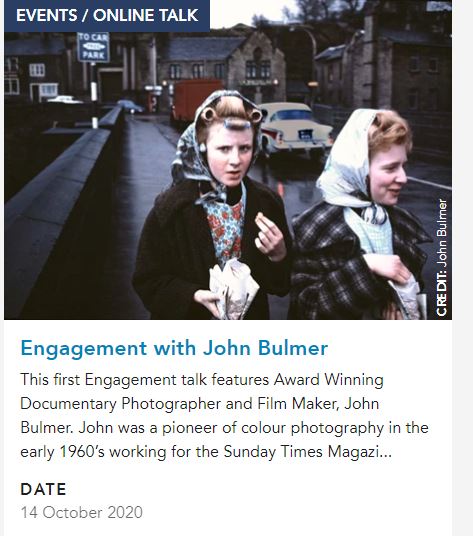
This is the first in a series of talks which will feature documentary photographers. Bulmer started more interested in the mechanic of the camera than taking photographs until he saw the book ‘Family of Man’ and was given a small Box Brownie. Whilst at university he signed up to join the campus news group as their photographer.
His work is mainly colour which he is known as one of the early pioneers for whilst working for the Sunday Times magazine in the 1960s and 70s. His work was also used in the new Town Magazine which included a large number of new and different stories from aboard as well as the UK.
The first Sunday colour supplement featured Bulmer’s work with David Bailey acknowledging his work and even sharing the front page on many occasions. He has since moved into documentary film making but has made sure that all his archive has been saved with TATE.
VII Interactive: The Aftermath Project lecture Series: Conversations with Grant Winners about Winning Work, with Jessica Hines and Sara Terry
16th October 2020
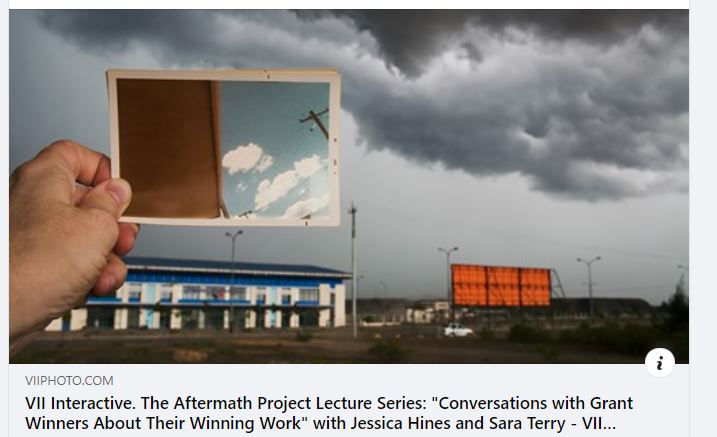
In this talk Hine talks about her 13 year project ‘My Brother’s War’. This project was a finalist but not a winner and I can’t understand why as it has such a powerful narrative. Hine lost her brother to suicide following his return from war. It has taken over 35 years for her to even start the project and then 13 to finish as she tries to remember information, piece together facts that she has found, research and investigation let alone a number of trips to the site of the war zone.
This was a very personal story, one that needed strength to face not only her family issues, lack of information but to keep reliving the events. All she had was an old box of stuff that had been given to her on her mother’s death. This box moved house with her several times before she even opened it. Its as much her story as her brothers. Her need to highlight to the world the issues that these young soldiers return with – PTSD. The project is made up of a number of chapters which maps his life and her journey to closure.
The work includes found images and those that she made herself, starting with 35mm film and then digital. She uses text and diary entries and letters he sent home – all extremely personal.
Social Documentary Network: Documentary Photography Reconstructed with Bayete Ross Smith, Michelle Bogre, Stephen Mayes
19th October 2020
I hadn’t discovered the Social Documentary Network before but this was a really interesting discussion. Mayes started by discussing the tight confined in documentary photography and how the format is more important than the content. He stated that now more than ever it is important to challenge the norm.
The floor was then handed over to Borge. I had heard her speak before and so I was prepared for the whistle stop tour through sections of her book ‘Documentary Reconsidered’. She states and for which on the whole I agree, that photography has the ability to document as well as distort and reshape the world it records. She recommended looking at the work by Pete Souza – a project undertaken on the White House –‘The way I see it’, which I will do.
She then moved on to the aspect of truth in documentary photography, an area of which I will be covering in my Contextual Studies extended essay. She highlighted that all images are fictional to a degree with some being reconstructed, a form of ‘new truth’, (Azadeh Akhlaghi). She discussed the fact that into day’s modern world of digital images the ‘meta data’ can easily be lost whilst it is transferred from place to place. This is vital information as without it there is no evidence of fact. These images are easily manipulated.
This is not a new thing – look at Dorothea Lange and W. Eugene Smith, the image was staged, framed and altered in post processing, although not as successfully as today’s modern digital image files.
Borge briefly covered the aspect of power imbalance between photographer and subject – another area for my extended essay. I have previously written notes on this in my Contextual Studies blog and will cover this within my final submission for my extended essay.
The second speaker was Bayete Ross Smith, a journalist who was not originally from an art background but works to show civil injustice and to show the truth. His aim is to look at and ensure that the story is told truthfully. Assessing what is included and what is not. Something that I will need to do when I start my editing process. He stated that its important to understand who is in control of the image and to question this as a viewer of images. This point has been raised by a number of writers I’m reading at the moment – Susie Linfield to name just one. His work highlights the difference between the national and international gaze using a combination of new technology and story telling with large projects of work entitled ‘Our kind of People’ and ‘Hyphen-Nation’.
Bibliography
Access 19/10/2020
Social Documentary Network: https://socialdocumentary.net/
Stephen Mayes: http://www.stephenmayes.co/
Bayete Ross Smith: http://www.bayeterosssmith.com/
Michele Borge: http://www.michellebogre.com/
Link to talk: https://www.youtube.com/watch?v=XoUkO3pisS4&t=26s
Head-on Photo Festival (replay) Artist Talk: Belinda Mason & Dixie Link Gordon
22nd October 2020
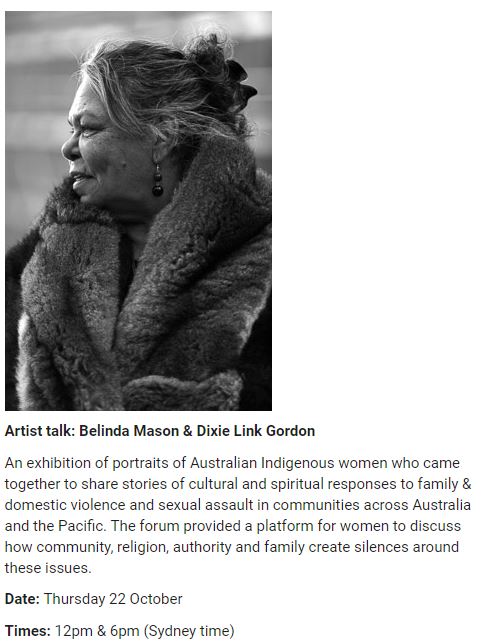
This presentation was based around the portraits produced by Mason working with the women’s justice advocate Link-Gordon. The project started back in 2016 when Mason presented her work to the United Nations. The work represents the five continents and over twenty countries, depicting the women who have coped with and are subject to violence in their homes.
In March 2020 Mason was asked to attend and photograph the women of a large delegation of indigenous women/first nation which was to address the issues of violence, sexual assault and religion. The aim of these images was to give a voice to the attendees. To help them take back the message to their own communities.
Relevance to my practice
The work includes the most powerful and simply lit black and white portraits of these women. Each was given a copy and asked following the conference to write their story. This for me is a powerful use of text with an image. Without their stories you wouldn’t think twice, they are beautiful images but they hide the scares. They need the text to complete the story and highlight the facts of what these women have to live with and hide on a daily basis.
Bibliography
Access 22/10/2020
Silent Tears project: https://silenttears.com.au/
Breaking Silent Codes: https://www.headon.com.au/exhibitions/breaking-silent-codes
Video: http://www.breakingsilentcodes.com.au/faq-2/
Website: http://www.breakingsilentcodes.com.au/
Photo Oxford Festival: Let Us Now Praise Famous Women: ‘Discovering the work of Female Photographers’
Bodleian Library Presentations
24th October 2020
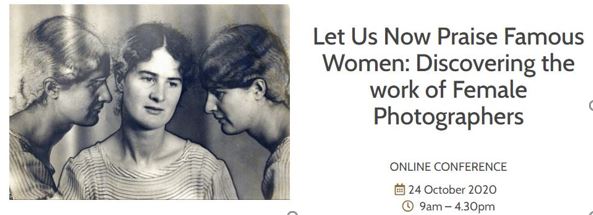
An all-night event for me with an amazing list of speakers. I have added a word document of all the information I gathered from the speakers here. For me there was a consistent finding that female photographers have been over looked throughout history or only gained any kind of recognition if associated with a male photographer.
The podcasts will be available to listen to again which I think will be valuable as the time difference made the later discussions difficult to follow aft er a long day working.
Royal Photographic Society talk: Little Poland: A Community in Devon Ken Holland
27th October 2020
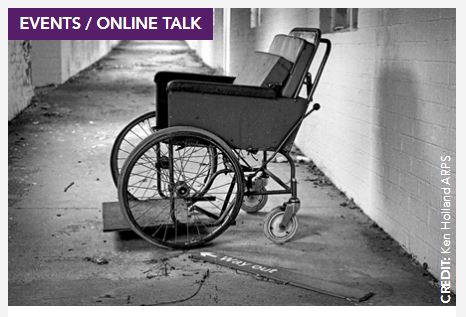
Holland says “My basic philosophies in photography are: an image should always say something to the viewer, technicalities are important, but not at the expense of meaning and emotion, photography should be exciting, challenging, questioning and a pleasure, and we should enjoy sharing our experience, expertise and love of photography with others“
This project was clearly a labour of love following the lost of a close friend who first introduced him to the old hospital site. It was previously used by the American’s during the war but was given to the Polish who moved to the UK following the end of WWII.
The conditions were obviously crapped, with whole families living in one room and up to ten families sharing a single bathroom and toilet facilities, but the families made do and reused and fixed everything.
The project of documenting the decay started in 1995 and has continued until it was pulled down and replaced. These amazing black and white images capture everything in all its state of decay and evidence of occupation. Holland ensured that he didn’t disturb anything, capturing the situation as is, returning multiple times but sadly finding vandals had started to add to the destruction.
Relevance to my practice
For me this shows the evidence of never thinking you have the story first time, to keep going back, exploring different angles, seeing things in a different light and researching your subject. I think I need to add more environmental images to my Body of Work project to link my subjects to the location. The use of black and white shows the decay, isolation and loss and I’m drawn back to this as a medium.
Belfast Photo Festival: The Age of the Female Gaze
5th November 2020
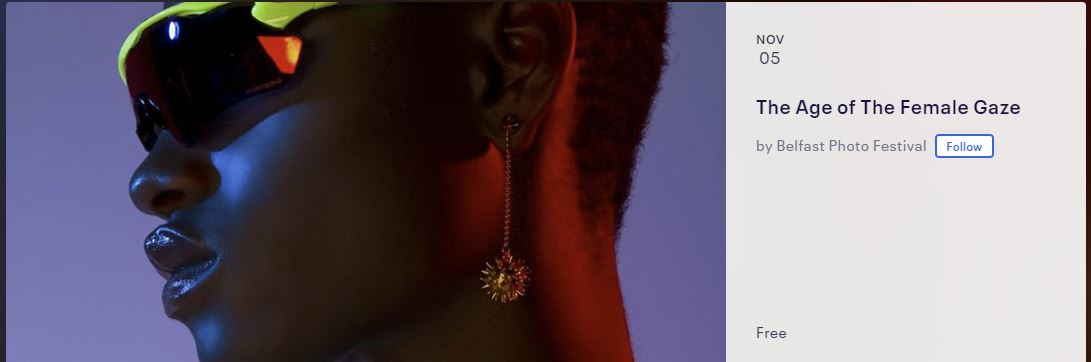
The panel:
Flossie Skelton — Journalist, British Journal of Photography
Nydia Blas – multidisciplinary visual artist
Holly McGlynn — award-winning fashion photographer (Levi’s, Chanel, Playboy, Tiffany) and teacher of fashion photography at Central Saint Martins
Giya Makondo-Wills – British-South African documentary photographer
This was the start of the Belfast Photo Festival lectures/panel discussions. A lot of good points were raised with each photographer showing examples of their current projects. What came across strongly to me have also been raised at other presentations, women form about 80% of the students in the classroom but only 15% in the commercial field, they are grossly under represented.
As the photographer you have the power to make or break a story, you have the opportunity to give a more diverse view and to move away from the ‘male internal gaze’ – this made me stop and think about how I have been approaching my work and how I have been processing the images so far. I think that when I could to complete my next assignment which is concerned with editing, I will need to reflect more on how I have achieved the results I have.
As photographers we need to ‘unlearn the techniques that reinforce the male gaze’ – this needs to start at the grass roots, with education in schools, universities and colleges. Social media has not helped female photographers as it standardises art work, everything starts to look the same. As photographers women should utilise other means to publish their work.
What was interesting to me was their interpretation of the ‘female gaze’ and we need to move forward by:
- Asking why are we only shooting white women? There is a need to show other women of diversity;
- Not retouching models – no one is perfect, show character in skin and body shape;
- Ensure that all young models are protected when they first start out in the business. Any abuse needs to be call out and they need to feel supported to raise issues;
- Documentary and colonialism needs to put in the past. The skill of the photographer is/should be the most important aspect not the colour of their skin or their gender
- Remembering that when working on a project you have the power and control and this should not be abused – respect your subject and put the humanity back into the profession;
- Ensuring that the release and distribution of the images is respectful to your subject.
Relevance to my practice
My Body of Work I think will be mainly portraits and this talk has just reinforced by current practice of not spending hours in photoshop re-touching and altering images. I want to tell the story of the women of Ngawi, how the isolation and the conditions in which they live shows’ on their hands and in their faces.
Witnesses to History: I, the witness – from Memory to Reality
6th November 2020
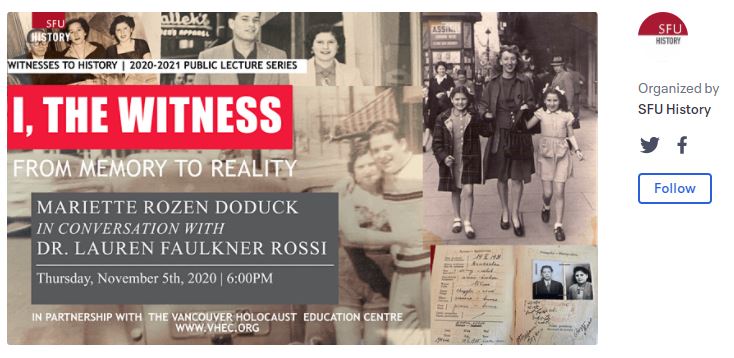
The Simon Fraser University Department of History.
“Time didn’t really mean anything to me. Time meant only to survive that one day. I can’t explain. It’s not like I knew that next month I’m going away, there’s no such thing as next month. It was to survive this one day from starvation, from freezing, from being sold, from being caught, from being killed on the street.” – Mariette Rozen Doduck
I took the above quote from the advert for this talk. For me it also summed up how a large number of people are feeling at the moment with the current lockdown/not lockdown situation, living one day at a time. I know that this is not half as bad as the situation then.
This wasn’t a photography talk but a great example of how the researcher and author of the book has worked closely with her subject, getting her to take her time, to remember and discuss a very painful time in her life. Even when she emigrated to Canada her troubles were not over. A story of such power of human strength. Not only through living through the war but then to move to a different country.
Mariette Rozen Doduck was born in Brussels, Belgium before the start of WWII, in May of 1935. She was the youngest of eleven children. In 1940 Belgium fell to the German forces and she was forced to hide in a number of different places, some of which included an orphanage, a convent, and in Christian homes.
She survived however the majority of her family were killed. She emigrated to Canada in 1947 with the only three surviving siblings. Thinking that the situation would improve she was sorely disappointed when her experience continued in the form of antisemitism. This surprised me, I would have expected nations that were not that close to the war to understand that these children were not the cause of the war. She found herself placed on her own with a foster family in Vancouver. It took her time to adapt and because she was not used to having a “normal life,” she ran away a number of times in the first year of being in Canada. The time to adapt was gradual. she started to accept her new family, community and school going on to finally attend the University of British Columbia. She became actively involved in her community and co-founded the Vancouver Holocaust Education Centre.
Relevance to my practice
Not directly relevant to either of by courses but it did highlight to me the importance of research, listening to your subject, allowing them time to move from subject to subject, guide them with the right questions to understand and document their story truthfully. Giving people time is one of the most important things in life and costs nothing.
Belfast Photo Festival ‘Landscapes – Challenging Convention
8th November 2020
I think this is the second in the series of talks for the Belfast Photo Festival and covers the importance of landscape photography in the Irish photographic practice. It seems that it is one of the most prevalent in Irish female practitioners encourage the viewer to rethink and question the nostalgic and romantic connotations associated with the landscape.
Today the panel consisted of:
- Eugenie Shinkle – Reader in Photography (Westminster School of Media Art & Design, London)
- Jill Quigley – Irish photographic artist
- Ruby Wallis – Irish photographic artist
Jill started the presentation, originally from County Donegal but lives now in Belfast. She showed a number of her images from her latest work which is based around old abandoned buildings in the rural environment ‘Cottages of Quigley’s Point’. Her work highlights the simpler way of living. She enters these buildings with permission if she can obtain that otherwise when they are left and the access is available, she freely enters and explores the interiors. Using a large format camera and flash she adds evidence of her presence in the form of spray paint, fabric items, lights etc. The project is based on her interact with the space.
Ruby Wallis was the second artist to show her work. The images presented were heavily reliant on the current lockdown situation. Working at night and using flash, she gets in close rather than working at a distance, looking for tones and detail in the night sky. She is exploring how the night sky changes our understanding of the environment. Her project ‘A woman at night with a camera’ provides a glimpse at the female gaze and the reclaiming of space that would otherwise be left to the male view, trying to overt the impression that women walking at night gives the wrong meaning.
Relevance to my practice
Although not directly related to my studies it is applicable because I’m addressing the female figure in a very male dominate environment. Its important for me to highlight how powerful these women are, how they pull the community together and can cope with anything that is thrown at them even though they are often in the background.
Photo Israel Festival: Taking pictures transforming the World
12th November 2020
This panel discussion consisted of three different parties each highlighting the importance of documentary and social change:
The first Miriam Priotti and Moira Rubio Brennan from PH15, and NGO that believes in using photography as a tool for change. They started by giving cameras to the children of a village in Argentina who used the medium to show the world their story. The work has been shown in a series of exhibitions. The name PH15 comes from the area the children come from, a very run down area of Argentina. As they highlight ‘taking photos just got easier. But do those photos have the power to tell us a story, to show us a feeling, to help us understand?’ This work has opened the doors for a number of the participants to go on to higher education and a career in photography.
The second person to show their work was Shannon Elder from the Native Agency. They are a group of five photographers who believe in the power of the image. They are working to try and change the use of visual photojournalism to include more diverse groups from around the world. Currently they work in Latin America, Africa and Asia. They encourage the cross pollination of information through helping young photographers to grow and improve the documentary community.
The final presentation was from the Social Documentary Network – Glenn Ruga. Ruga discussed and showed the platform for documentary project, exhibitions and shows. A collection of images with includes text, interviews which are up loadable free for a year. They also produce a magazine called ‘ZEKE’. This is managed by others but the on-line platform is managed and controlled by the photographers. This give more in depth information. The group are driven to improve and share a passion of photography.
Belfast Photo Festival: Depicting the Female Figure
12th November 2020
The panel consisted of:
Marie-Louise Muir – Presenter (BBC)
Hannah Starkey – Photographic Artist specialising in staged settings
Dragana Jurisic – Award winning multidisplinary artist working with image, text and video
The talk started with a brief overview from both photographers. To start Hannah Starkey, a British photographer who uses staged settings of women in every day life. For over 20 years she has used actors to reconstruct scenes of sitting in cafes, shopping etc. Her images are based on the utmost respect for both photography and women, a hybrid of photography and art. Her project ‘100 muses’ gave women freedom, helped them to be nude that wasn’t for a medical reason or with a view of expectation of sex. They felt free and she gave them that freedom. I had reviewed her work before and really admire her approach both photographically and processing wise.
Dragana Jurisic came next and I hadn’t seen any of her work before. She was born in the former Yugoslavia and but now lives and works in Dublin, Ireland. She works across a number of different media of photography and video. Her projects are predominately around loss of national identity, the growth of nationalism. She states that her work is heavily influenced by the work of Rebecca West who combines images and text into chapters.
Relevance to my practice
The influences are clear in both their work, religion, politics, peers. Both show respect to women and the strength they hold and this is something I’m trying to ensure in my work.
Grain On-line Talk: Polly Braden. Women in Photography
13th November 2020
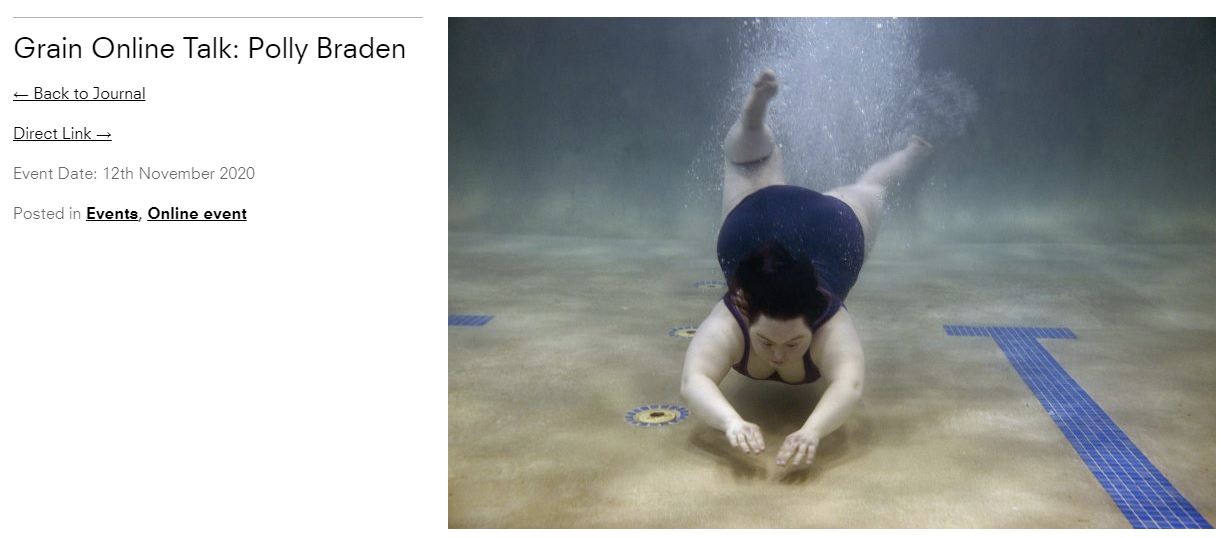
I can’t remember how I came across this talk but I’m glad I logged on. Polly Braden is a documentary photographer whose projects are not single shoot and run but a form of ongoing conversation between her subject, herself and the environment in which they live and work. These are longer term collaborations, gaining trust and a deeper understanding.
Working with single mothers in rural environments is one of her long-term projects were she combines portraits with the environment. She is trying to tell the story that is often hidden. The voice that is repressed. Her first major project was ‘Made in China 2002’ were she travelled and worked as a teacher whilst trying to gain access to local factors to show the conditions under which young girls travel miles to work as the sole income earner for the family. These stories are often shown in B&W but she wanted to show the other side, the truth.
The other project ‘London’s Square Mile: A Secret City’ shows images taken over a 12 year period, looking as an outsider, of an area within the city of London with its own laws, police and even the Queen isn’t allowed. The work consists of images and text, were she was drawn to the women that may work their or even live in this very male dominated environment. The images show a clear power imbalance. The architecture is used to frame the subjects that are often not aware of her being there. Over the years it has become more difficult to photograph in this area.
Her other work includes ‘Lockdown’ for the Historic England Trust and ‘Great interactions’ were she worked closely with people with learning difficulties.
Relevance to my practice
For me her work shows the trust she has developed with her subjects especially the ‘Great Interactions’ project. She shows such respect and a depth to the story. You can’t just rely on a single visit to get the story. Images can’t be produced following a five minute conversation. Your subject needs to understand that you respect their position, that you will show their story as truthfully as possible.
RPS Engagement Talk: Mik Critchlow
27th November 2020
Critchlow is a social documentary photographer based in the North-East of England. He original entered the Navy but left to go to Art College. His work is very much based around his home and recording life and the changes in the environment and community. He captures life on 35mm B&W film and still uses that today, some small digression into digital but doesn’t really like the results.
The project that seemed to have started if career was based around the mining community, the housing, the people both at work and social aspects. It was a hard life. His grandfather worked down the mine, went to war, returned and then went straight back down the mine. The use of B&W really captures the mood of the time and the conditions. He captures the life, the interactions, life and death, not only of the people but the mine itself. He was commissioned to record the closure of a number of key mines in the area. He recorded the effect this had on the community, the hardship and the loss pride the people had.
He has continued to capture the effects of change on the local community, housing, unemployment, the rise in youth crime, and the growing drug culture.
Relevance to my practice
Critchlow stated that he was influenced by the work of Chris Killip and I can see this in his images. I have previously reviewed Killip’s work for by Body of Work Project and I can see the likeness. I can strongly relate to his approach, sticking to a project, seeing it though and forming bonds with the locals to gain their trust. Even with the modern day youth they allow him in, allow him to photograph them, even when high on the latest substance.
Royal Photography Society Engagement Talk: Jim Mortram
11th December 2020
Mortram is a British social documentary photographer and writer who has worked on a long term project based around his local community addressing the lives of people society wants to forget and who don’t have a voice. This ten year project ‘Small Town Inertia’, based around ‘community’ uses text and images in order for their stories to be told, for the viewer to really see the conditions under which others live. To stop assumptions and to really see. Mortram considers himself a conduit for their voice. He considers the people he photographs as the heroes of life and the social system.
He photographs with respect and I think this comes from his own situation. At an early age he had to leave full time education and become his mother’s full-time career. His father couldn’t cope and so for the next fifteen years he was a 24×7 career. Over this period he became more and more isolated both mentally and physically until a friend called by and left him a camera and told him to get out of the house. This was the start of a love affair with his local community.
Each of his images are taken following a conversation, forming a bond of trust. He records each session, using text from the interaction to form the full story of the image. The images are raw, emotional and respectful. They show society in all its pain, highs and lows. He aims to show the imbalance in society.
Relevance to my practice
This was a very emotional presentation for both the presenter and those listening. For me Mortram’s own situation and mental state comes across in his images. He is capturing the very heart of his community and giving them a voice and this is very much what I want to try and achieve with my Body of Work images on the women of Ngawi. Mortram shows the other side of the community, the side that people don’t see. The use of image and text helps I think as first viewing most would dismiss as another case of images covering drug addicts and poor society but Mortram captures more than that by forming strong bonds with these people and I believe I have tried to do the same with the people I have captured during my project.
Ariella Aïsha Azoulay in conversation with Wayne Modest IZK Institute for Contemporary Art.
‘Un-Documented: Unlearning Imperial Plunder’
17th December 2020
There was a large amount of preamble before the main discussion really started. To begin with they played a short film ‘Un-documented’ which highlights the connections between the artifacts that had been taken over the decades from explorers now held in museums around the world and the asylum seekers that are trying to enter the countries that took these items.
It details the theft of these objects, placed on display in foreign locations with no agreed return, some being lost to archives and never even seen. The film links this to the people who are forced to migrate from their home lands, seeking shelter. Both it is claimed are ‘falsely perceived “objectless” and deemed “undocumented” by border regimes. As the “undocumented,” they are denied free movement and unduly criminalized’.
The film which was in three parts can be seen here: https://vimeo.com/490778435
Museum of Contemporary Art Denver: Nan Goldin in conversation with Tania Bruguera about art and activism
17th December 2020
I had been looking forward to this talk as I have been a huge admirer of her work for some time. It was however disappointing to find that this was a pre-recorded session between Bruguera and Goldin due to Bruguera being under house arrest in Cuba.
The majority of the hour long discussion covered the situation that Bruguera found herself in and not a lot about the work by Goldin until about twenty minutes towards the end. Very few images were presented which was also disappointing. Golding did highlight her work with the P.A.I.N (Prescription Addiction Intervention Now) activist group, which she founded following her admission to struggling with an addition to pain killers (OxyContin). She organised and led a group of fellow sufferers in ‘staged “die-in” protects’ held in museums that receive a large amount of funding from the drug company that makes OxyContin. This fight has been going on for over three years. She found that the project was a way for her to focus after coming out of the clinic and to keep herself from the drugs.
Relevance to my practice
There is a link to my Contextual Studies here as Goldin uses her images to both fund the support of the group to identify the wrong doings of the drug companies, governments and doctors and also gives a voice to those that are addicted to these pills. I would have liked for her to have shown more of her images but she was more interested in the situation of the interviewer. For me it was a failing of Bruguera not to steer the conversation back to Goldin’s work.
Towards the end of the interview, it did become interesting when they started to discuss ‘Political Art’ stating that museums are only showing this type of work to deflect peoples, attention from where their funding is coming from. The P.A.I.N group are only small, with young people moving to the larger focus groups. Goldin explained how important social media is but the media is normalising the issues, there are too many images that glorify drugs that people just accept the situation without asking if it’s right or wrong or what they can do about it. Political Art isn’t just about corrupt governments it’s about making people see what they don’t want to see.
VII Interactive: Sarah Leen in conversation with Maggie Steber
18th December 2020
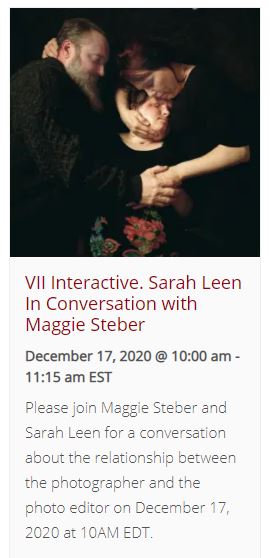
This discussion was based around the photo editor relationship. Both described what they considered the role of the editor had, coming from years of experience on both sides of the fence i.e. photographer and editor it is clear that this position is important and as a photographer you really need to look after this relationship. The editor is key to giving assignments, they try to match the skills of the photographer with the assignment and the type of images they need for the story they are trying to publish. They undertake a key part in the research prior to the assignment and are there to direct the photographer as to the kind of images they need. They are the support and intermediary between photographer and publisher. They manage the budget, select the images and work with designers. They are the independent eye; they see things you as the photography may not. They look at the images as if they are the viewer and ask the hard questions to make the story.
They look at images independently, often removing images that you as the photographer have become too close to. They are there to challenge you, push you and encourage you to produce your best work.
Relevance to my practice
As I’m about to start the editing process it was a useful session. They covered the methods to finding an editor – attending photo festivals that often have review sessions with editors, enter competitions – editors often use these to spot new talent, work on a long-term project and produce a body of work, use social media – for your professional images not your family or cat images, get out and about and be seen, get feedback for peers and make sure you read and research lots of other photographers and the publications for whom the editor works. Go to them with ideas and images, they need to know your skill set, don’t expect a handout with no proven record. Work on something you are interested in as this shows in your work. All great advice and useful for this part of my course and I think into the next.
RPS: In Conversation with Giles Duley
22nd December 2020
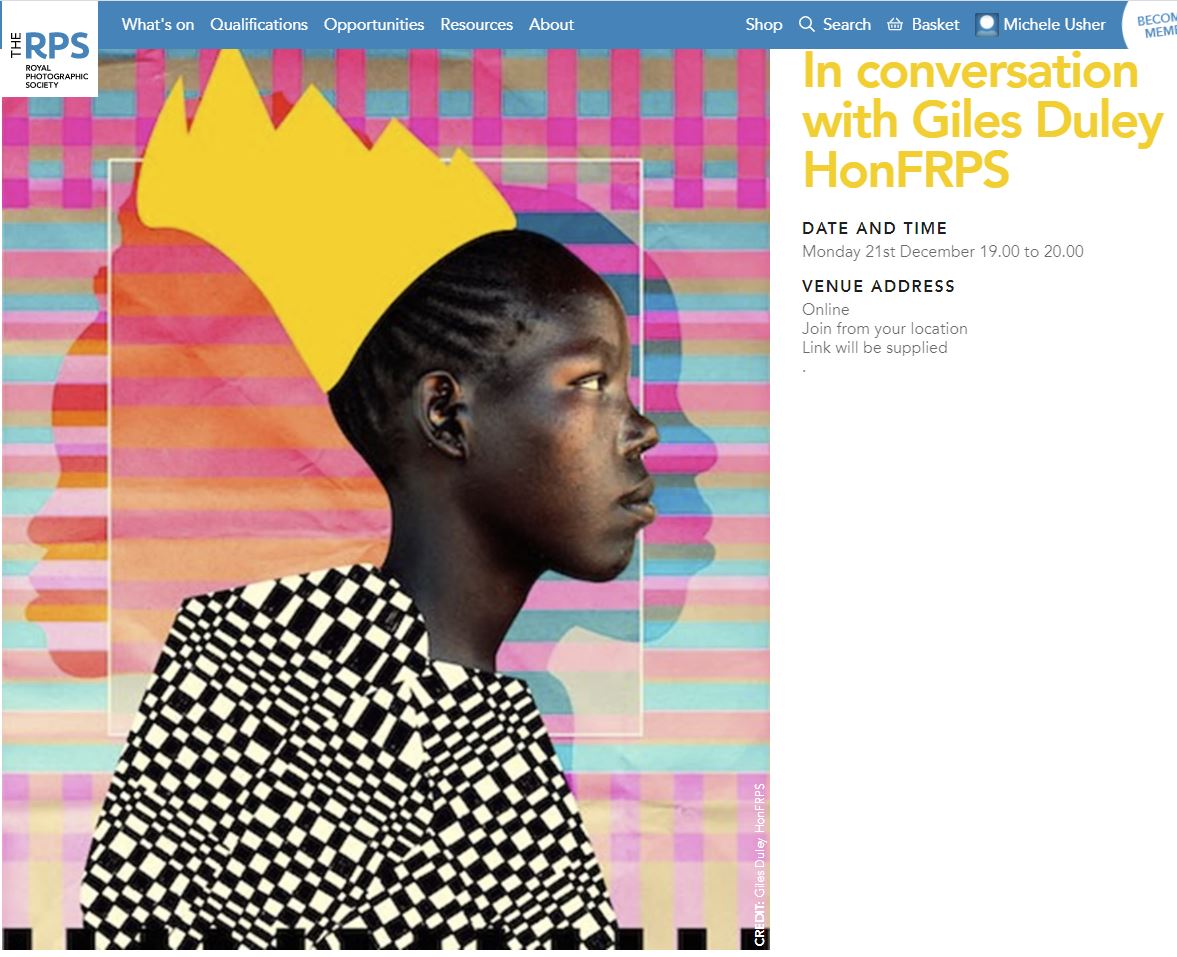
The last presentation of 2020 for me and it ended on a high. Duley is an anti-war photographer and founder of the charity ‘Legacy of War Foundation’. He started as a photographer in the music industry, photographing mainly the ‘punk’ movement, then moved into war photography which resulted in the loss of three of his limbs from a landmine.
This hasn’t stopped him and his desire to show the world people’s stories, covering issues for Save the Children and other humanitarian causes. In 2014 he went to Lebanon, just three years after his accident. His aim is to never shop people he photographs as victims, he works with them, forming strong personal bonds before he even picks up a camera, which considering is disabilities is film not digital, adding to the challenge of the situations.
In 2016 he returned to Lebanon, only to find that in most cases the situation of the people he had photographed had not changed, this was a turning point for him, thinking that his images were not good enough, that he wasn’t doing a good enough job to raise awareness of the situation of these people. He soon realised that in order to make a change he needed to work with others, to collaborate, to tell the story through image and text and now film. It wasn’t enough to hand over the images and think they would be used for good, to highlight/promote the issues, he needed to take charge.
He highlights what he calls the other side of the truth, it may not be front page media work, but by publishing the images he tries to inspire others to make an improvement in the world. As he states, the stories don’t just stop because you leave, you need to return a number of times to follow the people, giving them a voice.
PowerHouse Virtual Book Launch: The Boys by Rick Schatzberg in conversation with David Campany
15th January 2021
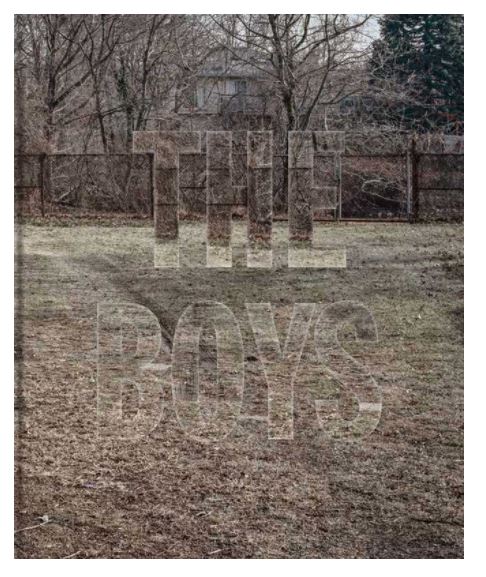
The presentation started with a short two minute presentation of the book. The hard cover, front and back is embossed as shown above. Inside there are about a dozen ‘gate fold’ pages. These show a series of portraits of his friends. The outer folds from their youth the inside as they are today but shirtless, showing evidence of age, and scares from medical and work incidents.
The book is based around a group of friends and started when two of the group died unexpectedly. The book was a way of coping with the grief and maintaining a memory of the two that were lost. There are a mixture of old 1970s snaps to modern day posed shirtless portraits. They tell the story of a shared history. The twelve chapters are a mixture of images and text from each of his friends which address their friendship, ageing, loss and memory.
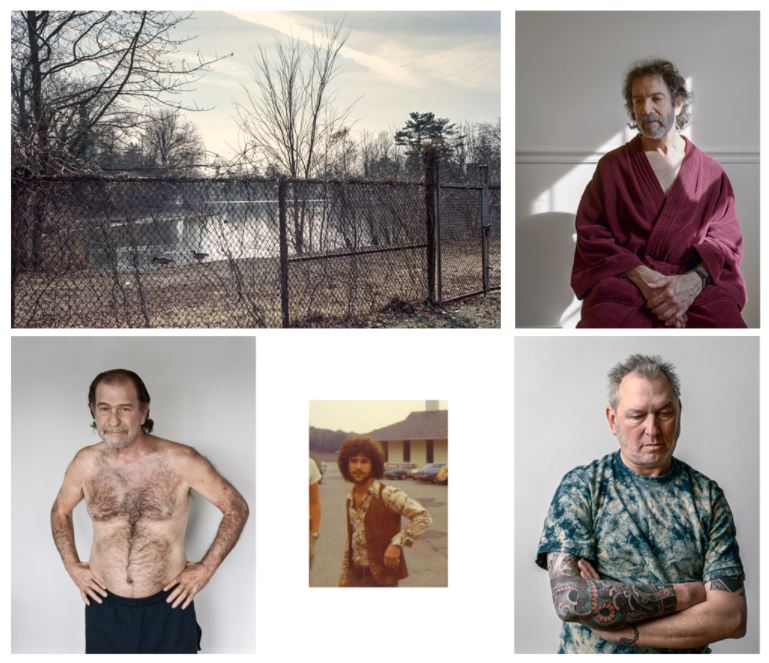
Relevance to my practice
The main reason for watching this was to understand the whole book making process, from start to finish. To gain an insight into the editing process, the design, publishing and how best to present the final result.
The style is clean and professional which is the way I want to present the final work on Ngawi. Each chapter having a link to the next. I really like the way he used the gate folded pages to introduce the next chapter. I have moved this way in my Body of Work, utilizing the street panoramas to introduce each of my subjects.
Event link:
Royal Photographic Society talk: Photography and Reconstruction: European Cities in Popular Culture after 1945, by Dr Tom Allbeson
22nd January 2021
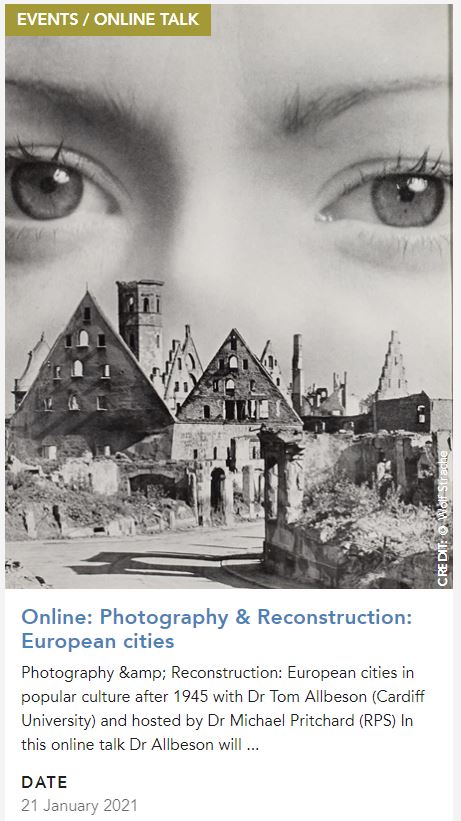
A well presented discussion on how photography was used as both a propaganda tool pre-war and post. The research project which has taken several years ahs resulted in a book consisting of four main chapters addressing bomb damage and ruin photography, architecture and photographs of Europe (UK, France and Germany).
Allbesion explained that post war was a culture of ‘aftermath’, from 1947 an era of ‘cold war’ and reconstruction and photography played a key role in showing the population the before and after images in the popular press and magazines of the times.
Reconstruction was not just of buildings but also that of political and popular culture. Photography was central to informing the people, retain memories and joining communities. It was a way to re-educate and promote the growth of the urban landscape which was changing fast. A way of promoting change.
The photo magazines of the time were used to rebuild the public and social roles. There was a growth in the use of photo essays, a way of showing not telling. There was a growth in the human focus and the deconstruction of enmity and the growth of unity forged by emotions.
Link to the talk: https://youtu.be/3oFAf5-pBHU
Exploring Identity through Photography – London Art Fair
26th January 2021
Panel: Diane Smyth (Chair); Jane England, Tsoku Maela and Adjoa Armah
Panel talk discussing the aspects of identity and the use of photography as a tool to show this. All identified the use of archive images and how these can be used to learn from the past to represent now.
Adjoa – an artist based in London who works mainly in archive photographic images following the discovery of images in Ghana which she now collects from across the country. Project called ‘Saman’ meaning ghost. She uses these to research her culture and identity.
Tsoku – South African based photographer who uses images and film to document his own culture, identity and mental health issues with the aim to breakdown the barriers, to make people talk about the issues. His images are abstract and surreal, often looking at other artists work, but also his own memories.
Jane – an art historian who now an owner of an art gallery ‘England & Co.’. She has a research-based approach to show work from artists based in the 70’s such as the work by Jane Bean.
Relevance to my practice
No real direct connection to my studies just interested in the work of these artists and the importance of identity, culture and archive even though my project is not based on archive images it was interesting to hear how they relate and how they are interwoven with their work.
Royal Photographic Society Awardees in Conversation: Anna Fox with Karen Knorr
27th January 2021
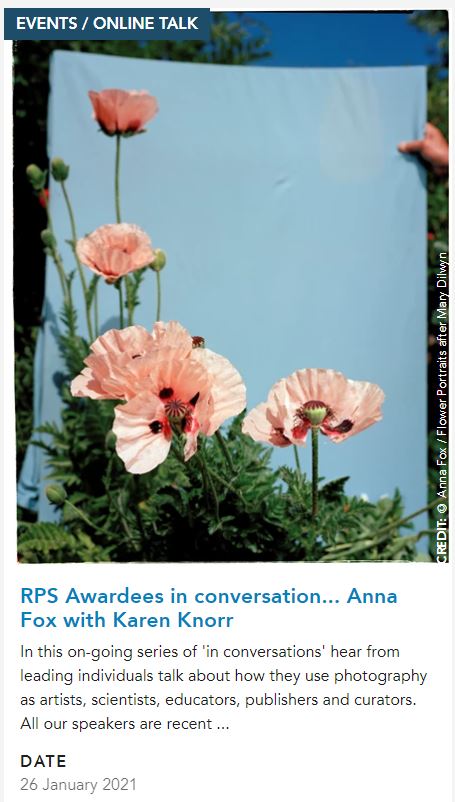
It was clear that these two were close friends with a strong working relationship too. Karen started with her project on Belgravia which covers the upper classes and culture of Britain. I had seen her work before through the various modules of my studies. The project consists of images of the street and the occupants of the apartments on the street. The images are black and white and are accompanied with text. The text doesn’t explain the image. The work highlights the differences between male and female. She didn’t record the conversations she had, but made notes after the event. For me these staged images show this world that most will never see or experience. It’s a window onto a world of privilege. She also talked about the images from the British Empire and Gentlemen – the world during the Thatcher era.
Anna spoke next. She started with a project in her local area of Basingstoke, an area seen as the next London. She photographed everyday life, the ordinary, using text from the community and local newspapers. She is famous for her project ‘Work Station’, another example of the Thatcher era. There is a clear influence of Martin Parr and Paul Graham in her images. For me her strongest and most powerful work is that of ‘My Mother’s Cupboards, my Fathers Words’. This small format book packs a punch. The book able to hold in one hand, printed on pink paper, the text is raw and deliberately hard to read which forces you to look clearly and take them in. This is when you get the impact. Words spoken by her father which were directed at her mother, grandmother and even herself. This was a very personnel project and must have been very hard to complete.
Both Anna and Karen have worked closely with other photographers on projects and also together. They are currently working on re-enacting the route taken by Abbot – women who did road trips along Route 1 in the US, documenting poverty, politics, and events.
OCA student arranged talk and presentation by Jim Mortram
31st January 2021
This was the second time I had heard Mortram talk about his project ‘Small Town Inertia’. The first was with the RPS back in December 2020. It was well worth the donation and so relevant to my own Body of Work and Contextual Studies essay. The need to give the people the voice they so desperately need. The presentation followed the same format as the first talk so I won’t repeat my notes here but direct you to my post of the 11th December 2020.
For me the talk reconfirmed the importance of social documentary and that the stories of life are just on your doorstep, there is no need to travel to far flung lands to see the impact of social change or hardship. All of the images produced for the book and blog are within a three-mile radius of his home. This distance is due to the limited time he can be away from his mother for whom he is the sole career. Little is even documented about the lives of full-time care givers, it’s the side of society that people don’t want to think about, just brush it under the carpet, out of sight out of mind – someone else’s problem.
There is a strong political theme and social drive behind each and every image. The stories need to be told and Mortram believes he is there to do that. He believes that news should be about the people and the community not some ‘B’ rates celebrity, we should be seeing what is really going on, but there should also be context to that image, a story that needs to be documented. He often spends hours with each person, going back numerous times to talk and to listen. I found this quote from the Guardian which sums up the work, but then he did say that a lot of the article was paraphrased so I’m not sure if he did say this:
“Telling these stories, for me, is a peaceful form of resistance to a very real situation. The world is full of people who want to tell others how they should be living, when what they should be doing is sitting down with them and finding out what their lives are really like, and why they’re like that in the first place. That’s all I’m trying to do.”
https://www.theguardian.com/artanddesign/2014/feb/19/people-photograph-dont-have-voice-jim-mortram-norfolk-portraits [accessed 31/01/21]
I also found the following from 1854 Presents which I think would be really nice to use in my Body of Work:
“The key component to facilitating intimacy is trust, trust and a desire on all parts to share testimony and truth.
As a photographer you have to listen in so many ways – the real key is to check one’s ego in at the door, to not think of the camera as a free pass or a shield. It’s just a tool. The one thing you have to remember to bring with you when you make work is your humanity and humility”.
https://www.1854.photography/2019/01/qa-j-a-mortram-on-his-ten-year-project-small-town-inertia/ [accessed 31/01/21]
Link to the talk: https://drive.google.com/file/d/1gi7nJV1q0Y519N2z8XpNaHa2K42CP8ue/view
Out of the Archives: Collecting Stories of Everyday Life by Four Corners
5th February 2021
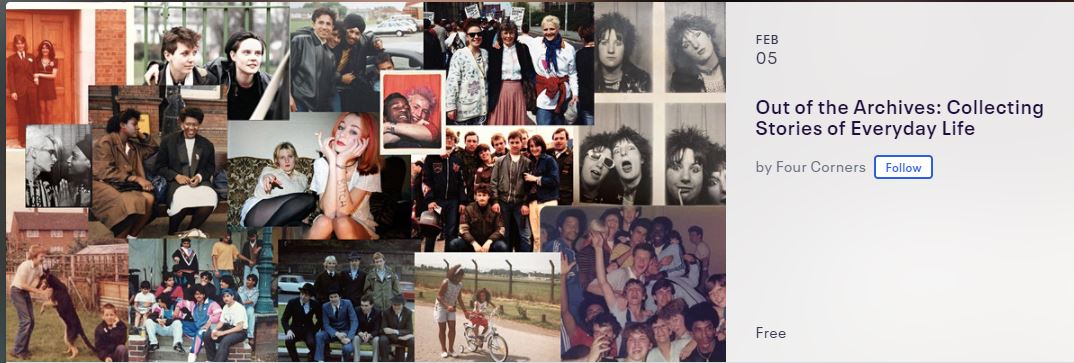
Panel: Geoff Broadway, Lisa Der Weduwe, Four Corners (Ruby) and Carla Mitchell
Lisa started the discuss representing the Museum of Youth Culture and the project ‘Growing up in Britain’. The organisation holds thousands of images which started in in 1997 as a major archive of youth culture, recognising what was important to the youth of the day, music, relationships, unemployment etc. Very much based around the everyday life, people’s stories and storytelling. This has now progressed into a more structured archive, targeting aspects of life that are important today – LGBTQ+, BAME and women’s history. They have started the ‘outreach champions’ programme. Aimed at public engagement during lockdown. Starting in Clacton as a pilot, on-line and off-line targeting youth culture. The participants can download a ‘home-pack’ which is full of tools and ideas as to how to get started. They are working hard to expand their reach and moving to target all ages with workshops and hotlines, memory postcards and working with the over 60’s to gather and record memories using multi media formats to gather and retains records.
Geoff discussed the ‘Living memories’ project, which is current in its third year, working with personal archives, recording people’s stories using old images from albums. The project aims to raise awareness of the importance of these documents. Its an opportunity to involve the community. The stories are broad from holidays, important events, trauma and culture. They currently hold over 5000 images from the WWII onwards.
Relevance to my practice
An enjoyable and enlightening session on how the community can be encouraged to record and retain memories but to also help heal by discussing events and trauma. This links with both my Body of Work around rural communities and isolation and Contextual Studies and giving a voice to the members of a community. By recording and archiving these stories, events will not be lost. By involving people, they don’t feel so isolated.
Useful links from the talk
https://museumofyouthculture.com
AWP In Conversation with Laura El-Tantawy
6th February 2021
Laura is an award winning Egyptian Photographer, who hadn’t considered photography as a career but started as a writer and took a module in university in photography to get some ‘easy’ credits. She came from a very political family – bit not in an activist sense but from a grandfather that was interested in both local and national events and encouraged her to be the same. She has managed to tell her stories though images in project such as ‘I’ll die for you’ and ‘In the shadow of the pyramids’. Her projects link memory, and identity. The death of her grandmother caused her to return to Egypt and to discover her culture and what it meant to her. The images reflect strong emotions, from her childhood and through her work she has managed to move on from her loss.
Her work is experimental, using film and digital, often at night with long exposures, the images are blurred, bright and powerful. She has also started using her mobile phone more as this is often easier to capture the moment and easier to move around the city. It was interesting to hear her editing process which starts in the camera, deleting as she goes along. She doesn’t process a lot even when the images are downloaded. She selects the images and then leaves them – often for weeks but returns to them to re-arrange or change. She involves very few people to review or help edit or design. It is important she says to ‘keep your vision and not theirs’. Her books are about a journey, through the pages in the form of touch and smell and then the images.
Relevance to my practice
For me it was really interesting to hear her editing and processing process. I have always been taught not to delete in camera as this not only causes issues with the SD card but also you might just delete the image you want, wait till you get back and down load. Also hearing how she only trusts a few people to review her images. I’m the same but mine is a confidence issue, something I don’t think she has. I have to agree with her on trying to ‘keep you vision’, its so easy to be driven in a different direction. There have been a number of suggests on my Body of Work that I have been asked to look at and consider and I know that’s not going to work or its not the style I want to get to the final result.
Social Documentary Network: ‘View from Russia’
7th February 2021
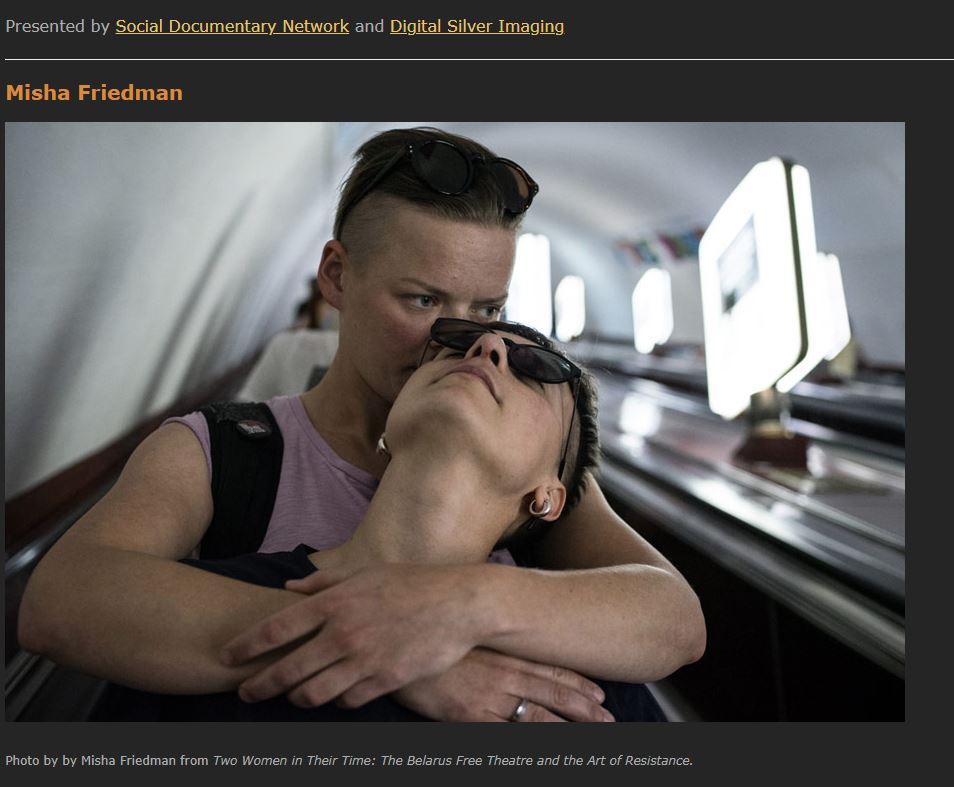
Link to talk: https://www.youtube.com/watch?v=nTOylQN3kOE&t=26s
Nadia Sablin (b. Russia, 1980) started the programme with her project that was based on her return to her family village in Russia, about a two-hour drive from St Petersburg. Her work seems to sit somewhere between documentary and fictional storytelling, exploring the larger world through a very personal and emotional narrative. This projects gives a very intimate view of rural Russia and the Ukraine, covered over a number of years the images are of the life and work of her two elderly relatives.
Misha Friedman (b.1977) was next, after graduating with a degree in economics and Russian politics he worked in finance in New York, but after the 9/11 incident he switched careers to volunteer as a project manager at Medecins Sans Frontiers and at the same time taught himself photography. His work is a collaboration of ideas and thoughts from theatre, plays and written works. For me the work is difficult to read and follow. There are multiple meanings, asking lots of questions and maybe not getting an answer to any of them.
The final panel member was Sergey Ponomarev, (b.1980), he began his career working for the Associated Press before becoming a freelance photographer and contributor to the New York Times. His work is based around the depiction of the daily life of Russia, its culture and the changes in the landscape due to climate change. He highlights how this has affected the lives of farmers who rely on the land to make a living, how migrants are allowed to work the land but not own it. The Russian Government are forcing people into remote locations in the East to protect its boarders. The images demonstrate the conditions in a photojournalist way and having been to Russia and seen the conditions myself I can relate to these images.
Relevance to my practice
There were a number of reasons for me to watch this presentation, the first to recount my own experiences of Russia, the second the similarities of the project by Nadia and Sergey to my Body of Work and that of rural communities and the women that live in them and finally the style and presentation of the images.
Out of Place: Joe Twigg, Lewis Bush and Peter Fraser
London College of Communication
9th February 2021
This event was based around what each photographer on the panel understood as ‘place’, what it means to them, be that a physical location or a memory and how that related to their photography practice. Each panel member gave a brief overview of their work, what influenced their work and current projects.
Joe Twigg started the presentation, explaining briefly that he was based in South London, grew up in Wiltshire, attended over 20 different schools as his parents were hippies with ‘middleclass values’. He has travelled extensively and left school without any qualifications to work in construction and landscaping. He didn’t become interested in photography until he was 30 and now combines the two careers. His project ‘Why do so many construction workers kill themselves’ was a basis for his first book and focuses on mental health, the place and landscapes around London. The work has helped his own mental health.
Lewis Bush works across a number of different medias but was trained in Art history and then moved into photography. The project he spoke about covered his travels around Europe – 7 weeks and 10 cities, each was walked extensively. His images look for places that can be a metaphor, the past still in the present with the history embedded in the landscape. Showing the scares of the past.
Peter Fraser was the last to speak, only showing five images, stating that he doesn’t like to explain his images. Each image he states highlights the external and internal feelings of the place and how they are often at odds with each other. He likes to show the tensions been the geographical place and the internal place. Not sure I really understood this and would probably require a lot more research.
Photo café: In Conversation with Ania Ready, Gianluca Urdiroz, Holly Houlton, Paul Romans and Tommy Sussex
11th February 2021
Probably not the best of talks and so to save time as I have lots to catch up on, I have taken a copy of my hand written notes:
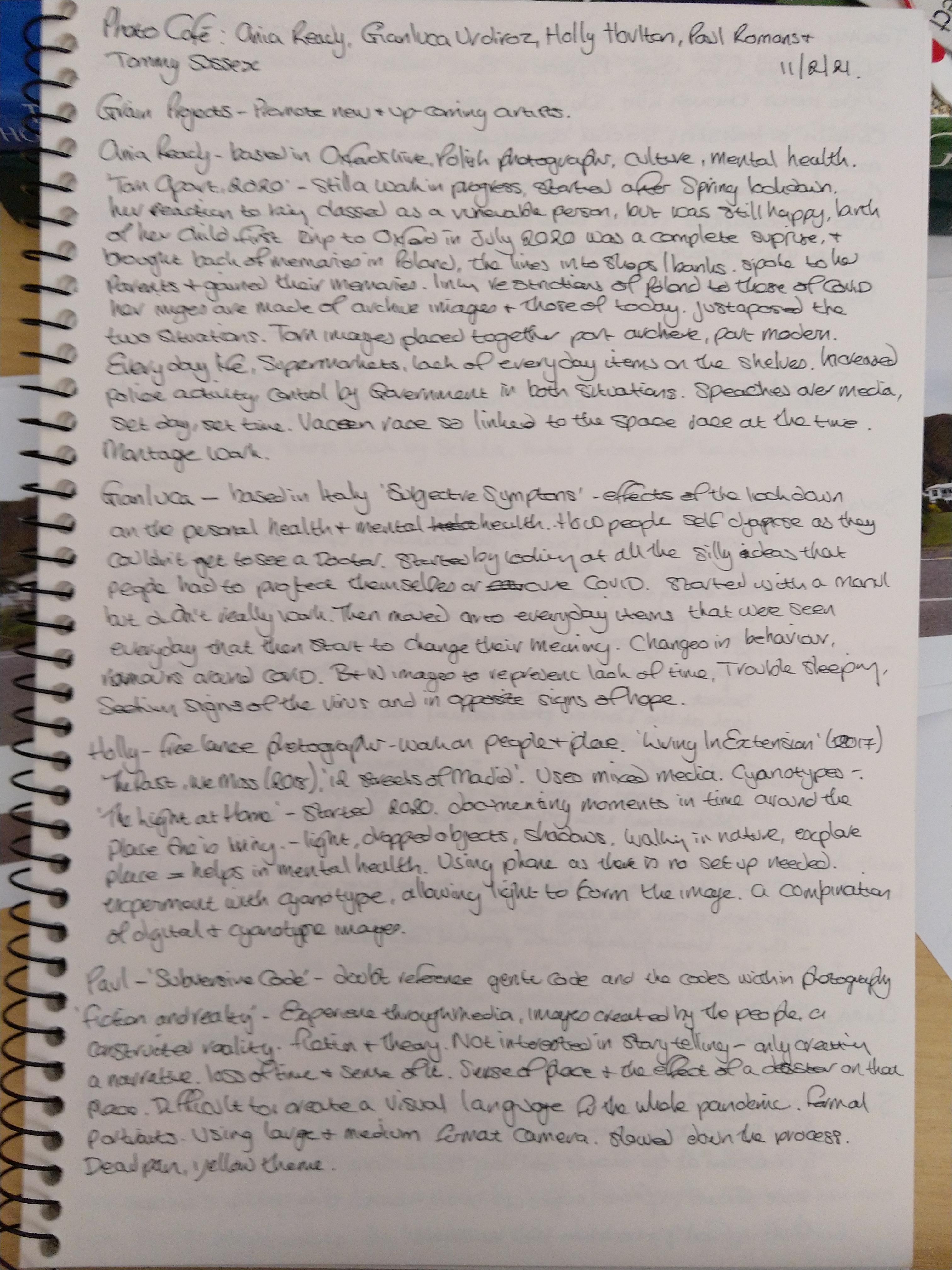
CSA Annual Photography Lecture with Donna Ferrato and Laura Pannack
16th February 2021
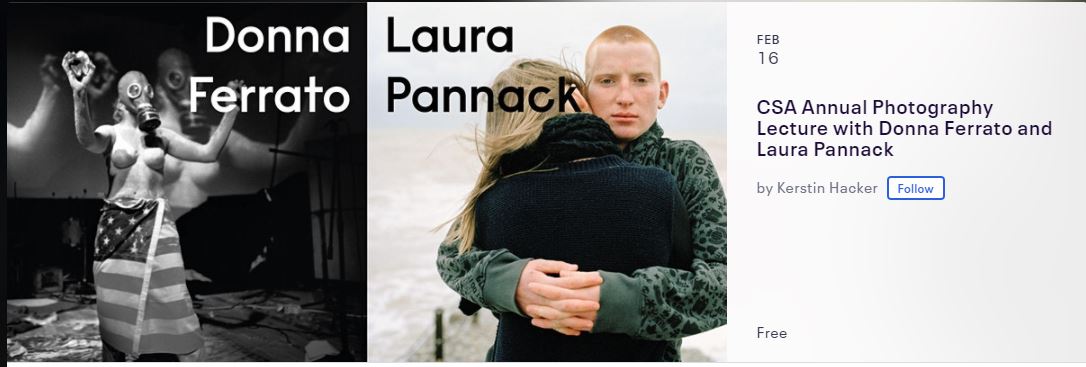
This wasn’t the first time I had heard these two speak. Ferrato once again gave a passionate presentation around her work on family violence. She has been highlighting these issues for a number of years and it is just heart breaking to hear what these women go through. She is a champion of the cause and uses her images to bring to the fore the issues, warts and all and isn’t afraid to hold people accountable. Her life becomes theirs, living and sleeping in their homes to capture the most intimate moments, nothing is not recorded. I wonder how much of her own life she has lost/given up for these women and the fight against family violence?
Pannock’s presentation was very different and showed the differences in approach and maturity, I think. Her work focuses on youth, using polaroids and film. She is also trying to give a voice to her subject, gaining trust and forming relationships with her subjects, something that rang true with my own Body of Work. She works and experiments with single images and different medium. Pushing the boundaries of the film during processing and enjoying the mistakes that often happen. Like Ferrato, her projects run over a number of years, often taking several visits and discussions before a camera is even thought about and in some cases a camera is never even used. She explained how it was always important to be honest with her subjects.
Link to talk: CSA Annual Photography Lecture.
RPS In Conversation with Sarah Lee
16th February 2021
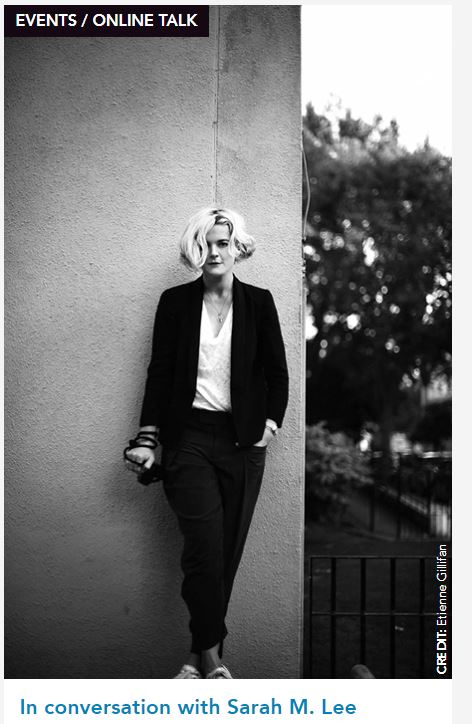
Sarah M. Lee studied English Literature at University and gained access to free filma dn a darkroom which started her interest in photography. She entered a competition and although she didn’t win got spotted by the editor of the Guardian New Paper. She was offered a freelance and has continued to work for them ever since. She specialises in portraiture, and her favourite quote is by Henry James: “Three things in human life are important: the first is to be kind; the second is to be kind; and the third is to be kind.”
She spoke about a number of different project; ‘Behind the Curtain’, Tender as the Nighthawks’ and ‘West of West’. Each very different, but very people focused. It was very interesting to see how she selected her composition, angle, depth of field and use of either colour or B&W. She is very much an observer of human nature, never in your face, as she explained there is a fine line between getting the image and the person feeling exploited. Saying that she has been known to take risks to get the shot. I have to agree with her when she says that B&W is all about tone and texture, and having come from a film base she is considered in her approach and style. She explained how important it is to read and research, keep up to date and push yourself. It is important to be yourself she says and not try to copy someone else, find your style and voice.
Relevance to my practice
Her work and approach to her projects is very similar to mine, that of observer, to not intrude into the lives of those that we photograph. Her use and thoughts around B&W are very much in the same way as my own and I wish I could use all B&W for my Body of Work but it’s just not going to work, I think I need that warmer feeling to the images. Like Sarah I have found that I have pushed myself with both my Body of Work and the whole course. It has resulted in areas of work I would not have thought about and listened to some amazing photographers to understand their approach and processes in order to improve and develop my own voice.
Photo 2021 Talk – In Conversation with Michael Cook
21st February 2021
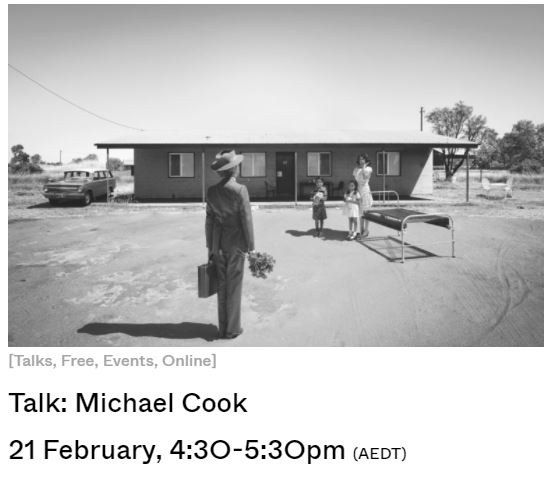
Cook first got into photography, like most by accident, a present from his brother. From starting in photo labs he moved on to taking wedding images and then owning his own studio, before settling on fine art photography in 2009. The project in discussion tonight was ‘Living the Dream’. A series of staged images based on location three hours north of Alice Springs. The images explore the notions around home ownership, consumerism, social conditions, questioning the pressures and norms. His images show a need to connect and belong, often asking ‘what is important in life?’. There are only six images in the series which were created following a number of repeat visits to the location. The stage images are a disconnect between social conditions and going through the ‘norms’. Questioning the idea of the ‘ideal life’ and what we really want and need in life.
Cook discussed the area of truth and photography, stating that photography doesn’t have to be truthful, it should question and make you think. It needs to connect to the viewer on some level and also be truthful on some level. The message bridges the political and personnel wanting his images to show more than a black and white answer, pushing the boundaries and gets people talking and asking questions.
Relevance to my practice
These images and the project have very little relevance directly to either my Body of Work or Contextual Studies however I was very interested in his approach and I think that applies to my own work. I’m drawn to the black and white images, the way they raise more questions than answer and I try to create that with my own work, probably more with my documentary images, its an area to explore more in my SYP and following this course.
RPS Engagement Talk with Arteh Odjidja
26th February 2021
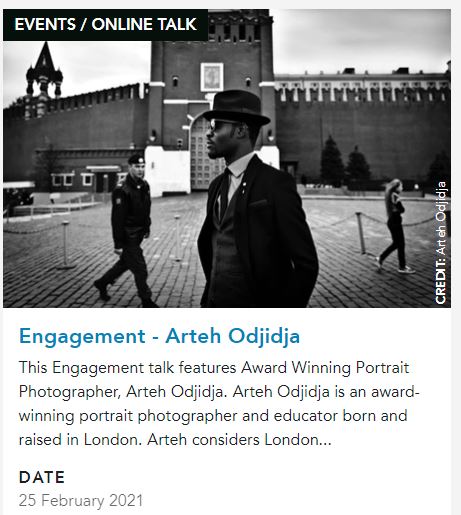
A portrait and fashion photographer who was born and raised in London. Parents originally from Ghana. Photography has been in his family for a number of years, with his father working in the film industry, running the film production back in Ghana but following the military coup meant that his family had to move to the UK.
Odjidja trained as a graphic artist, but it wasn’t until a review of his portfolio were, he was told his work didn’t have any passion or creativity he realised that he was trying to please too many people and not finding his own voice. A film by Ozwald Boatong OBE was his turning point and a form of inspiration.
He explained briefly about how his career had moved from marketing and retail to trying to gain access into studios and working as an assistant. Working as an assistant gave him assess to both the equipment and the right people to eventually working for Leica. He stated the importance of telling the story which resulted in the project ‘Stranger in Moscow’ and working with the Dandy Lion Project – work towards male empowerment in the black community. Some of his other projects centre around migration but not from the usual angle of look at these poor people, far away from home or these people that are being supported by government taxes, no he has chosen to show how these people have moved to a new country and are giving back to their local community, reversing that image. The series is about reversing and changing peoples understanding, empowering and giving a voice. He does this by shooting the images and telling a story, a balanced narrative, focusing on their strengths, emphasise their contribution and gaining trust.
Relevance to my practice
His work relates strongly to my both my Body of Work and Contextual Studies. My aim is to give a voice to the rural communities of New Zealand. The media always seems to paint a poor picture of life on the edge, poor mental health, drugs, gangs etc but what I found was a strong sense of community, pulling together to fix and make do. The work by Odjidja does the same. What sells a story is bad news, not the hope and community sprite, they look for the bad instead of showing the positive side of the situation/location.
Martin Parr Foundation: talk with Susan Meiselas
26th February 2021
Today Meiselas spoke about two of her projects which have resulted in books ‘Tar Beach’ and ‘Eyes Open’. Each project was very different but started in 1974. Tar beach started with a group of girls in the mid 70’s – known as the Prince Street Girls. The project centring around the community of a street in NY. The church playing a key role in their lives. They contacted neighbours and people of the street to share memories and photographs – a true collaboration project. Each image was carefully scanned and returned to its owner which was difficult during the lock down in NY. Getting interest was challenging so they used local shops to put up posters. This started a flow of images and interest of people looking back on images from the roof tops and how people lived and coped with the heat without aircon. The editing was all done on Zoom and ISSU as she claimed this was the easiest way to keep distances, manage ideas, colour and editing. She explained how the decision around the front cover was probably the most difficult and this started me thinking about my own decisions around how I would like the cover to look for my Body of Work.
The second project ‘Eyes Open’ – really started when she was teaching in the 70’s, she would set up a darkroom and was then given a large number of free Polaroid cameras along with film for the children. Meiselas contacted other teachers to see what they were doing and eventually formed a collaboration across the country. The current project includes 200 teachers and over 400 children. The project offers ideas, projects and interactive learning for the children along with introducing other artists to them. The project in international which with the use of Zoom and other platforms has made the whole project more accessible.
Relevance to my practice
This was so relevant to both aspects of my course – the use of Zoom for editing and feedback which I have already started with fellow students and my tutor. ISSU is a product I have looked at for possibly showing my book as a final submission and photovoice as a technique for helping others without a voice in the community, an area I’m thinking more and more about progressing into post my current studies.
Wex Photo: In Conversation with Alys Tomlinson
27th February 2021
Tomlinson didn’t study photography but English Literature and believe s that this has really been a help to her career. She moved to NY and started to work for ‘TimeOut’ as both a journalist and photographer which meant she was able to gain access to a number of areas not usually available to the general public.
She works on both personal projects in B&W (film) and commissioned work in colour and digital. Her personal projects seemed to take second place due to the stress of finances until see saw a film by Jessica Hausner on Lourdes, France. She then spent a number of years returning to the same location to photograph the people who visit the holly place. Each time she came away disappointed until she realised that she wasn’t really capturing the people and the place, so decided to return with a large format camera that made her slow down and really think about capturing the very essence of the place and one person in particular – a nun. This project has progressed onto a short film ‘Vera’.
Relevance to my practice
Tomlinson made a few interesting points and highlighted a number of difficulties that she experienced whilst making the book and then the film but one point that has remained with me is her comment on finding your own voice within a project. Its important to be true to the subject, and yourself. Find an angle that is different, yes research but don’t follow their path make your own. Step outside your comfort zone, experiment and experience.
RPS: Talk with Robert Darch
10th March 2021
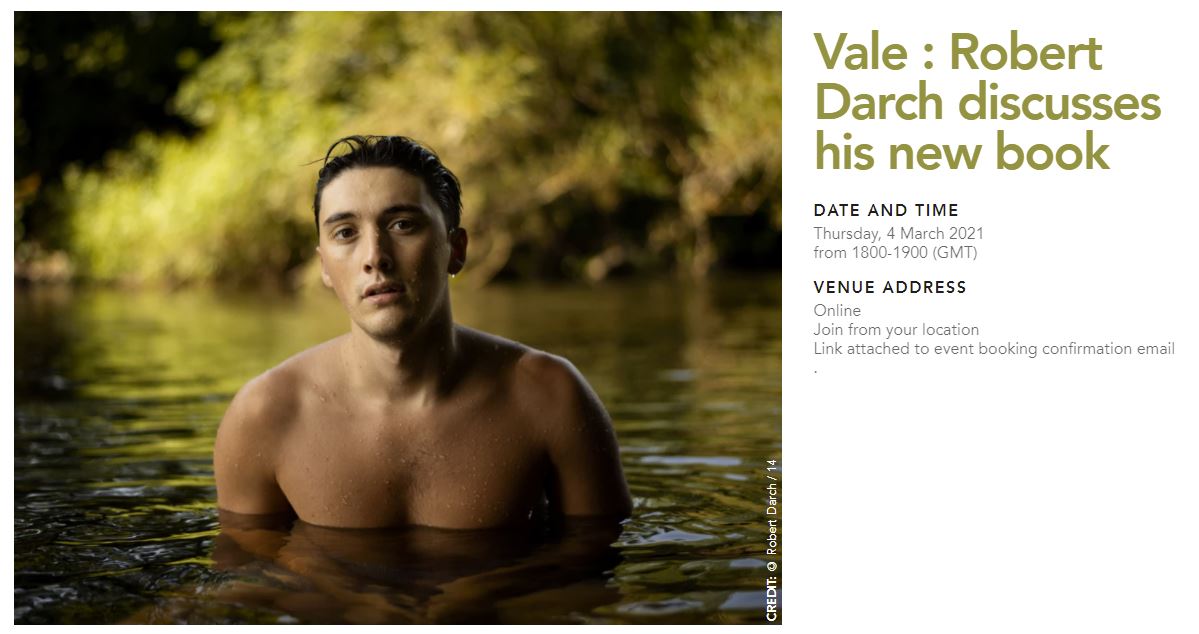
This was originally streamed on the 5th March (New Zealand) but due to technical issues I couldn’t gain access until ten minutes before the end, luckily the RPS had recorded the presentation so I was able to catch up and enjoy the presentation today.
Darch started to study photography in 2000 at the University in Wales, but in his second year suffered a minor stroke after noticing the loss of sight. After a period of recovery, he returned to his studies but had further issues in the form of ME. He spent a lot of time in house trying to recover/cope with this new situation, starting to look for projects inside the house, looking at light, self-portraits, interior spaces and then started to photograph others with the same condition. He moved to Devon and started the long journey to recovery eventually returning to complete his Masters.
His projects are based around place, emotions, the contrast between inside and out. He tries to capture the emotions, atmosphere and lost time in his life due to illness. The images are unsettling and very personal. The book was self-published which he said was not easy. Starting with far more images than needed, printing and posting on the wall to work with them for selecting, editing and flow throughout the book. He recommended making a number of pdf proofs to get feedback and a feel of the flow.
Relevance to my practice
So glad I was able to catch up on this as it reassured me that my process flow and method of selecting and editing was similar to someone who had already published. I still need to produce my pdf versions but as the majority of my images are ready to be exported from Lightroom and I’m in the process of learning InDesign hopefully this should be too far away.
MACK Talk: In conversation with John Divola
12th March 2021
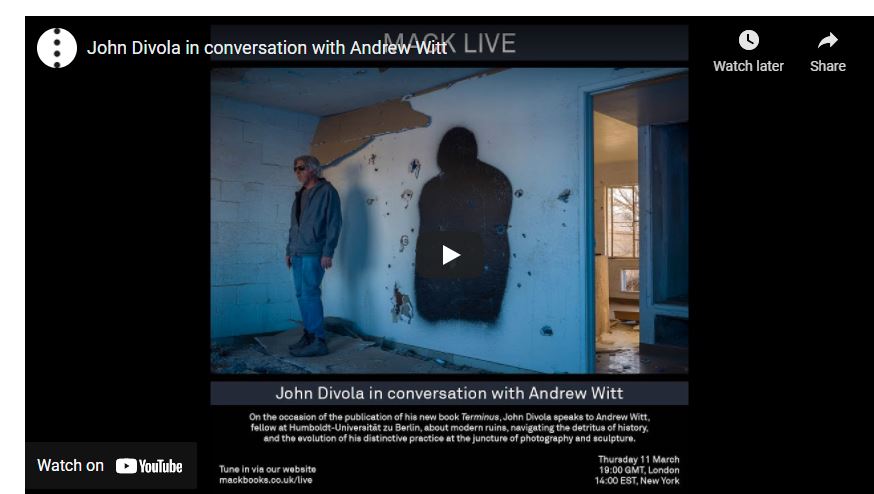
In this talk Divola spoke about his resent project and book ‘Terminus’. He has lived and worked in the US for over 50 years with this particular project starting in 2015 when he came across an old Airforce base that had been left to fall apart, left for the local drug users to strip the copper from the walls and take what they could to sell. The runway was still in use but the housing was not. There was approximately a square mile of buildings which he has photographed – the halls mainly and at the end he has painted a large circle or shape. Using a large format camera and visiting the site at different times he gets different effects.
The project started with a book in mind which is not how he normally starts; he tries to be fluid and see how the work evolves. When he photographs he tries not to effect the space, leaving no evidence of his presence, this time he has left his mark. He is interested in space, feelings, emotions, how people treat the space, the marks they leave and what its like to be in that space.
RPS: Contemporary Group Online Talk: ‘Lies, Damned Lies and Photography!’ Maria Falconer
16th March 2021
An interesting talk which links to both my Contextual Studies and Body of Work. As Falconer states the relationship between photography and truth is complex. She asks the very important questions; Is the medium of photography truthful? Does it show reality? Photography has developed and has been affected by a number of factors – science and technology. As technology developed photography came to the populous and so the growth of the medium took off and so did the ability to change the perspective and truth.
Falconer covered areas of crime, identification, evidence and if there ever was nay truth in photography. She addressed the early use of photomontage in propaganda, Surrealism and the growth of publications and how one image can have different meanings depending on how it is used and what text is applied. She also highlighted the use of domesticated animals were used to lie in a National Competition.
An interesting talk that raised far more questions than it answered.
PhotoVoice Worldwide Community with Nicole Brown: A Systematic Approach to Analysing Visual and Textual Data
19th March 2021
I logged into this at 3am in the morning as my Contextual Studies includes aspects of PhotoVoice theory and its an area that I would like to progress following this course and maybe even into a Masters or PhD. I had known about the Community as part of my research and often log into one of their talks or look at the project work being highlighted. They offer a series of on-line course that enable you learn the techniques of the methodology.
Brown started with a brief history of the process and then moved on to her own study (PhD work) into the development of a new framework that helped users analyse both the visual and the textual data that was being received.
Her project was based around subject suffering from fibromyalgia. Each week she would ask a question and get the participants to place objects into a box based on that question. They would then photograph the box and send her a narrative in response to the question and a copy of the image of the box. This data would be analysed based on her framework processes. Her research paper is to be published in April.
Brown explained how it was important to provide support but not lead or influence the participants. She also allowed them to communicate not just in written word, but poems, emojis etc. Its important to note that photos and text can lie and information can be withheld. There is a strong sense of ethics and ownership to be established. Trust needs to be gained.
RPS Documentary Engagement Talk: Melanie Friend
26th March 2021
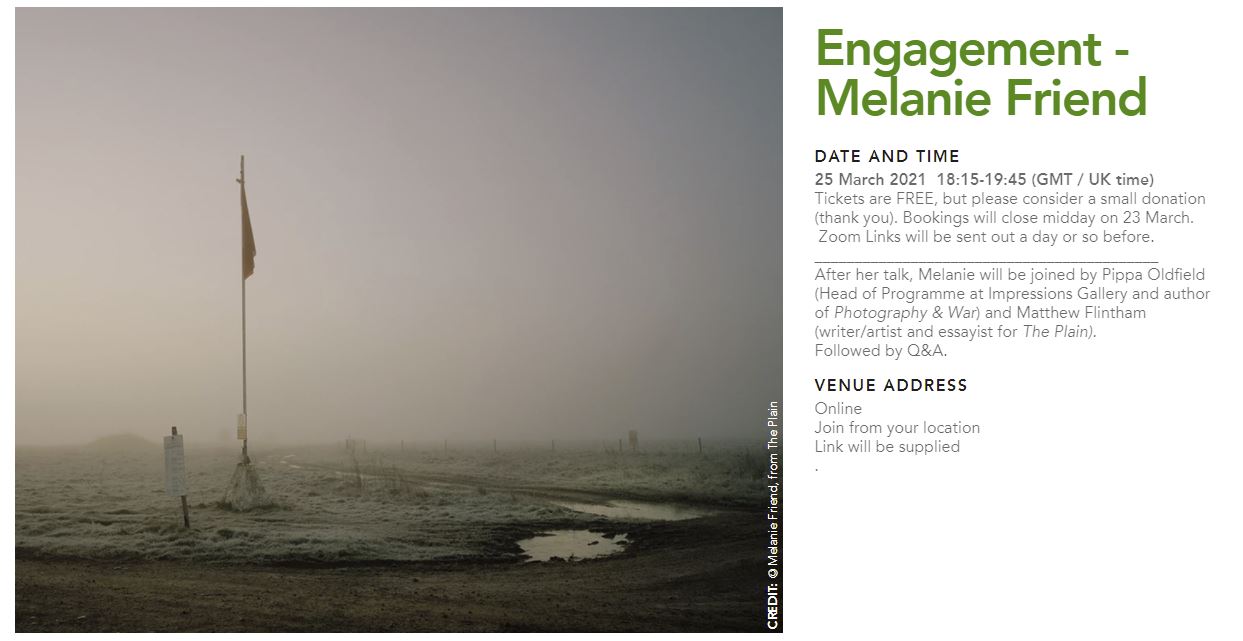
Friend started as a photojournalist in the 80s and 90s but began focusing more on long term projects in the 90s. Her projects were based around migrants, human rights, and the cold war. One of her first major projects was based at the women’s camp at Greenham Common. These were wide angle black and white images, showing life in the camp, the destruction to fence lines and the interaction with the police. These brought back memories as I would drive by the camp to work each day – not in its heyday but long after all the major unrest.
She moved away from journalism to focus on communities that needed to have a voice, her degree project focused on young single mothers, moving on to Kosovo and the migrants in camps controlled by the Serbian police, highlighting the issues of ethnic cleansing.
Her life changed following an illness, realising she needed to slow down, rethink how she worked, but still wanting to represent those without a voice she moved more into writing, podcasts, and exhibition work. Her projects now use a mixture of image, text, interviews and video.
She spoke extensively around her latest project – ‘The Plain’ these landscapes capture how the military are embedded in the community, how the land is affected, the damage to the environment by military vehicles and how in some images their presences can’t even be seen even though they are on practice.
Relevance to my practice
Her latest work is probably not as relevance to my Body of Work or Contextual Studies compared to her earlier projects on communities, mental health and giving voices. Friend has the ability to show the feelings and emotions of the time with both the use of the camera, lighting and black and white documentary style images. The wide angle capturing everything – that’s not to say these images were not cropped, processed before printing. She has continued to keep in touch with the single mothers she photographed for her degree, monitoring their progress and changes in circumstance, something I hope to do with the subjects of my project.
Photo Live event Gauri Gill – Image Maker Webinar
8th April 2021
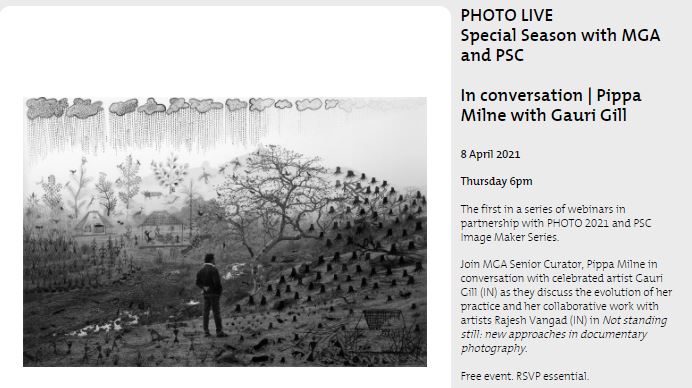
Gill is based in New Delhi and has spent years photographing communities that have been marginalised, with some archive of over 40,000 images she only now thinks of producing a book and that was mainly due to the fact that she was locked down during the pandemic.
Her project ‘Fields of Sight’ is a collaboration, the images consisting of layers of narrative to tell the final story. The book is a combination of images and text and paint on the images. She states that she finds it hard to know when a project is complete. Drawing a line and letting go is difficult. It’s a mixture of photojournalism and fine art.
She claims that she uses her camera as a way to gain access to people and their lives, stating that it breaks the ice and leads to conversations. The people she works with see her as a way to get their story across. In a number of cases her images have been used as evidence in court cases where the woman has to justify her rights to money or land. The images are there to provide a voice to the often voiceless.
Relevance to my practice
There was such a strong link to both my Contextual Studies and Body of Work with this talk. The rural communities, the female aspect and the male dominance. The voice to the voiceless is a strong theme of my essay and I can relate to this. I do struggle with the concept of using fine art photography as a way of representing the narrative as apposed to the traditional documentary style – I wonder if this takes away the effect of the situation? It may help to reach a wider audience as it its more likely to be exhibited, but then its more art than fact.
VII Agency Insider ‘Reporting the Siege of Sarajevo’
9th April 2021
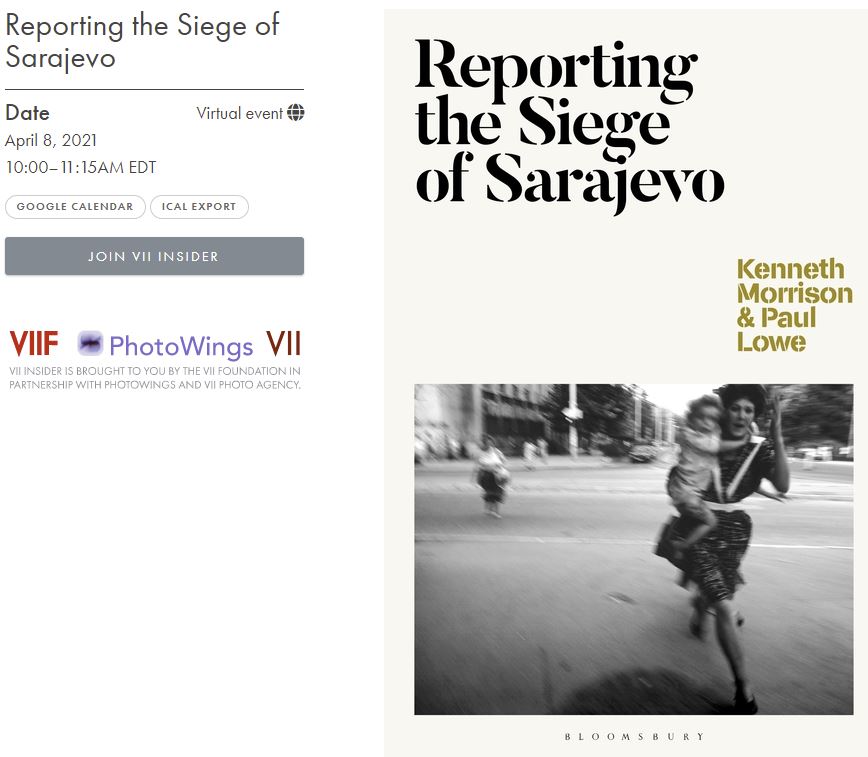
This was a 2am start for me but well worth it. Based around the collaborative book project by four photojournalists of the time from the first bullet being fired through to the changes in technology for report on the situation to end with the current state within the country. A powerful and frank discussion on the events they found themselves in.
The images were often raw but the emotions within their voices was even more so. I had to go out to the location during the situation due to working for the UK defence force, but was only based 20km outside so only heard the situation, these photojournalists were living it every day. Its hard to imagine the long-term effect this has on an individual. I could hear the frustration was they realised that their images, regardless of the evidence were having no effect on the outside world. The UN was allowing this situation to continue. Its only now that their images are being used to bring individuals to justice.
The Camera Store ‘Making Photobooks for Publication’ with Dr J Ashley Nixon
9th April 2021
Probably one of the most enjoyable, practical and information presentations I’ve attended in a while. Nixon has produced over 11 photobooks himself and seems to be on a roll, producing around two a year. Nixon has developed a framework of the ‘5P’s’. These are steps to consider and questions to ask yourself when considering the production of a photobook.
Step 1: Purpose
- Why do you want to produce a book?
- What content do you want to share with an audience?
- Do you plan to do an exhibition? Or is this the alternative?
- What is or story and narrative?
- Make a record of your journey to production
- There needs to be a linking factor
Step 2: Planning
- Creating content in words and images
- Photo assignment/project/opportunities
- Gathering content
- Interviews
- Translations
- Additional research, documents, scans
- Creating images that fit within a book, these are very different to that of an exhibition
- Cover images and chapters
- Double spread or single – remember gutters
- Multiple formats
- Note book for recording
- Who? What? Where? When? Why?
- Permissions
- Who will print, buy and sell?
Step 3: Process
- Writing
- Images – printing, editing, sequencing, drafting
- Design – software, typeface, words
- What kind of book?
- Consider a magazine or Zine
Step 4 & 5: Publishing and Promotion
- Print services
- ISBN
- Online presence – self promotion
- Competitions
- Book stores
- Cost
Relevance to my practice
Packed full of useful hints and tips for when I’m producing both my mock book for assessment and for when I complete SYP as I would really like to produce a book for the ladies that gave up their time to take part in my project.
Currently I only have a quote as the written part to the book but I would really like to undertake a small collaborative piece for the book and maybe as part of the exhibition. As this will only be a limited edition, I understand that the cost will be high and so thinking about grant funding will be worth investigating as it is a very local project, my own local council may be interested in funding part of it. I have also been thinking of producing a Zine to go with the exhibition for a small contribution of a ‘gold coin’.
Photoland Talk ‘A Conversation with Bas Losekoot’ and his project ‘Out of Place
16th April 2021
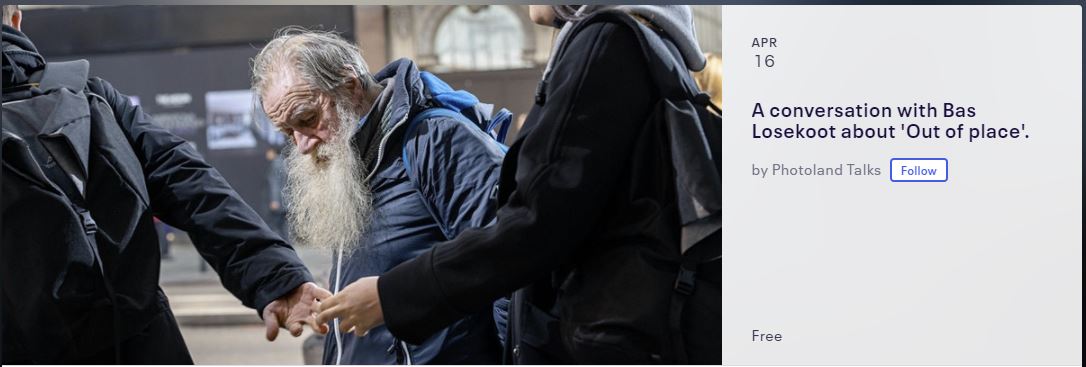
This project started in 2011, a global project across nine cities, documenting the lives of people who live in the streets, their movements, the progress from cities to rural life, the rural environment and the commuters.
He questions why people want to live in cities when they are such lonely places. Are these megacities really offering happiness? The project focuses on the high transit zones of the cities, subways, finance districts. How we as humans move together yet keep our distances. How we are alone, isolated behind our newspapers, books and ear pods. We want to be alone but be together.
Losekoot is a photographer whose work addresses socio-cultural issues using cinematographic apparatus and techniques that challenge the understanding of everyday urban routines, mental health, rhythm, distance and mobility of the human species.
Photography and Series
Art House Open Lecture Series 2021: Vanley Burke
20th April 2021
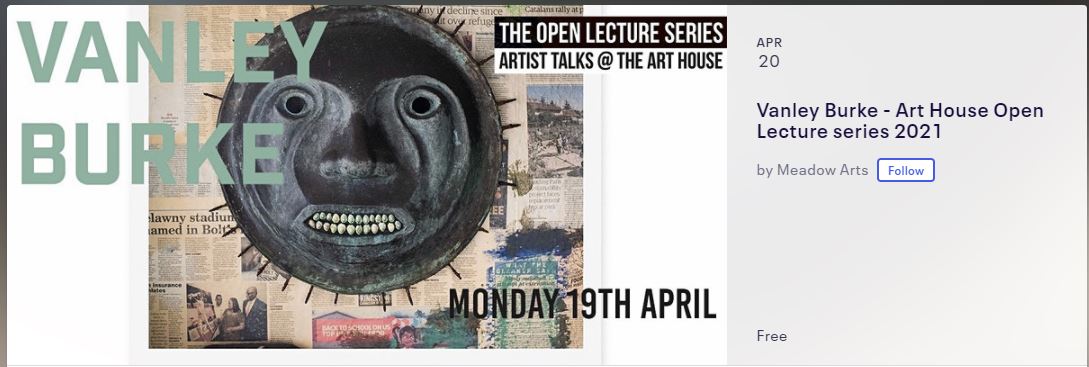
I had seen Burke’s work before, the iconic image of the young boy, his bike and the Union Jack Flag and so I was interested in hearing more about his work and projects. It was a little disappointing to only get 30 minutes of him discussing his projects and then the rest of the time allocated to questions from the organisers of the talk.
Burke photographs the lives of people and how they live and cope with moving into new spaces. He documents lives from a very unique position, very different from the media. He lives and works with local communities and shows their lives in a very open and frack way, cafes, hair dressers tailors etc. He has captured conflict and the intentional use of space, how its lived in, changed and grown. He has continued to follow a number of his subjects over the years and they have become friends. His work shows how culture travels from country to country and how it is adaptive. He is a major collector of artifacts, making sure he captures them in place first before they are moved to his tiny flat.
RPS: Publishing Photography – In Conversation with Dewi Lewis
20th April 2021
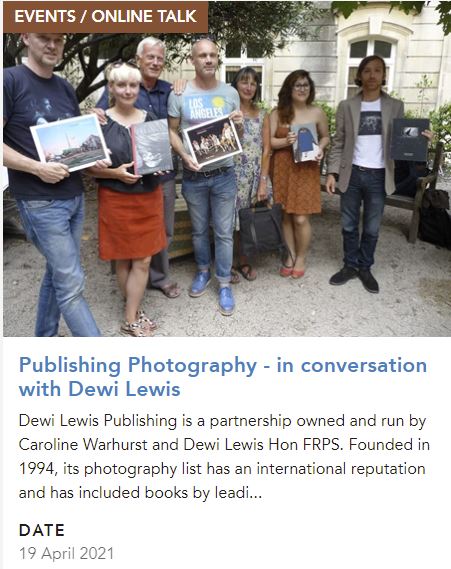
Lewis is a publisher who started his own company in 1994, currently published over 500 books, with 200 titles currently in print worldwide. Before the pandemic he would publish between 20-24 books a year. This is an independent publisher so he was offering some valuable advice for the future, for SYP and if I want to complete one of my bucket list projects.
- Developing the book concept – the why, what, who is it for, what content and the form you wan to use. The content is key, beautiful images don’t always make the best books. Be honest with yourself. To make money it needs to connect with an international audience, have a human connection and an interest for many.
- Understand the publisher – what do they usually publish, where do they sell, what to they usually produce and how do they want to interact with you. Do your research!
- Submitting work – cold calling, getting attention, portfolio reviews. Attend book fairs, speak to them directly, net work and make connections
- Publish or Self-publish – how much work do you want to do? Cost, do you have the skills? Kickstarter funding, grants
- Think outside the box – is a book the right medium for your project? Would a magazine or ZINE be better?
Relevance to my practice
Loads of useful hints and tips for my mock up book for assessment and for the next stage of my course in SYP. I have to admit the thought of showing my work to a professional is a little bit intimidating but it needs to be done if I’m to grow and improve and I think most are happy to help. A book was never on the radar when I started this part of the course – but then neither was a global pandemic. I did want to offer the ladies that have taken part some form of gift so I would like to produce something that they would like to own. Funding both an exhibition and a book is going to have to be carefully considered and planned for so approaching the local council, or crowd funding will need further research.
Image Makers Webinar Series: Photo Live with Dana Lixenberg
6th May 2021
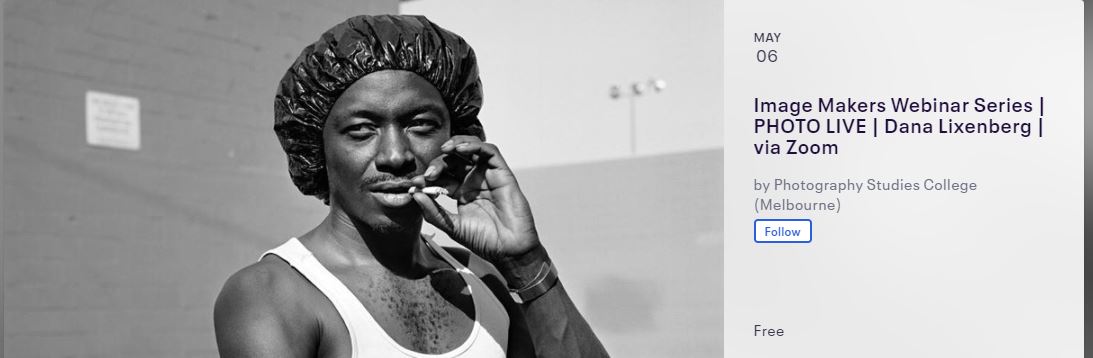
Lixenberg is a Dutch photographer who lives between Holland and New York. The majority of her work consists of long-term projects and the one under discussion today was the project ‘Imperial Courts’. This started in 1993 and is based around the housing project that was build between two major motorways in LA. Here she managed to gain access and the trust of the local gang members. She photographed them using a 4×5 camera taking images over a number of years capturing the families, and now the children of the original subjects, many that have ended up in jail or dead through the violence in the area.
It was amazing to hear how over the years she has remained in touch with the groups, how she gained access and the trust of these people. It was hard to hear that when the images were exhibited the subjects didn’t attend as they rarely leave the area they live. She would however return to give copies of the images and she produced small books for them to keep. The images consist of portraits, landscapes and now she has also started to use video. The use of black and white seems to add to the mood of the locations and as she explained, she tried to use colour but they just didn’t feel or look right.
Relevance to my practice
I had originally booked this just out of interest but found that her approach to this community was very similar to mine, gain trust, listen, show respect and observe. Never judge. For me it must have been heart breaking to return to the place and find people that you had formed friendships with were no longer alive due to drugs, gang warfare or in jail due to murder charges.
RPS Documentary Engagement Talk: Daniel Meadows
14th May 2021
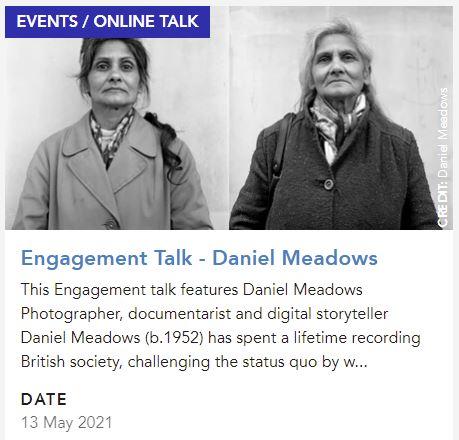
In this talk Meadows offered his ten ‘Rules for Engagement’ and recommended reading the book ‘Let us now praise famous Men’ by James Agee and Walker Evans. The rules were to address the moral and ethical issues of documentary photography.
- Know why you are doing the project, who its for and where it will be seen
- Practice explaining what you do including who benefits from it. Be clear and succinct
- When deciding your subject matter, research it on the ground and in books. Familiarise yourself with all the ways in which it has already been covered and begin work only if you think you can bring something new to it.
- Once you’ve committed to a project immerse yourself in it. Live close to it, as close as you can and in a way that is sustainable. Nothing must be more important than your work.
- Work by yourself and be disciplined. Do it for at least 8 hours every day and do it as well as it can be done.
- Make a habit of engaging with strangers particularly with people whose attitude are not your own. Be polite, don’t argue, listen, be curious and respectful.
- Celebrate wonder.
- Catalogue everything you produce as you go along
- Don’t call yourself an artist.
- Don’t expect anyone to be interested in what you’ve done for at least 20 years.
Relevance to my practice
Some great advice and some hard rules to follow.
Auckland Festival of Photography
4th June – 7th June 2021
Travelled up to Auckland to spend four days fully immersed in the Photography Festival. Funded by the Auckland Council all events around the CBD and the greater Auckland area were free. Events ranged from small bespoke galleries to outdoor locations on the waterfront or in the streets to on-li`ne talks, with presenters from the US and Japan. I tried to view as many as I could but Auckland is not the easiest city to get around and some of the locations closed early due to the fact it was a public holiday weekend for the country but I did manage to see:
- Cameron McLaren & Cosy Ellingham outdoor Waterfront exhibition
- Chiara Panariti & Gianfranco Ferraro at the Ellen Melville Centre
- Lene Marie Fossen ‘The Gatekeeper’
- Mitchell Moreno ‘Pandemaniac’
- Claudia Heinermann ‘Siberian Exiles’
- Cameron McLaren ‘From Lockdown to Reopening’
- Stuart Clook ‘Precious Landscapes’
- Photobook Friday
- Stuart Clook & Dale Rio ‘Out with the New: Historical Photographic Processes’
- Sampford Cathie ‘Retrospection: 100 Years of Devonport”
- New Zealand Defence Force Photographer ‘Standing Apart, Together as One’
- Lake House Arts Members ‘Community Photo Exhibition’
- The Harakeke Project ‘They were young once’
- Henderson Photographic Society ‘members Collection’
- Female photographers using film
- Yasser Saeed ‘Structure Alone’
Relevance to my practice
This trip was really just for my own personal interest but I was interested in seeing the different uses of spaces both internal and external to display the images. The simple open space with a single projector for Lene Marie Fossen’s ‘The Gatekeeper’ was so powerful as it made you sit and watch the whole presentation, to take in the powerful, thought provoking images and text. In fact I watched the presentation through several times.
I noted that several artists seemed to find it difficult to edit their series, trying to cram it far too many images for the space – Yasser Saeed being an example. The images were often repetitive as if he couldn’t make up his mind which to select. A problem I probably had undertaking my edit for my Body of Work.
I was drawn to the exhibitions that were in the landscape, such as those on the water front, in the CBD or at the entrance to the major tunnel construction within the city centre. This for me highlighted the use of space, linking the artist to the viewer in a more intimate way than a cold white box. The open space exhibition is something I would like to explore with my Body of Work. Printing and displaying the images within Ngawi along the fence lines, exposed to the elements, just like the residents of the space.
Photo London – Book Club Live: Sebastiao Salgado in conversation with Peter Fetterman
23rd June 2021
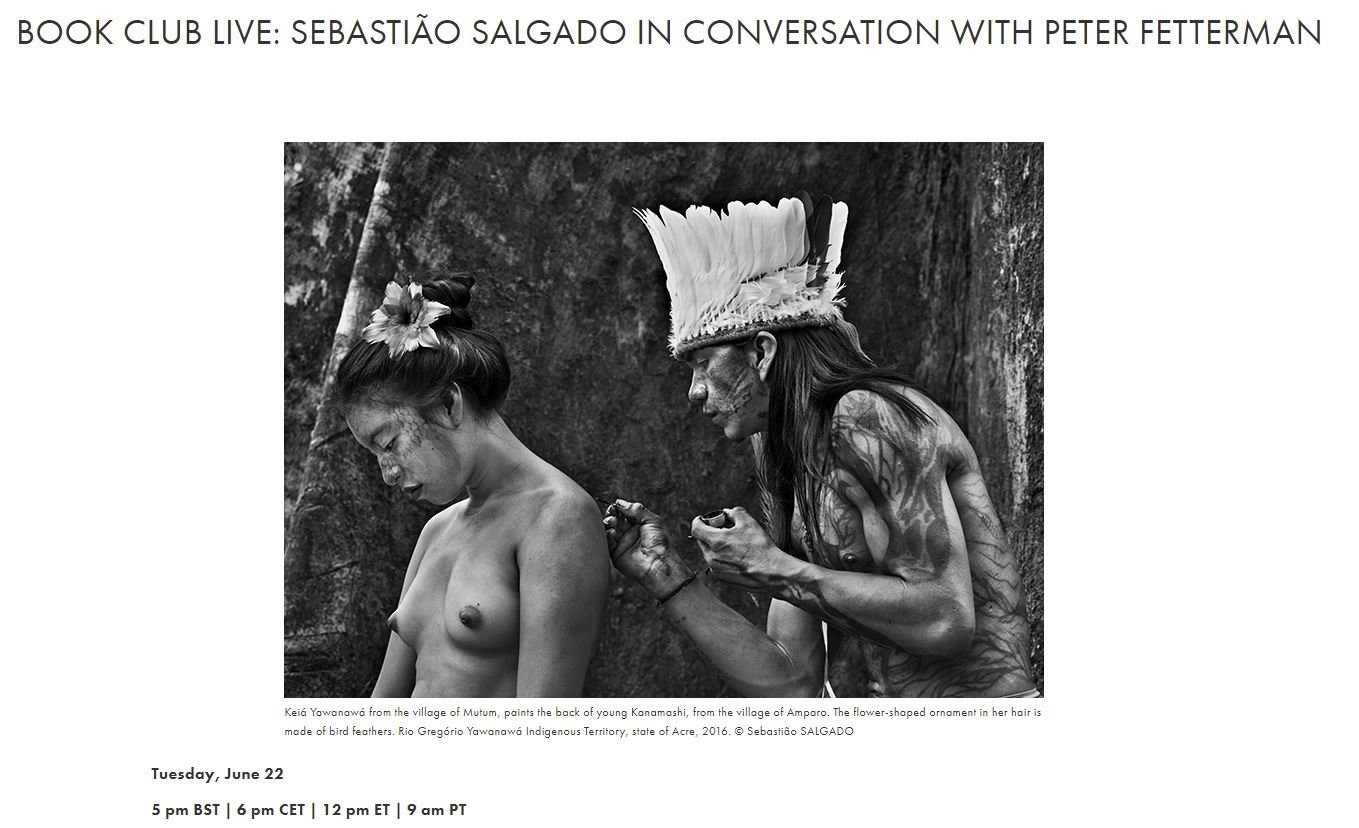
I was so glad I managed to get to see this presentation as I had missed the VII Agency one. The talk based around his life work in the Amazon and the release of his book. He explained how the book has taken over 14 years to produce, that preparation in important, but also to be prepared to change direction with a project that is going to take years to produce. It is important to adapt to your surroundings, to stay as long as is needed.
He is so passionate about the forest and explained its importance not just to Brazil but to the whole world. He uses his photography to transmit a message, stating that only by living there do you gain an understanding of the space you are trying to capture. You need to believe in your story, if you don’t then this will show in your images. He believes that you should be prepared to return and return again to live the story.
Relevance to my practice
I can’t really compare Ngawi to the Amazon but I do agree that in order to truly know a place/space you need to return several times and if possible, to live there. You cannot hope to gain an understanding in a single visit. By living or retuning then you can really capture the essence of the people, and the space. I’ve lost count how many times I’ve drive the road to Ngawi and every time the coast is different, coast more warn and the light has changed.
Photo London – Guy Tillim in conversation with Valeria Carullo
8th July 2021
Tillim used photography to explore his own country of South Africa. It allowed him to explore and gain access to areas not normally allowed for a white person. He explained that photography was not his first love but soon became a passion. He started to follow the major US photographers and this initially influenced his style of image making. Tillim stated that this had both positive and negative effects as he was trying to always find the drama in an image.
The 1990s saw a lot of photographers out of work. He soon realised that he needed to stop following the trends, to find his own style as the environment was not the US, he needed to stop looking for the drama and allow the space to tell the story. These were places going through major change. He originally tried to capture this in the people, buildings, the decay due to lack of ownership and control. This first project shows the need to be in the environment, be apart of it and record what is there. The movement of people from the country to the cities. The second project was completed some ten years later and focused more on the environment and a lot less of the people.
 Michele Usher