1st October 2020
Travelled to Ngawi for the eighth lady in my series – Pam. When I arrived, I was met at the door by her husband Larry. Larry did most of the talking as he explained Pam was having problems with her memory. Early on set dementia seems to have place Pam into a world of her own. She had just celebrated her 82nd birthday. The couple had lived in Ngawi for over forty years marrying when Pam was seventeen, which these days seems very young.
Larry had been able to trace both sides of the family back to the time when they lived in the UK and arrived in New Zealand in the 1846 from Liverpool. There were some amazing images on the walls of their families through the years. Although they only had three sons both were from large families. Pam was one of nine and Larry one of eleven.
Pam seemed reluctant at first but Larry reminder her that she had agreed to take part, so she went to comb her hair and put on some lipstick. After a few apprehensive starts we got into the flow and as soon as she took me into her comfort zone of her garden she seemed to relax and drift off into her own world, often forgetting who I was. I want to try and capture both her lucid moments and those when she drifted off.
While we were outside Larry had sorted out a few of his old photographs of the area showing me the time before all the development, they had purchased one of the first sections, the image showing the original property, no road and a single power line that was for the Lighthouse. He also had some newspaper articles one showing his purchase of a tracker – original cost of GBP15 and still running today to take his boat into the water.
It was great to meet them both but I’m not sure I got as much out of Pam as I did from Larry, this was really due to the fact of her condition, so I will have to make the best of it.
6th October 2020
The first Tuesday of the month is the local camera club evening. I have to admit I’m not a great club fan and I don’t tend to submit any images but I was particularly interested in going tonight as the guest speaker was Andy Spain who I had met and spoke to in May of this year around my ideas of the street pano of Ngawi.
When we arrived, Andy was standing at the side of the room and so I went over to say hello and thank him for his advice on my idea of the panorama – luckily, he remembered the exchange. He asked how I was getting on and so I explained my difficulties around the stitching, he highlighted the same issues with his so he made it a feature and suggested that I should deliberately introduce alternative images that link back to my initial idea of Ngawi being isolated and the rural mental health issues. He is also taking portraits of the people of Cuba Street and trying to link them with the street panorama. His concertina book would involve a 7m print and then a hidden section at the back containing the portraits. He suggested I use the same idea. He is in the process of trying to find funding as the printing would be extremely expensive. I liked the idea but wasn’t prepared to copy. It would be nice to use the street images I have produced but I think I need to think of something else.
11th October 2020
Spent part of my day producing and submitting Assignment 3. I had made a bit of a mistaking thinking that I needed to complete part three of the course work prior to the Assignment but this one was just really an up date on my progress.
My final submission can be seen here but in summary I detailed all the work I had completed to date, my numerous different themes and ideas due to the COVID situation and links to the different photo sessions I have completed. I don’t think I offered a very good overview of my reflections and thoughts of the images as I’m still trying to settle on the final theme/direction of my project.
I think the strongest is that of the women of Ngawi but I don’t want to lose all the other images I have taken. It will be interesting to gain a different view. I have asked for several peer reviews as I have produced images and developed them and these on the whole have been positive – the problem is how to bring them all together.
14th October 2020
Received a request from my tutor following my submission to meet up via Zoom the following day, so agreed a 7am meeting.
16th October 2020
A really positive session with my tutor to discuss progress and ideas for moving forward.
We addressed a number of ideas and he agreed that the strongest theme are the women but to ask myself ‘Do the images show what I found?’ i.e. that these women are the backbone of the community, that there is a strong absence of men. I could edit the sessions with a clear direction of symbolism for example images of land, work and sea are usually considered masculine whilst things within the home are feminine. We discussed the large imbalance of the male/female population and how this could be shown in my series.
I raised my concerns around the colour v black and white images. My tutor said they worked in either with some being stronger as colour but that I had managed to process in a consistent manner.
My tutor suggested I review the work of:
- Mark Neville
- Jo Coates
- Sophie Gerrard
- And some of his own projects; Aspirations
Recommendations for the next stage:
- Undertake a quick edit and see how the images fit using the question posed above;
- Review the artists discussed;
- Experiment with a more formal set up or go along to a community event see if I could get any male residents.
Overall, I feel more positive about the project. It will be interesting as to how I can gain access to a community event or for the setting of more formal portraits, as this really isn’t a New Zealand way and especially in these remote locations.
20th October 2020
Had a few free hours to do some processing of the Pam photo shoot of the 1st October. I had been putting it off as I didn’t think I had achieved the right feel and the session wasn’t easy to complete. The following are some I like and I think I have managed to capture her in both her lucid and lost moments.


All images processed from the session can be found here.
26th October 2020
My tutor suggested a number of photographers to research one of which was Mark Neville. I have already reviewed his work and a summary of my thoughts and ideas can be found here. The second artist was Jo Coates and I have provided more detail in my photographer’s section here.
In a similar way to Coates I try to spend time prior to picking up my camera with each of my subjects. I’m not a natural portrait photographer and like Coates I’m an introvert, so undertaking this kind of photography is extremely challenging, but by not placing that barrier between me and my subject at the start I think both of us relax and go with the natural flow of the session. I find myself drawn to her environment portraits as these tell the story of the subjects situation, they seem to be in context and add to the narrative which is something I’m trying to achieve with each of my sessions at Ngawi. For me the direct gaze towards the camera means the photographer is part of the image, they are there changing the situation, it’s staged and unnatural. For my Body of Work, I want the subject to be completely un-staged, as if I wasn’t there, I’m an outsider, not part of their environment and therefore I want to be unseen.
The next photographer was Sophie Gerrard. I have provided examples of her work here, but I was particularly drawn to her work on the island of Orkney situated off the coast of Scotland, this location is very much like Ngawi, remote communities working together to make a living from the land or sea, money from tourists during the summer months and making do. Fixing what’s broken as it can be sometime before a replacement is obtained.
Orkney, well Scotland in general was one of those places I was always meaning to go to when I lived in the UK but never got round to, but through Gerrard’s images, although staged there is a similar feeling to that of Ngawi. The community coping with the isolation, the weather.
She uses a combination of portraits and environmental studies to tell the narrative, but for me there seems to be a more there then she is telling, more questions than answers. The muted colours add to the mood of the location, the rolls of seaweed remind me of my photoshoot with Sue (see here), a way to supplement her pension. Like others Gerrard uses that direct, dead-pan gaze in her portraits, giving a barrier between subject and viewer and for me gives a very cold atmosphere to the narrative.
28th October 2020
At my tutor discussion it was recommended that I look at some of his work, in particular the project ‘Aspirations Doncaster’ (2014). I found a recent article on-line which took place earlier this year where Les Monaghan stated:
‘I am interested in class, community, and representation. I make difficult photographs with people I represent often after long term engagement, listening and reflecting. Previously a press photographer schooled in unambiguous imagery, I have deconstructed the documentary method through successive projects; staging photographs with migrants in assimilation (2006 – 2008) and A Dream of Doncaster (2016), working with text and portraits on Aspirations Doncaster (2014) and The Desire Project (2015 – 2016); fictionalising documentary with A Series of Dislocating Events (2011 – 2014); and collaboration with Relative Poverty (2016 – 2019). Works are often shown on a large scale engaging directly with the public.’ (2020)
Link to Article: https://miniclick.co.uk/2020/02/29/leeds-talk-with-les-monaghan-and-lily-miles-19th-march-20/
Link to Project blog: http://aspirationsdoncaster.blogspot.com/
The combination of portraits and text has not been something I wanted to consider. I wanted the viewer to look and make up their own story, to see a side of Ngawi that is not normally on show, that hidden aspect, the back bone of the community. The women that seem to hold everything together and keep going through thick and thin, the highs and the lows, regardless of what life throws at them.
It was interesting to read the blog site for the Aspirations project, to see the environmental portraits of the young and their parent or care giver. Monaghan took over 600 images in a population of over 300000 which is a such a small percentage of the population compared to my project where the population is less than hundred. It was interesting to see in these deadpan environmental portraits the dreams of the older generation compared to those of the young in 2014. The aspiration from midwife to surgeon, that jump in education and training expectation.
Or the influence of social media and the draw of making it big from on-line interaction, a case of an easy life or lowering of aspirations?
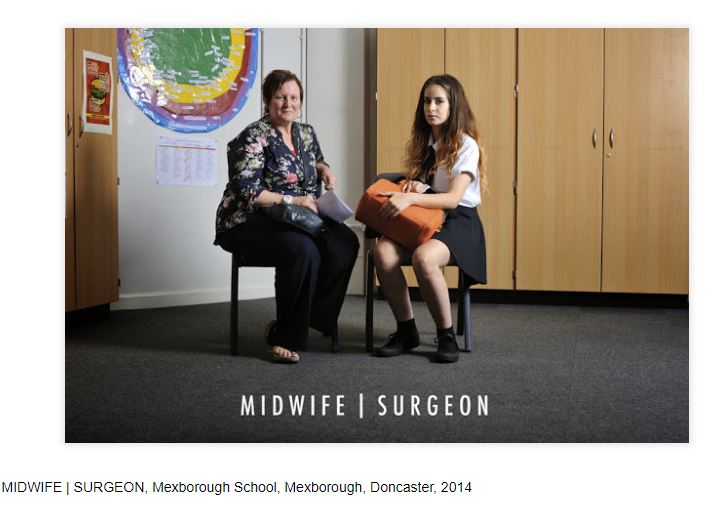
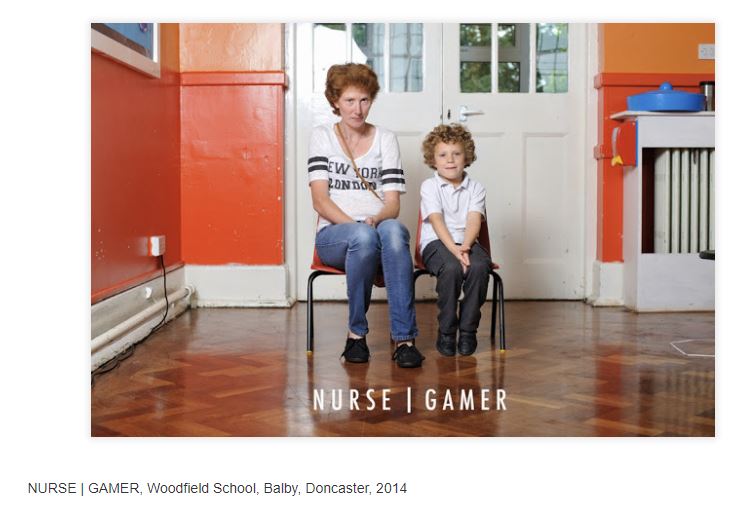
I found this statement from the blog really reflected the world today:
‘The aspirations reflect the de-industrialisation of Doncaster, the hopes of the middle classes and their recognition of the value of extra-curricular activities for their children, the stark gender divide in potential employment and the overriding concern with job security impressed upon young people since the decimation of local coal and manufacturing industries and the effect of this thinking on, limiting aspirations to the achievable and consequent stunting of social mobility’. (Monaghan 2014)
 Michele Usher