Levels of Meaning
This section of the course work starts by reminding us that as photographers when making photographs ‘it is best to steer clear from literal interpretations’ (Boothroyd, 2013) and as a language photography is often complex.
It is important to understand the meaning of the language and allow the ‘visual codes to produce more in the mind’s eye than meets the visual eye’. It is important that the parts of the image are used to create an impression that is beyond the literal and obvious meaning.
I have been asked to provide meanings for the following terms:
- Metonym – the act of referring to something using a word (or image) that describes one of its qualities or features
- rhetoric – the art of effective or persuasive language
- symbol – a sign, shape, or object that is used to represent something else
- connotation – a feeling or idea that is suggested by a particular word although it need not be a part of the word’s meaning, or something suggested by an object or situation
- innuendo – (the making of) a remark or remarks that suggest something sexual or something unpleasant but do not refer to it directly
- euphemism – a word or phrase used to avoid saying an unpleasant or offensive word
Editing
Trying to edit your own images is not going to be an easy task as it may mean removing images from the selection that you have grown attached to, but its important to identify the strongest theme/narrative to your final selection.
The Work in Progress section to this blog shows how I have selected what I consider to be the best images from each photoshoot, however this was against a very changing narrative.
As I start to review the editing I have completed so far and narrow down my selection I will use the following four questions:
- Is this image strong enough as a visual piece without the rest of the series?
- Is this image adding anything new or emphasising a point that I want it to?
- Is it detracting from or contradicting the rest of the series?
- Am I overlooking any less striking work because of aesthetic concerns that may be secondary to the impact the piece will have on the final reading?
Looking back at the images I have made and the through processes I have gone through, along with the external effects of the world pandemic, it is interesting to see the changes in my images.
My original thoughts were based around traditional documentary, trying to capture the landscape and the people of the location. As this became difficult through the COVID situation I needed to try and capture a different aspect, one of the effects of the situation on the location, loss of income etc. Not being able to travel would have restricted my ability to capture anything and the decaying cray project (detailed in Work in Progress) was not very successful. The hard outer shell has not broken down and so this has been put to one side.
Luckily for me and New Zealand as a whole we managed to isolate and restrict the spread of the virus and we were soon able to travel and mix with others. The residents of Ngawi are very protective and although they have a large number of visitors to the location that transition through to the lighthouse and seal colonel along the coast it took me some time to gain their trust.
My initial session explored the landscape and by stopping and talking to one of the residents on the beach I was able to get my portrait session (see General Images, Trish). The letter request resulted in two more residents (Melanie, Alison) and a session out on one of the Cray Boats.
By talking to each person, I was able to obtain an introduction to the next and a slow building of trust (Bea, Donna, Julie, Pam and Sue). These ladies are the true backbone of the community. On their faces they show the effects of holding things together. There’s a story in each line. Life is tough but they hold things together. They learn how to cope with the constant wind, the ups and downs of the local industry, they adapt and the move on.
My editing process, along with my thoughts and reflections can be found in the Work in Progress section of the blog
Using images and text
Roland Barthes highlights two forms of the use of text with images; anchor and relay. Anchor, is defined as text that fixes the meaning of the image, mainly used in media releases such as newspapers, where the image is accompanied with text which explains the image, such as the location of the image, the subject of the image. Other examples are that of advertising. Barthes explains in great detail the use of text in the advert for ‘Panzani’ – pasta. Text used in adverts are used to sell the product, be that food, vehicles, beauty products, home ware or a type of lifestyle. There is a clear point to this text, the viewer is left in no doubt.
The second use is relay text, here the use of words should add to the ‘interpretation’ of the image. One example we were asked to look at was the work by Keren Knorr (b.1954), a German born American photographer and Professor of Photography. Two of her projects; ‘Gentlemen (1981-1983)’and ‘Belgravia’ use text in a relay form. Looking at the images from her website for the ‘Gentlemen’ project the text seems to come from a novel based in Victorian times.
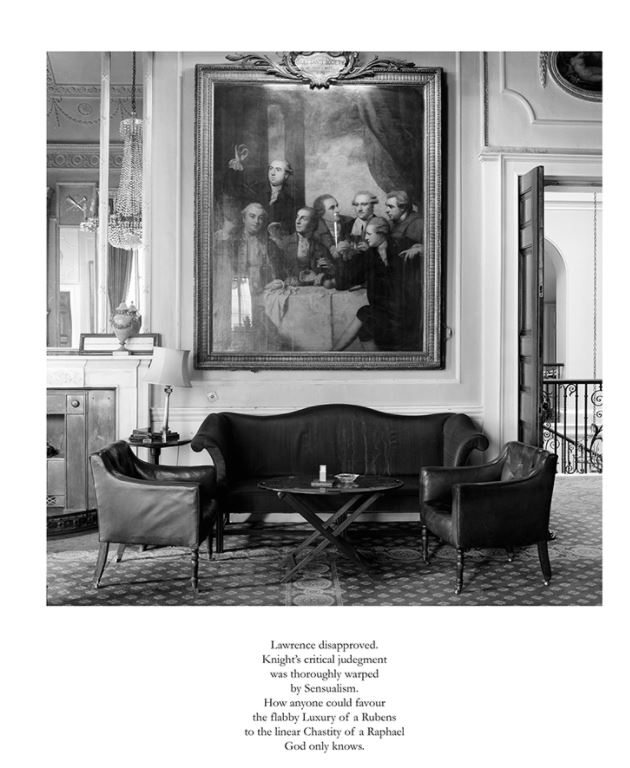
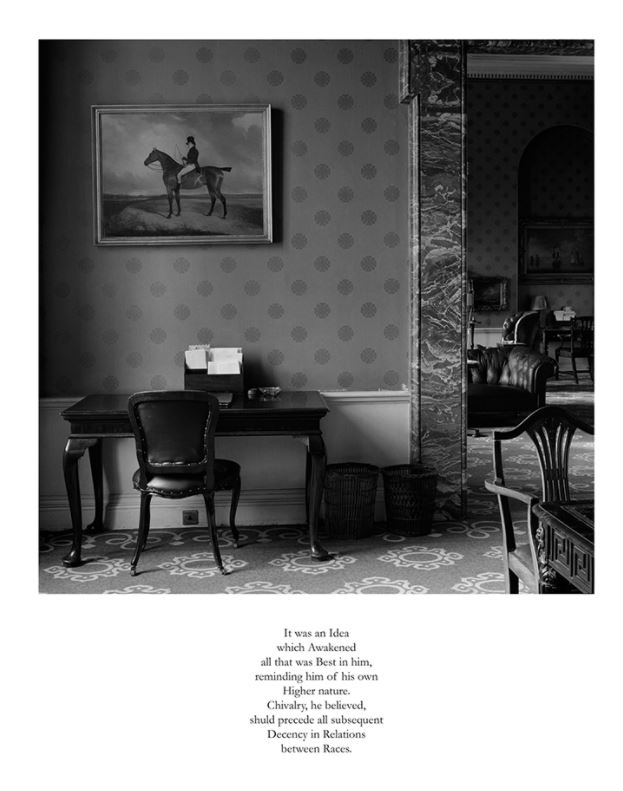
Images taken from www.KarenKnorr.com.
For me the images speak of both a power or implied power, and sexual discrimination. I think the following quote from an article I found on line in the Observer sums up the feeling I get from these images:
‘It is this conceptually driven play of image and words that makes Gentlemen such a mischievous meditation on the sanctity – and absurdity – of these male institutions and the people that inhabit them. The portraits and the texts are not what they initially seem, the former being art-directed by Knorr to be both “natural” and revealing, the latter being constructed from parliamentary speeches of the time, as well as quotations from contemporary news reports. The end result is a kind of visual and linguistic mimicry that echoes, sometimes directly, sometimes obliquely, the language, values and beliefs of the English aristocracy. Among them is the belief in primogeniture – the right by law of the firstborn son rather than daughter to inherit the parent’s estate. Being born male, then, is, as Knorr suggests, the first privilege from which all others flow’. (O’Hagan 2016)
Bibliography
Accessed 15/12/2020
Karen Knorr website: https://karenknorr.com/photography/
Guardian Article on the Project ‘Gentlemen’ (Feb 2020): https://www.theguardian.com/artanddesign/2020/feb/19/karen-knorrs-best-photograph-wartime-inside-a-gentlemens-club
1854 Photography article: https://www.1854.photography/2020/05/karen-knorr-gains-access-elite-london-gentlemens-clubs/
Article with Sean O’Hagan (2016) The Observer ‘Gentlemen by Karen Knorr review – eminently clubbable’ https://www.theguardian.com/artanddesign/2016/oct/31/gentlemen-karen-knorr-london-clubs-mocking-rich-powerful
 Michele Usher