Blue Prints Exhibition New York Public Library October 19th 2018 – February 17th 2019
Attended the exhibition on 15th January 2019 (information taken from Documentary Course)
Victorian England during the industrial revolution was a remarkable environment for discovery and learning. A succession of innovations in science and technology yielded changes in society, among them a divergence of gender roles. Men were defined by their accomplishments and ability to provide, while women were largely confined to the domestic sphere. However, one exceptional figure was Anna Atkins (1799-1871) who emerged from these strictures. Encouraged by her father and his circle of friends, Atkins began in 1843 to combine her artistic sensibility with her curiosity of botany to create Photographs of British Algae. It was the first book to be illustrated solely by the new medium of photography and the first sustained effort to apply photography to science.
She used the process called cyanotype which is a photographic printing process that produces a cyan-blue print. Examples of those produced by Atkins can be seen here:
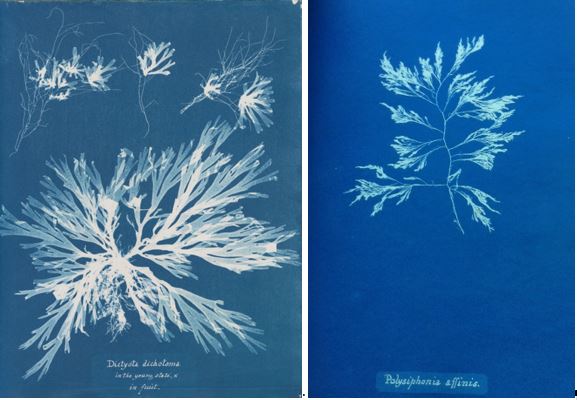
As described in Wikipedia [accessed 19/05/2020 https://en.wikipedia.org/wiki/Cyanotype] the English scientist Sir John Herschel discovered the procedure in 1842. Though the process was developed by Herschel, he considered it as mainly a means of reproducing notes and diagrams, as in blueprints. It was Atkins that really bought the process into its own by using it in a process by placing objects directly onto the paper and exposing them to sunlight. The paper is then washed with water and then washed in a weak bleach solution (but not for long) and then re-washed.
Cyanotype prints do not react well to basic environments as the image fades. Another unusual characteristic of the cyanotype is its regenerative behaviour: prints that have faded due to prolonged exposure to light can often be significantly restored to their original tone by simply temporarily storing them in a dark environment.
 Michele Usher