Gideon Mendel was born in Johannesburg, South Africa, in 1959, he initially studied psychology and African history at the University of Cape Town. At the start of his career as a free-lance photographer, he documented life in South Africa under apartheid.
In an article for The Guardian (2018), Mendel states ‘I’m part of a long line of South African white, mostly male, frequently Jewish, photographers who have had at different points a deep fascination with black poverty, and because of power relations, have had very easy access to black poverty. That’s something I’ve been thinking about a lot recently. To what extent are the images you make a result of your privilege?’
The majority of his work is focused on the political, and racial struggles in South Africa leading up to Nelson Mandela’s release from prison in 1990. Three years later, Mendel moved to London and starting photographing people living with AIDS, first in Africa and then around the world.
‘My own first encounter with the disease had been in 1993, photographing on the Aids wards in Middlesex hospital, London. That experience set me a journey to photograph the disease and responses to it. By the time I took this picture, I had gone with home-care teams into people’s homes; I’d photographed in hospitals, I’d shot drama projects, educational projects, activists campaigning. This image put it all together. It’s a classic image of a mother’s care – even just things like seeing all the plants in their rusty buckets, the sense of nurturing.’ (Mendel, 2018)
Awareness about HIV/AIDS was growing rapidly around this time, the antiretroviral treatment (ART) was difficult to access for many and as a result, the disease was having a major impact on communities around the World. As a result Mendel started to develop what was soon to become a lifelong focus in his work ‘An Evolving Response’ [http://gideonmendel.com/an-evolving-response/].
Another major part of his work is the project ‘Through Positive Eyes’, this a collaborative project with the UCLA Art and Global Health Center. The project works with subjects located in seven cities around the globe, all of whom are HIV positive. The project is three to tell the “story of HIV/AIDS in the fourth decade of the epidemic” when access to treatment is “far from universal”[https://throughpositiveeyes.org/] Developed by Davide Gere at the UCLA, the workshops which form part of the project are led by fellow photographer Crispin Hughes. ‘In this body of work, Mendel’s role has shifted from photographer to enabler, handing the camera over to HIV positive people, who he works with in order to document their stories.’
Bibliography
Websites accessed 02/07/2020
https://www.huckmag.com/art-and-culture/photography-2/gideon-mendel-the-ward-hiv-aids/
https://www.artco-art.com/artists/71-gideon-mendel/biography/
Kingsmead Eyes project
During my Documentary Level 2 course I was introduced to the Kingsmead Eyes project which was result of the collaboration between photographer Gideon Mendel and 28 pupils from Kingsmead School in Hackney. The children documented their world over six months, photographing their friends, families, community and at the same time Mendel undertook a parallel photographic engagement in the school and the Kingsmead Estate. Using old Rolleiflex cameras he made a portrait of every child in the school. The 249 portraits were used in a video and assembled into a composite image for an exhibition. The project demonstrated a remarkable diversity with children from more than 46 countries. This video was on display at the V&A Museum of Childhood between November 2009 and February 2010.
The Kingsmead Estate, was recognised as being amongst the highest 4% for deprivation in the UK. The estate suffered from a negative reputation but conditions improved with regeneration initiatives which encouraged a stronger sense of community. The school played a major role in this turnaround, to achieve the highest standards with academic achievement above the national average – impressive considering that 85% of pupils speak English as a second language. For this project pupils were trained in the use of digital cameras in a series of workshops led by the photographer, Crispin Hughes.
The project leaders spent time with the pupils explaining photography, documentary, technical skills with the cameras to be used and the project itself. The front page of the website consists of a grid of images – the children who took part in the project.
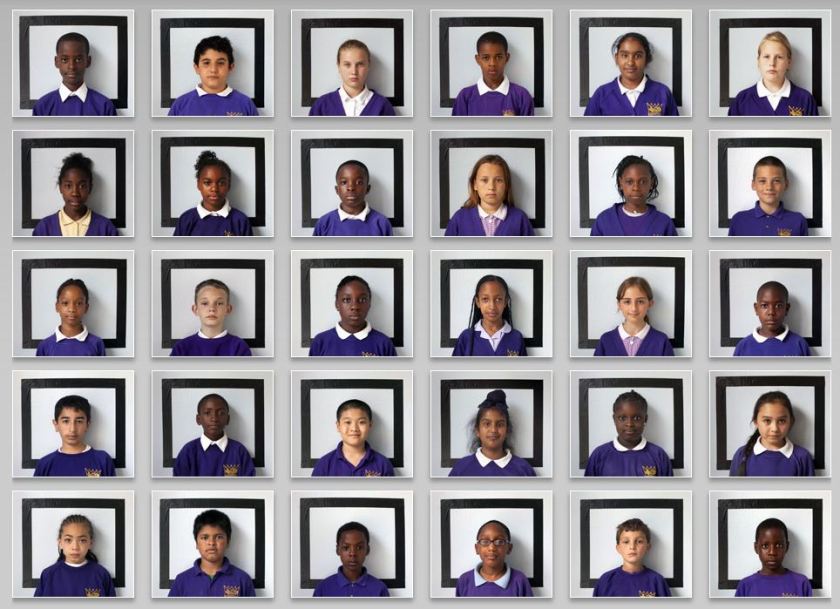
Image taken from the website 25/05/2020
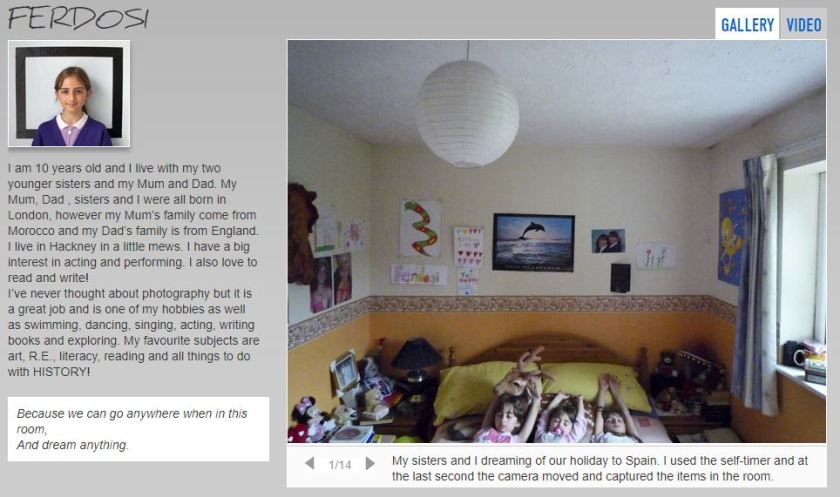
Behind each image is a mixture of a student profile, images taken by the student, text in the form of a poem (hand written) and a short video. This mix I think makes the project a success and so much more personal that the projects covered in Photovoice.
Bibliography
Websites accessed 25/05/2020
 Michele Usher