Rue is an Edinburgh based who in the series ‘Phototaxis’ and ‘Resurrection of the Dead’, used the cyanotype process to convey ‘the environmental challenges faced by moth populations’, which are in decline within Britain due to a range of issues one of which is light pollution.
In both projects the moth is required to make direct contact with the cyanotype print, but in the case of the ‘Resurrection of the Dead’ Rue chose to leave the cyanotypes unfixed, which allows any evidence of the moths to fade over time once exposed to light.
Rue: “I have used the traditional photographic technique, cyanotype, to highlight the absence of moths in our night skies, being keen to examine how elements of a photographic process can become integral to the meaning of the work and act as metaphor. The cyanotype process refers back to the work of Anna Atkins who was taught the process by its inventor Sir John Herschel. She made a scientific study of British seaweed and plants, which she published in a series of beautiful blue books, releasing the first in 1843. In many cultures, including our own, the colour blue is rich in representational meaning: the forbidden, things confined to the dark night, heaven, death and the infinite. Moths can see further into the blue end of the spectrum than humans and are particularly attracted to white/blue light.” [accessed 20/05/2020]


Moth study before and after exposure to light
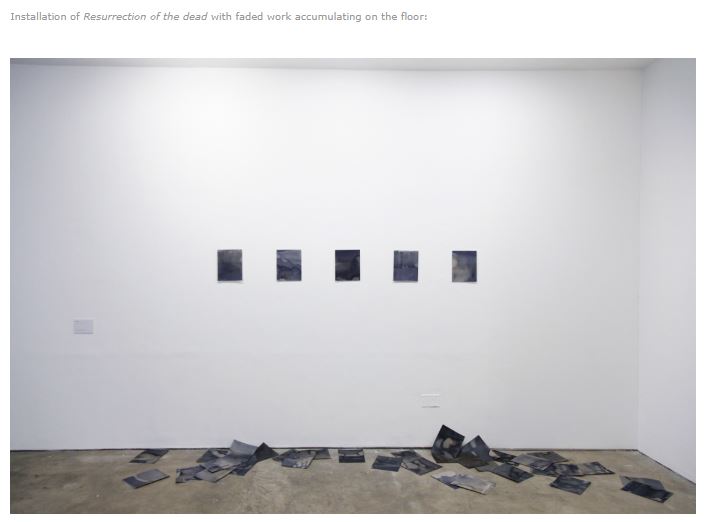
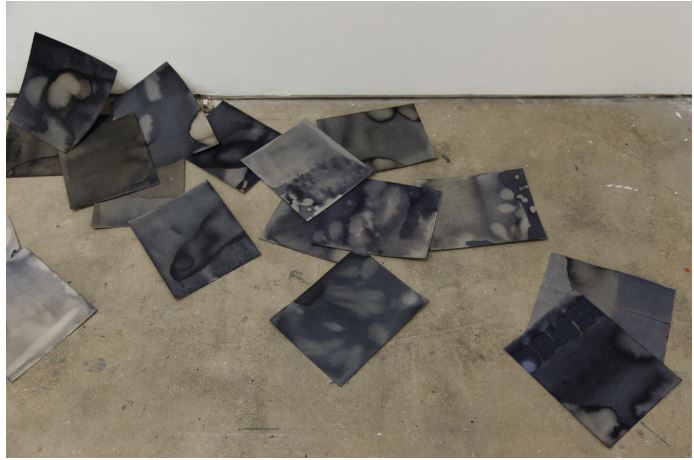
During the exhibition she replaced the images and left the old ones fall to the floor as a symbol of the end of the moth’s life, never to return:
I noticed on her website that she had also produced a book in a similar manner to that of Kasson depicting more images of the moths, this time fixed so they didn’t fade and, on the reverse,, she has listed all the species which have not been seen since 1980. [https://vimeo.com/154768912]
Bibliography
Website accessed 20/05/2020
https://dergreif-online.de/artist-blog/nic-rue-phototaxis-resurrection-of-the-dead/
 Michele Usher