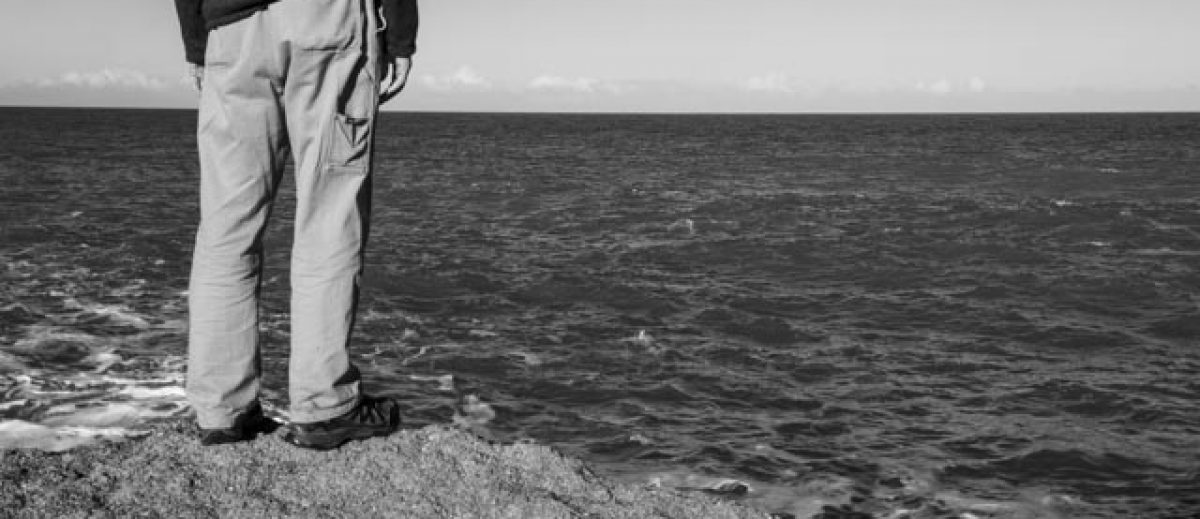
The following is the initial draft of a possible foreword to the book I’m considering as part of my final submission.
FOREWORD
Michelle Usher’s photographic essay focuses on the lives of women living in the tiny fishing village of Ngawi located in the Wairarapa region of New Zealand which occupies the south-east corner of the North Island. It is a sparsely settled, rural region. Physically, the Wairarapa consists of the broad flat valley of the Ruamahanga River running north to south down the western side with the majority of the region steep hill country to the east. The area is bordered by the rugged Tararua and Remutaka Mountain Ranges on the west and the Mount Bruce hills to the north. Along the east and the south runs the 220 km coastline.
It is a distinctive coastline whose normal form is a rocky foreshore bordered by a narrow platform of raised beach backed against steep hills. Vegetation is sparse for the weather here can be fierce. There is no landmass between Wairarapa and the Antartica and cold southerly storms sweep up the coast. They alternate with warm, foehn North-west winds, sweeping down off the mountains, often gale force in strength and blowing for days, even weeks at a time. It is a wild and spartan coastal environment, largely isolated by poor communications well into the 20C. Ngawi is located on the eastern edge of the broad Palliser Bay, open to the south and completely exposed to the ‘Nor-westers’ blasting across the Bay.
The fish stocks around the coastline were prolific but poor communications, difficult access to markets and an almost total lack of any sheltered anchorage anywhere around the coastline, none at all in Palliser Bay, prevented any large scale local fishing industry. In the 1950s this situation changed. An overseas market developed for crayfish, or rock lobster, initially in the United States but increasingly in Asia. Since crayfish were taken close to the shore in rocky, shallow water this was fishing suitable for small vessels which could be launched from the land. On the western shore of Palliser Bay a shingle beach at Ngawi offered such an opportunity. The difficulty here was that the beach drops off steeply, over a gravel lip. It requires the power of a bulldozer to drag boats back onto the beach and hence the iconic lineup of ‘dozers’ in various states of repair, each hitched to a large boat trailer, lined up on the Ngawi foreshore.
The fishing village that developed at Ngawi the the ‘70s, ‘80s, and ‘90s was almost unique in New Zealand. It was an insular little community. The road out was poor and unreliable and those who lived there were cast on their own resources. Lifting crayfish pots in rough seas and close to rocks was hard and dangerous work but it offered the chance for young men with little capital to make substantial amounts of money. It attracted the young and adventurous. This was an exciting place to be for ‘the good keen man’. But for women the situation was different. They faced long lonely days while the men were away. There were few amenities in the village and the nearest town was an hour and a half’s drive over a difficult road away. The closest school was an hour each way by school bus and the nearest secondary College at Greytown even further. In the winter the southerly storms came and for most of the year the North-west winds rolled down off the Remutakas, accelerated across the bay and smashed head on into Ngawi. It required a particular character to adapt, settle and enjoy this environment. Some didn’t and left. Some stayed and grew to love the tight knit little community and exhilarated in their isolation and physical surroundings.
Michelle Usher is a talented, semi-professional photographer living in the Wairarapa. (Okay?) She is currently completing a BA Photography from the British Open College of Arts. For her Level Three Body of Work she was attracted by a chance to investigate the lifestyle of the eight women who currently live permanently in this isolated place.
Black and white imagery is used to set the Ngawi scene. This works effectively, giving not only a sense of place but also evoking the harshness of the physical environment. The colour images of the eight subjects are informal and seek to imbue the viewer with a sense of their individual personalities and the different preoccupations of their daily lives. Each set includes an occupational portrait and then the camera moves in closer, sometimes to just a pair of hands, to capture the essence of their activities. The images are carefully chosen and well taken, leaving the viewer with an understanding of how each of these eight women copes with life at Ngawi. Michelle has taken the time to gain the confidence of her subjects and this has enabled the relaxed and candid atmosphere of the images. The viewer has a sense of having come to know each woman individually and to understand the lifestyles possible in this village.
This relationship with her subjects convinced Michelle that ‘Inside the Shell’ of Ngawi, is a core of women, whose roles can often go unnoticed, but who are an essential strength of the community. Her images convey that story perfectly. This is a professional and satisfying body of work.
Jim Graydon
MA(Hons) History, Dip. Professional Photography New York Institute of Photography, Author: ‘On the Edge – Wairarapa’s Coastal Communities’ pub 2013, 2nd Ed 2021.
Following feedback and discussion elements of text were considered to person and reference to me as the photographer should be removed which has resulted in this next version:
This book focuses on the lives of the women living in the tiny fishing village of Ngawi located in the Wairarapa region of New Zealand which occupies the south-east corner of the North Island. It is a sparsely settled, rural region. Physically, the Wairarapa consists of the broad flat valley of the Ruamahanga River running north to south down the western side with the majority of the region steep hill country to the east. The area is bordered by the rugged Tararua and Remutaka Mountain Ranges on the west and the Mount Bruce hills to the north. Along the east and the south runs the 220 km coastline.
It is a distinctive coastline whose normal form is a rocky foreshore bordered by a narrow platform of raised beach backed against steep hills. Vegetation is sparse for the weather here can be fierce. There is no landmass between the Wairarapa and the Antarctic and the cold southerly storms sweep up the coast. They alternate with warm, foehn North-west winds, sweeping down off the mountains, often gale force in strength and blowing for days, even weeks at a time. It is a wild and spartan coastal environment, largely isolated by poor communication. Ngawi is located on the eastern edge of the broad Palliser Bay, open to the south and completely exposed to the ‘Nor-westers’ blasting across the Bay.
The fish stocks around the coastline were prolific but poor communication, difficult access to markets and an almost total lack of any sheltered anchorage anywhere around the coastline, none at all in Palliser Bay, prevented any large scale local fishing industry. In the 1950s this situation changed. An overseas market developed for crayfish, or rock lobster, initially in the United States but increasingly in Asia. Since crayfish were taken close to the shore in rocky, shallow water this was fishing suitable for small vessels which could be launched from the land. On the western shore of Palliser Bay a shingle beach at Ngawi offered such an opportunity. The difficulty here was that the beach drops off steeply, over a gravel lip. It requires the power of a bulldozer to drag boats back onto the beach and hence the iconic lineup of ‘dozers’ in various states of repair, each hitched to a large boat trailer, lined up on the Ngawi foreshore.
The fishing village that developed at Ngawi the ‘70s, ‘80s, and ‘90s was almost unique in New Zealand. It was an insular little community. The road out was poor and unreliable and those who lived there were cast on their own resources. Lifting crayfish pots in rough seas and close to rocks was hard and dangerous work but it offered the chance for young men with little capital to make substantial amounts of money. It attracted the young and adventurous. This was an exciting place to be for ‘the good keen man’. But for women the situation was different. They faced long lonely days while the men were away. There were few amenities in the village and the nearest town was an hour and a half’s drive over a difficult road away. The closest school was an hour each way by school bus and the nearest secondary College at Greytown even further. In the winter the southerly storms come and for most of the year the North-west winds rolled down off the Remutakas, accelerated across the bay and smashed head on into Ngawi. It required a particular character to adapt, settle and enjoy this environment. Some didn’t and left. Some stayed and grew to love the tight knit little community and exhilarated in their isolation and physical surroundings.
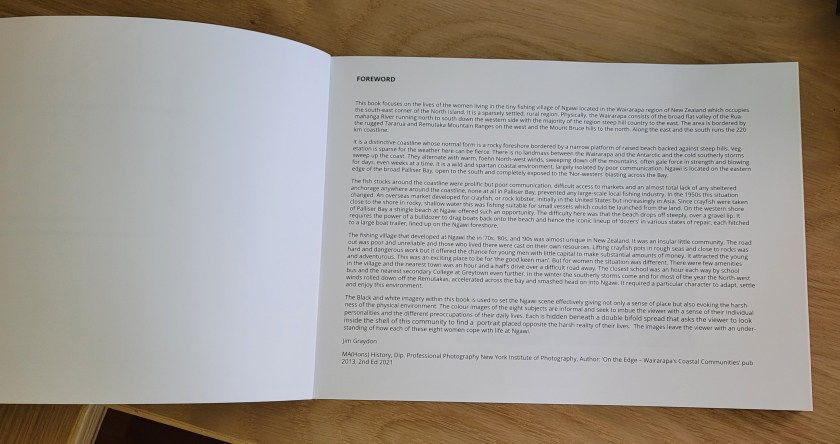
Although I agreed with some of the removal I felt that it had lost a lot of feeling from Jim’s initial review of the project and so we agreed to replace some of the text. This now sits perfectly on a single page within the final draft version of the book:
This book focuses on the lives of the women living in the tiny fishing village of Ngawi located in the Wairarapa region of New Zealand which occupies the south-east corner of the North Island. It is a sparsely settled, rural region. Physically, the Wairarapa consists of the broad flat valley of the Ruamahanga River running north to south down the western side with the majority of the region steep hill country to the east. The area is bordered by the rugged Tararua and Remutaka Mountain Ranges on the west and the Mount Bruce hills to the north. Along the east and the south runs the 220 km coastline.
It is a distinctive coastline whose normal form is a rocky foreshore bordered by a narrow platform of raised beach backed against steep hills. Vegetation is sparse for the weather here can be fierce. There is no landmass between the Wairarapa and the Antarctic and the cold southerly storms sweep up the coast. They alternate with warm, foehn North-west winds, sweeping down off the mountains, often gale force in strength and blowing for days, even weeks at a time. It is a wild and spartan coastal environment, largely isolated by poor communication. Ngawi is located on the eastern edge of the broad Palliser Bay, open to the south and completely exposed to the ‘Nor-westers’ blasting across the Bay.
The fish stocks around the coastline were prolific but poor communication, difficult access to markets and an almost total lack of any sheltered anchorage anywhere around the coastline, none at all in Palliser Bay, prevented any large-scale local fishing industry. In the 1950s this situation changed. An overseas market developed for crayfish, or rock lobster, initially in the United States but increasingly in Asia. Since crayfish were taken close to the shore in rocky, shallow water this was fishing suitable for small vessels which could be launched from the land. On the western shore of Palliser Bay a shingle beach at Ngawi offered such an opportunity. The difficulty here was that the beach drops off steeply, over a gravel lip. It requires the power of a bulldozer to drag boats back onto the beach and hence the iconic lineup of ‘dozers’ in various states of repair, each hitched to a large boat trailer, lined up on the Ngawi foreshore.
The fishing village that developed at Ngawi the in ‘70s, ‘80s, and ‘90s was almost unique in New Zealand. It was an insular little community. The road out was poor and unreliable and those who lived there were cast on their own resources. Lifting crayfish pots in rough seas and close to rocks was hard and dangerous work but it offered the chance for young men with little capital to make substantial amounts of money. It attracted the young and adventurous. This was an exciting place to be for ‘the good keen man’. But for women the situation was different. They faced long lonely days while the men were away. There were few amenities in the village and the nearest town was an hour and a half’s drive over a difficult road away. The closest school was an hour each way by school bus and the nearest secondary College at Greytown even further. In the winter the southerly storms come and for most of the year the North-west winds rolled down off the Remutakas, accelerated across the bay and smashed head on into Ngawi. It required a particular character to adapt, settle and enjoy this environment. Some didn’t and left. Some stayed and grew to love the tight knit little community and exhilarated in their isolation and physical surroundings.
The Black and white imagery within this book is used to set the Ngawi scene effectively giving not only a sense of place but also evoking the harshness of the physical environment. The colour images of the eight subjects are informal and seek to imbue the viewer with a sense of their individual personalities and the different preoccupations of their daily lives. Each is hidden beneath a double bifold spread that asks the viewer to look inside the shell of this community to find a portrait placed opposite the harsh reality of their lives. The images leave the viewer with an understanding of how each of these eight women cope with life at Ngawi.
Image of the final version within the book ‘Inside the Shell (2022):
 Michele Usher