Crowdfunding
Crowdfunding is based around a social networking campaign that allows the person trying to raise funding for a project to ask for small amounts of money from a large number of people. Anyone interesting in pleading to support the project states the amount they are prepared to offer. There is a set period of time for the funds to be raised usually a month. If the target is reached then the funds are released to the project owner and the sponsors are charged. If the target is not reached then no funds are released.
The process is started with your pitch or by publishing your proposal, this can be written but it seems that the more successful ones use a video which details the project, the aims and what each donor will receive as a gift. This could be a copy of the project. The more they donate the better the gift.
The key to success seems to be networking, social media, friends, family. Getting them to recommend and sharing. The platforms and process are all on line so linking to websites, mailing lists and social media such as Facebook, Instagram etc makes the whole process very simple.
Be realistic and explain what the money will be used for. Is it the whole project or just part and set the target amount – make it reachable. The more that join the more interest is generated as others see the figure and interest increase more will want to be apart of that journey. It’s important to understand that unless the target amount is reached the money is not released.
Making sure that the presentation is short, engaging and professional but not too slick as this may put people off. Researching and finding the right platform for the project is also very important as there are several now since the original US based one:
- Indiegog
- SeedInvest Technology
- Mightycause
- StartEngine
- GoFundMe
- Patreon
- PledgeMe – New Zealand based (https://www.pledgeme.co.nz/ accessed 26/12/21)
https://www.investopedia.com/best-crowdfunding-platforms-5079933 (accessed 26/12/21)
The video needs to be engaging and honest, State what the project is about, why it is important, not only to you but to others and finally how you will use the funds. Make it really clear and transparent as to how you will be contributing. Be clear that if the target is not reached then the project will not be completed. People are more likely to fund than if the proposal states that the photographer will complete anyway – give the wrong impression.
It is important that the donors are thanked and a reward is given – this doesn’t mean that this reward is same value as the amount donated and that their contribution is acknowledged. This includes up-dating the blog, responding to emails, questions etc. Once its complete following up and keeping networks is important. The running of the funding process if a job. A professional approach is important.
Budget and target:
- Remember platforms will take a percentage of the money donated
- Plan around pay day to ensure the donor has the money to pledge
- Include essentials; materials, printing, advertising, model fees, postage costs
Other sources of Funding
The course material addresses funding based in the UK such as the Arts Council (England, Wales and Scotland), or the UK National Lottery. These are of little value to myself based here in New Zealand. Looking closer to home research has resulted in:
They offer Arts Grants for short-term projects to fund New Zealand artists. There are between 4-6 rounds a year for amounts ranging between $5,000 – $75,000.
The creative communities scheme is a partnership between Creative NZ and the 74 local authorities around NZ. It aims to increase participation in the arts at a local level.
One of the largest private supporters of New Zealand arts and artists. Most grants offered are under $5,000. The Wallace Foundation anticipates applicants will seek and secure additional sources of income – no projects are funded in full.
Useful Website with links to other funding bodies:
https://artsmurihiku.co.nz/resources/funding-and-grants/nation-funders/
Working out the Budget and what am I worth?
Photography is never going to be a full-time career move for me and I can’t ever see me being asked to conduct a commissioned project but I will need to understand the possible costs implications of the exhibition and book production especially as I would like to apply to Creative NZ for funding.
The notes from the course offered a number of points to consider and I have selected those that are relevant to my exhibition and book production:
- Cost consumables – paper, ink, chemicals for platinum and palladium printing
- Darkroom hire – not necessary as this is my own and a friend’s. As the platinum printing will be completed with his equipment so I have asked him to calculate a mate’s rate fee per print as I will be doing most of the work, so this will be chemical cost, paper, power and the odd cup of coffee.
- Costs of editing images – these have been already produced as past of BoW but following portfolio reviews and discussion with fellow students I think I need to add some additional images and so a return to the location will need to be costed; fuel to get there and then the time to download and edit each image.
- Mounting and framing – I’ve held two joint exhibitions before with a fellow photographer. The first the prints were matted but no framed and the second they were matted and framed. The second exhibition although costing us more looked so much better so I have obtained the details of both framers.
- Cost of exhibition space: The possible locations I’m considering offer two options around fees. The first is based around a fee to hire for the duration of the exhibition which can be expensive for the artist and is not very popular. The second is based around a commission based on sales. With this option the risk is with the exhibition space. The commission is usually 40% of the sale price.
- Book design and production – I used part of my Lightroom Subscription package to design the book I submitted for BoW – InDesign. I have sent this to a professional photographer in Australia as part of my course work for part one and gaining professional feedback. Rohan Hutchinson has self-published over fifteen books and now owns his own publishing house so once I have feedback (due on the 4th January) I will apply the changes/suggestions and discuss costs.
- Web design – As part of my Adobe licence I can publish up to five websites and as part of BoW submission a website for ‘Inside the Shell’ was developed and published. As I gain further feedback, I will develop this further.
- Professional consultation – I’ve completed several professional reviews and I will continue to gain further feedback and exposure of my work as the course progresses.
The course notes provided a link to the AOP which provides web-based products that are available to students as well as professionals – provided you are a member. Luckily as an OCA Student that is provided for free (link here accessed 27/12/21).
Matching the Funding and ‘Support in Kind’
I’m not expecting any of the organisations I apply to for funding to cover all the costs – although the advice given on the Crowd Funding video seemed to imply if you stated that you would still go ahead and complete the project even if you didn’t get the funding this might put people off donating. I haven’t considered using one of the Crowd funding websites but I might if the costs are too high for me to consider.
I have been fortunate to be granted £150 from the OCA Enterprise Fund to put towards the production of the initial book/zine. I applied as part of a group submission as I plan to work with two other students who will add work to the final submission. I will need to write a short report covering how the money was spent.
I will be applying to Creative NZ to help fund the exhibitions and the book/zine so drawing up a list of items needed will be help the business case submission.
As detailed above a friend who attended the platinum and palladium workshop in Christchurch with me has gone on and built all the necessary equipment and has the printer for producing the negatives so this will help reduce the cost. The chemicals can be easily procured from Australia.
Engaging an Audience and Audience Outreach
As the course notes state, no funding organisation will just hand over money without understanding how it will be spent and who will be ‘consuming you work’. The audience is key to the success of the project. It is important to know who your audience is and how you will engage with them. How will the first interaction be accomplished? How will they interact with you as an artist and how will they interact with your work? In New Zealand it’s important to show how your work is equitable and links to the Māori community. For me the project can be related to any isolated community. What I need to do is bring my voice out more, this may mean a re-edit or text, change in design of the book or the introduction of texture.
The notes recommended reading the article by Doug Borwick (2013) on audience outreach: http://www.artsjournal.com/engage/2013/01/outreach-and-audience-engagement/ (accessed 27/12/21). A part from a long preamble around him not liking the term ‘outreach’ the four main points of the text were based around how the ‘engagement is about relationship formation and development’. This seems like common sense and basis business process. You need to for the relationships to gain trust and repeat business. By not interacting with your possible donors or audience you will be consider unprofessional and rude. For Borwick there seems to be four methods/ways:
- Artists Meet Audiences–These are the opportunities, before or after arts events, in which the public is able to interact with artists.
- New Population Centers–Taking art to places where there is not the opportunity to experience the genre. Originally, this involved going to smaller cities, towns, and rural areas.
- New Venues–The Random Act of Culture events, with art popping up in airports and shopping malls, are one example.
- Relatable Cultural Idioms (Familiar/popular forms and styles)–In an effort to be meaningful to more people, arts organizations undertake work outside their principal cultural idiom that has greater resonance with people they hope to reach.
I’m surprised that there is no mention of social media or other on-line platforms but then this article was written in 2013 and although in full use then it probably wasn’t considered the best way to interact with your audience, but the growth in on-line platforms and the global pandemic means that artists need to consider this as a key way to keep donors and purchasers up-to-date with current projects and work.
Budget Calculations
The spend to date consists of:
- Website – part of my monthly subscription to Adobe AUD $22.99
- Student Forum review – free
- Review by J Sybylla Smith – Black Friday Deal for one hour portfolio review USD $100
- Review by James Gilberd – quoted as $92/hr, however no invoice received.
- Additional photography books following reviews $70.
Future Costs possible Competitions:
- A5 ‘Zine, Splendid and Photobook/NZ 2022 zine comp’ – free to enter just cost of printing one copy for submission;
- Application for NY Portfolio Review – free
- AoP awards £75 for a project
- Head-on Foto Festival Submission – AUD $20
Exhibition Printing Costs:
Framing: A4 size with matt $28 each, A3 with matt $44 each [https://www.factoryframes.co.nz/shop/Photo-frames/Black-and-white]
Framing: A4 $51.30, A3 $70.80 each [https://www.framingonline.co.nz/shop/a5-to-a1-frames-with-mat/a3-frames/x_cat/00369.html]
Digital Printing for print: $6.48/print
Platinum and Palladium: $21.17/print
Details:
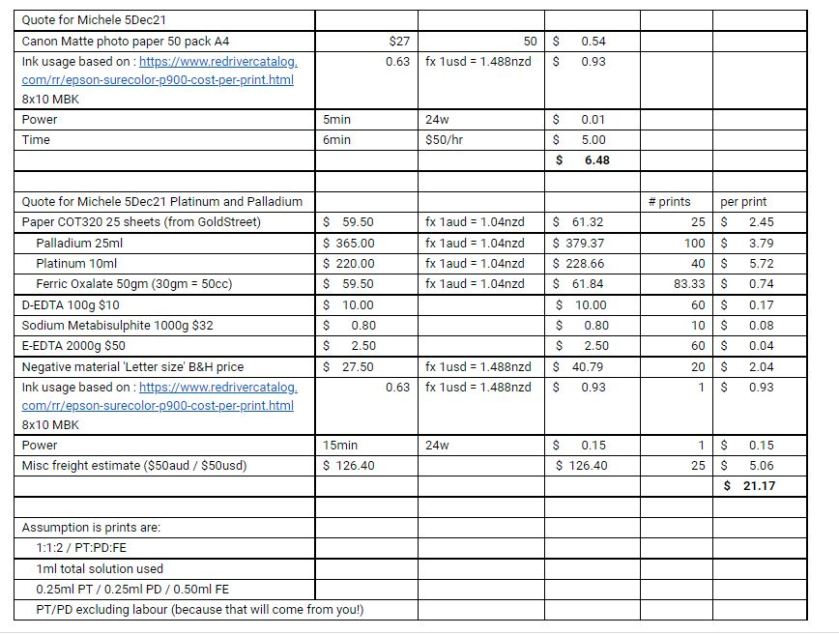
These costs will develop as I finalise the exhibition layout and book.
 Michele Usher