Notes taken from Work in Progress 5th December 2020
Tessa Bunney, a documentary photographer who is interested in the different environments that are shaped by human intervention. She works on both personal and commissioned projects. From her website she states: ‘For over 25 years, I have photographed rural life, working closely with individuals and communities to investigate how the landscape is shaped by humans. From hill farmers near my home in North Yorkshire to Icelandic puffin hunters, from Finnish ice swimmers to Romanian nomadic shepherds my projects reveal the fascinating intricacies of the dependencies between people, work and the land.’
Her most current project ‘FarmerFlorist’ looks at the ‘artisan’ cut-flower farms that recently started to grow in numbers within the UK. Looking at these images on her website I like how she is an observer, not disturbing the farmers as they go about their daily working life. The portraits are in the environment, often not seeing the subjects face, hidden behind their flowers, no direct camera interaction which seems to be the fashion at the moment. This is very much the style I’m trying to achieve with my images of the women of Ngawi. As the images rotate on her website they punctuated with text from the growers. These have obviously been gathered from her interactions with them. I don’t get a feeling that she is intruding in any way – leaving only a few footsteps and taking only photos.
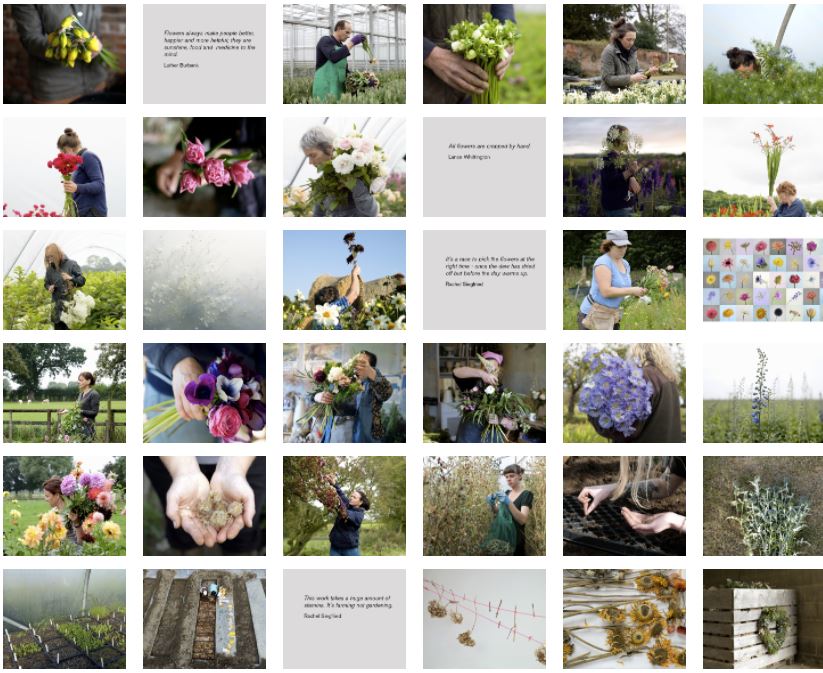
Screen shot from http://www.tessabunney.co.uk/project/farmerflorist/ accessed 05/12/2020
Bibliography
Websites accessed 05/12/2020
https://www.lensculture.com/articles/tessa-bunney-hand-to-mouth
http://magazine.landscapestories.net/en/archive/2013/vietnam/projects/tessa-bunney
https://vimeo.com/user12139949
http://www.northeastphoto.net/?portfolio=tessa-bunney-flower-farming-in-lincolnshire
24th January 2021
The books from Tessa Bunney have finally arrived so I have been busy looking at the style and her approach to the images used. All are soft covered, less than A4 in size and coloured. The first ‘Moor and Dale’ has a dead bird in the form of a Pheasant on the front, something that the animal rights people would object to. There’s no face to the hand holding the bird, in fact there are no images of people looking at the camera, she is clearly an observer, an outsider, but I don’t feel that there is anything uncomfortable with that. There is a short introduction by Paul Burgess and a map of the location to give a feeling of location. The text throughout the book has been supplied from interviews with the people who live and work in Nidderdale AONB.
There are a mixture of 5×4, small images and square format. I find what seems to be a disordered approach to the layout uncomfortable and appears to be more thrown together, but after looking through a number of times I see that this change causes me to stop and take the image in, to really study the image and try and understand what I’m seeing and read the text. I also like the ‘index of works’ that she has included at the rear. I might see if that works with my draft book for Body of Work.


The second book ‘Lakeice’ by Bunney covers the relationship between people and their relationship with the environment. This is a lot simpler in design, small with a centrally stapled series of pages, which comes in a separate plastic wallet. The images have been taken in Finland, all colour and range in style and size with some crossing the centre of the page, luckily the pages open flat so you don’t miss any part of the image. This project has a similar feel and approach to the first, the observer to life but this time you see the faces and a number feel staged. There is more of an interaction between subject and photographer. There is no text with the images apart from an introduction by Bunney and a short essay translated from Finish, both situated at the front of the book.


The final book ‘Hand to Mouth: A Journey through the Romanian Carpathians’ is in a similar style to that of the first but contains a lot more images. Soft cover, map and transcription of a conversation with one of the families she photographed. The project is divided into four sections which relate to the seasons of the year and the events which took place in each. Once again, a beautifully coloured example of the documentation of life, culture, environment and relationships. Each image is framed with a simple white boarder which holds your attention on the subject of the image. I really like the fact that you hardly ever see their faces, there are a few direct gazes but otherwise, you as the viewer are an observer. There is a mixture of landscapes, portraits and still life which show every aspect of family life as they use the land to grow food for the harder winter months. The images for me speak for themselves with some text at the rear of the book along with her signature small contact images and text.
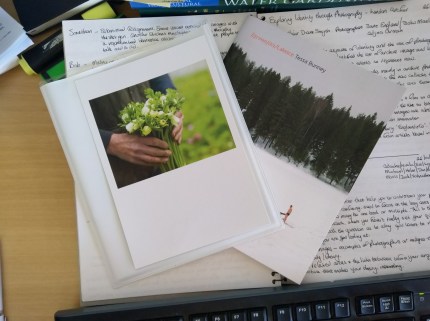
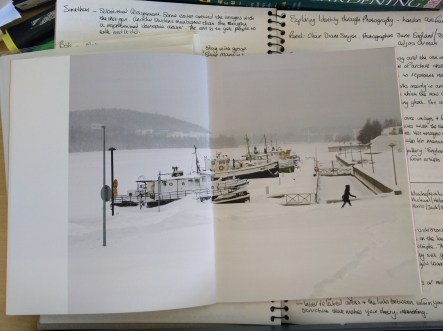
Each book had different aspects that I enjoyed and think about applying to my submission. The limited text I like, it means that the image needs to be strong enough to stand on its own to tell the story you want the viewer to see. I also like how she has used different formats to make you stop and understand that there is a need to pause and take the image in. There’s a nice balance of environmental images and portraits. I resonate with the lack of eye contact with the subject and the close crop of just the hands for example. I also like the use of the map as my assessment is taking place within the UK no one will know where Ngawi is so it might be a nice idea to include that at the start to help set the scene. Lots of things to re-consider as I continue to review and edit my project.
 Michele Usher