3rd December 2019
Following an on-line catch up forum with other Level 3 students it was recommended that a regular fortnightly blog post to detail thoughts and reflections from the previous blog and ones looking forward be added to the on-line sites for both Body of Work and Contextual Studies. It was recommended that this shouldn’t just be undertaken at assignment time and so I hope that this is the start of a regular post to discuss and highlight the highs and lows of the journey to my final Module of Level 3.
I needed an additional two weeks to complete my final assignment for Level 2 and pull all the work together for submission so I missed the November date for assessment. I discussed the situation with my tutor who recommended I request the possibility to progress to Level 3 prior to formal assessment at Level 2.
In order to start I needed to provide examples of my work and a ‘Statement of Intent’. My initial reaction was why should I produce such a statement? Surely my intent was to complete my BA. So I undertook some research on other blogs to see what was really needed. Research revealed various styles and area of content but main theme was based around the future intent for the Body of Work. In a similar vein my statement discusses my progress to date and my thoughts for my project based around the ‘quiet crisis within New Zealand’ – that of mental health [full Statement can be found here ]. The project is a continuation of the work I completed during my Documentary module only this time I planned to look at the issues associated with rural living within NZ.
Submission of the Statement and work resulted in an discussion with the Programme Leader on 29th October. Following this I received the go-ahead and was assigned my two tutors, both were contacted with an introductory email. I have had one discussion with my Contextual Studies (Garry Clarkson) and received the following advise and feedback:
Thoughts for Michelle Part one
BOW Tutor: Chris Coekin
Link the BOW subject with the ‘critical discourse’ of the subject of CS. Although OCA don’t specify I think it’s always better to separate them and not write specifically about your own work – rather choose case studies examples of practitioners who deal with similar themes/subjects and analysis their work and how it relates to a broad discourse. For you documentary portraits and space/place – global environment.
A good intro to ‘writing about images’ with different methods (if you haven’t already does so is:
- Gillian Rose (2013) Visual Methodologies, Sage (which you already have)
- Chapter on semiotics and ‘discourse 1’ is apt for you.
Themes
Space & Place
Environment becomes significant once human intervention is present in the space.
- landscapeonline.de. (2019). The concept of space and place. [online] Available at: http://lrlr.landscapeonline.de/Articles/lrlr-2009-3/articlese2.html[Accessed 19 Nov. 2019].
- Dean, T., & Millar, J. (2005). place. London: Thames & Hudson.
- Cresswell, T (2004), Place a Short Introduction, Blackwell Publishing.
- last two I have enclosed in a ‘reading pack’ – may (or may not) be useful to focus.
Use summon at UCA library (let me know if you don’t get this) and search for the themes and journal articles written about them. I will also set up a google drive to place anything I already have which might help – but be careful of being swamped. So in Ass 2 you can chose literature which you can summarise within broad sub-themes (portraiture, landscape, documentary, global, space/place)
Themes:
Quiet crisis
space and place ‘hillbillies’
Practitioner case studies
Look at space / place and portraits of people and what photographic strategies photographers employ to depict these communities.
Alex Soth
Chris Killip – In Flagrante
Paul Strand – Tir A’Mhurain: The Outer Hebrides of Scotland
Tom Hunter
- Assignment one will help you sample the visual culture of your project: Modernism & Photography in the global age ?
- Assignment 2 will be a lit review of the texts that talk about the theme – which I will nudge you towards.
All the best. Send me assignment one (word or pages files so I can make annotations on it) as rough as you need to explore broad visual culture to get you started.
Garry Clarkson, FHEA, IFJ, BA (Westminster), MA (University of Wales, Newport), CELTA (Cambridge).
OCA tutor: Photography, Creative Arts, Film & Moving Image.
I have subsequently been working my way through the suggested articles and reviewing the work by the photographers suggested and will also be adding Susan Lipper to the list as she was suggested by the Programme Director at our discussion. A full review of the articles and photographers can be found in my Work in Progress and Research log.
I have still not heard from my second tutor and so I have chased again – this is becoming a little bit of a concern as I don’t want to start down a track that is unachievable, meanwhile I’m progressing with the course work and setting up my Blog site. Despite not receiving any formal feedback on my blog from my last module I do feel that it works better and allows the assessors and tutors the ability to find my work in an easier way than my first few attempts so I plan to stick with the same format – unless I receive contradictory advise.
As previously stated, I have started the course work and I must confess to be a bit overwhelmed. I’m still trying to get my head around how the two courses will link and when I’m working through the material in one module, I worry that I’m not doing enough on the other module so at the moment I feel like I’m drowning. I’m still trying to get into a routine that covers both modules and linking them together. I think I need to slow down a little, take a breath and not try to do everything in one weekend.
Actions for the next few weeks:
- Continue with course work
- Review articles and chapters from Garry
- Complete initial shoot at location
- Send first draft of Contextual Studies Assignment
- Identify a local point of contact
- Research location, archives, on-line etc
- Chase tutor or contact college around BoW tutor
28th December 2019
I’m afraid to say that all my good intentions of posting every two weeks has failed due to work commitments and the time of year pressures. That said I have continued to work through the course work for both my Body of Work and Contextual Studies. The research required does seem to take a lot longer than previous courses but I’m finding it interesting and challenging.
After attending a few of the on-line forums (8th December and the 17th December) I was concerned that I may have jumped into a Body of Work project too fast without really thinking about the subject and understanding if there was really a problem. I knew from my Documentary course that New Zealand had a major issue with drugs, alcohol and abuse and that the mental health of the nation was also a major concern – hence the Government pouring millions of dollars into schemes and programmes to improve awareness of the situation and getting the average Kiwi to open up and discuss their situation and feelings – but was this just an inner city issue? Were rural communities more likely to support each other? I think I need to undertake some additional research using news paper articles, health reports and Stats New Zealand.
I have planned to complete my initial photo shoot on the 30th December. There is a small fishing village called Ngawi, located about an hours drive from where I live so repeat visits will be possible. According to Wikipedia – Ngawi (pronounced “naa-wee”) is a small fishing / holiday town within five kilometres of Cape Palliser, the southernmost point of New Zealand’s North Island. The town comprises mainly small wooden houses, called baches.
The New Zealand Ministry for Culture and Heritage gives a translation of “the native tussock grass” for Ngāwī. Ngawi has more bulldozers per capita than anywhere else. The bulldozers are used to haul fishing boats into and out of the water as there is no wharf or other access to the ocean other than the beach. The location has a large population of fur seals, and is popular not just with commercial but recreational fishermen. The best fish to catch are Paua (a type of abalone which is prized for its iridescent shell as well as the flesh), crayfish (also known as rock lobster), and cod. The place is popular with many types of fishermen, including spearfishers. Ngawi is known for its exposed climate, its intense and prolonged wind and the fact that there are almost no trees nearby. The weather can be extremely hot in summer. Several ships have been wrecked on the rough coastline.


Maps copied from Google Earth.
I found a really helpful article by Mark Scott written for the New Zealand national Geographic Magazine based on his experiences in the time he spent there. This gave me some insight to the area and possibly some of the challenges I may face to get to know people from the area.
Article link: https://www.nzgeo.com/stories/the-beach/ [accessed 15/12/19]
When I first researched the area and looked for images it was mainly on the tractors and the coastal scenery running up to the Lighthouse. There was nothing really on the inhabitants even though a number live there full time.
In order to understand more about the location and history I contacted the local District Archivist. The following was received following my request:
Kia ora Michelle
That sounds like an interesting and challenging project.
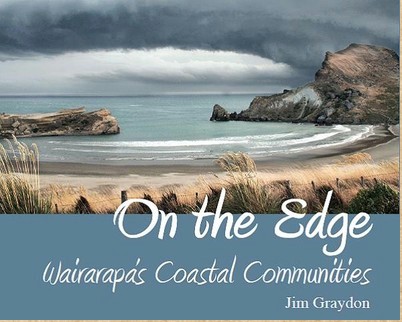
We published a book on Wairarapa’s coastal communities a couple of years ago, and Ngawi features it in that. The book is called ‘On the Edge’ (might be a good working title for your work too!) but it is out of print I am afraid. We can, however, arrange to have the chapter copied for you if you cannot access the book.
Our newspaper index is available on line at https://masterton.spydus.co.nz/cgi-bin/spydus.exe/MSGTRN/OPAC/SUBJ_NI
You can search there, under mental health, or under Ngawi.
If there is anything I can do help just let me know.
Ngā mihi
Gareth
Gareth Winter
District Archivist
Wairarapa Archive
Masterton District Council
From: Michelle Usher
Sent: Tuesday, 10 December 2019 9:25 AM
To: Archives <archives@library.mstn.govt.nz>
Subject: Archive information on Ngawi
Good morning
Not sure if you can help. I’m a photography student undertaking a BA in photography and for this I need to complete a personal project. I would like my subject to focus on Ngawi, rural life and mental health issues associated with life in these small communities. I need to complete research and was hoping to see if there were any articles held in the local archives as I can’t find anything that is available publicly?
Thanks for your help
Michele
I could manage to obtain a copy of the book, however Gareth kindly photocopied the chapter and sent me the section on Ngawi
https://www.mcleodsbooks.co.nz/p/nz-non-fiction-on-the-edge-wairarapa-s-coastal-communities [accessed 28/12/19]
‘Until recent times, the history of Wairarapa’s coastal communities is the tale of hardy, self-sufficient individuals prepared to tolerate isolation, absence of services, and unreliable communications, to enjoy the ambience and opportunities of their unique coastal environment. On The Edge chronicles the history of these coastal settlements and captures the atmosphere enjoyed by those who have lived or holidayed in the communities.’ Jim Graydon
I will utilise the link provided by Gareth and continue to research any local stories I can find.
I have also contacted a number of my friends who use the area for fishing. They have provided a point of possible point of contact who lives and works in the village. Once the holiday season is over, I will contact them to try and get some introductions to other residents that might be interested in helping me.
Actions for the next few weeks:
- Contact resident in the area and set up a meeting
- Complete photo shoot and post images to blog
- Finish articles suggested by Gary for my first Assignment
- Produce and post by Assignments
- Continue Research: Newspaper articles on Ngawi, mental health in rural areas, Stats NZ, Health Reports etc.
 Michele Usher