1st June 2020
Attended the ‘Rest of the World’ fortnightly forum. General discussion on progress, most are working towards the due date for final assessment and all the new requirements for submission. I was also pointed in the direction of Judith Crispin in relation to my work with the cray fish slowly decaying in my garage – see Work in Progress.
I had planned to take down my Solargraph but realised that I need to set up the scanner onto my new pc which I will do this week as a few more days won’t matter. Also managed to down load the images from the last photoshoot and received two possible families that may be interested in taking part in my project – fingers crossed.
2nd June 2020
Managed to up-date the scanning software to my laptop and scanned the Solargraph. I haven’t fixed it as I don’t have the chemicals so the tone is very pink but it clearly shows the solar effect across the sky and how the path changes over the month: I put it up on my Facebook page and people reacted positively – said it had dreamy feel.
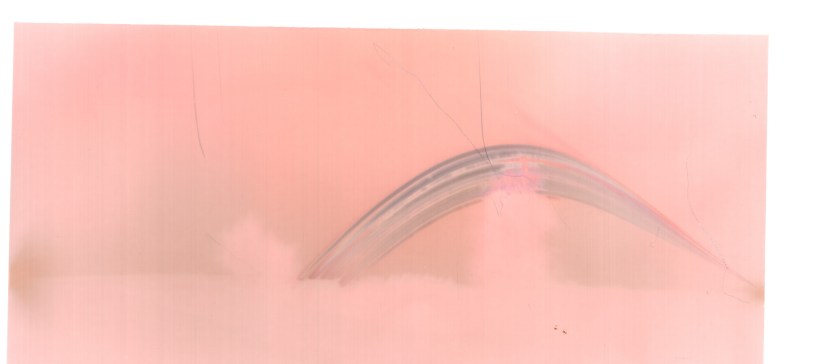
A fun experiment and we will see how the second one turns out in a month or so.
Also attended the AoP first breakfast Club talk with Hannah Starkey, Alys Tomlinson, Chloe Dewe Mathews and Tim Flach. The interviewer was carol Allen-Storey who on some research may be useful for my Body of Work as she undertakes work for UNICEF. My second talk on the 2nd June which was 3rd in New Zealand was with Susan Bright hosted by the OCA.
3rd June 2020
My letters posted last Thursday have resulted in two possible families prepared to be photographed. I have arranged for the first one Helen, her husband and son to be photographed this Saturday. An early start as I’m going out on the cray boat that they manage and the weather looks good.
I have also started to process the images from my last shoot and hope to get those completed this weekend.
4th June 2020
Attended a presentation by Charlotte Bellamy on behalf of the Photo Guild. She discussed ‘Creating a Cohesive Body of Work’ which I thought would be useful for my Body of Work project. She started by asking ‘what does cohesive mean?’ If you look this up then the simple answer ‘united and working together effectively’ and so how do we apply this to our work? She highlighted her approach after presenting what she thought was a great selection of images to her mentor and coach only to be told – yes, they are nice individual images but what holds/links them together? Having tried to gain my Honours with the PSNZ I know how that feels! And so she, just like myself went back to the drawing board. She expressed the importance of research, looking at other people’s work – what elements work together? Ask why they work and take lots of notes.
Factors that contribute towards consistency:
- Dimensions
- Colour palate
- Focus point
- Unique object or idea
- Post processing
- Stand point
- Lens choice
The following list of photographers were commended to start with and offered work that showed inspiration in cohesiveness:
- Viktoria Sorochinski
- Tsuneaki Hirmatsu
- Tine Poppe
- Torben Eskerod
- Todd Hido
- Ellie Davies
- Valda Bailey (look at her work for double exposures in camera work)
- Charlie Waite
- Sue Bishop
- Paul Sanders
5th June 2020
Joined with the fortnightly Documentary forum and then two MACK live presentations on book releases one by Brad Feuerhelm and the second by Janet Delaney ‘Public Matters’.
6th June 2020
Early morning trip to Ngawi to join a cray fishing boat at 6:45am. The commercial team of three kindly offered to take me out and see how it worked following my letter. The owner Andrew Sim has been living and working in the area all his life (apart from a brief spell in Masterton when he was younger). He started in Lake Ferry not far from Ngawi and worked in the cray and fish processing plant (see Research Log and Work in Progress posts), moved onto the boats as crew and then bought into the boat and finally became the owner.
The commercial enterprise forms part of the 350 tonne quota that the area is allowed to collect each year. It was amazing to see the process from start to finish. Andrew has over one hundred pots which are hauled onto the boat, the bait emptied and replaced and the catch placed into a holding box, whilst the pot is returned to the seabed. Each cray is checked, females with eggs are automatically returned, under sided are returned and those with any damage are also returned. At the end of the day from 124 pots 360 cray were collected. I didn’t count them all but as an estimate I would say over 60% are returned to the sea. One of the issues also are predators such as octopus’ that enter the pots and kill the cray, these creatures can destroy all the cray in the pot and most of the time just because it can.
9th June 2020
Joined in with the second AoP Breakfast talk which had two commissioning editors – Fiona Shields and Emma Bowkett (see Exhibition page for more detail). The two discussed how they approached the risk that photographers place themselves in order to cover conflict, and social events. The preparation needed and the approach they expect the photographer to undertake. This to me is a clear loss of freedom for the photographer.
I have continued to photograph my cray every day and have been posting the weekly results in both colour and black and white in my Work in Progress pages. This continues to be a very slow change and I’m still not sure how this will finish or form part of my submission – or even be included.
10th June 2020
Spent some time researching the work by Carol Allen-Storey (See Contextual Studies Research), a photojournalist who specialises in the complex social issues. Her images show people in a dignified way to highlight their quest for survival. She works hard to build trust and respects her subjects and their right to privacy. As she states on her website:
“My images are intimate, about issues and citizens I deeply care about. I believe photographs may not be capable of doing the moral work for us, but they can trigger the process of social consciousness.”
In a similar vein Jim Golderg is a social documentary photographer whose work concentrates on the lives of the neglected, ignored and socially isolated. His projects often take years to complete as he builds up trust with his subjects. His storytelling combines images and text, often written over the image by the subject.
In an article for the New York Times (2014) Goldberg states ‘I think my outrage about the desperation of the poor — and the dissatisfaction of the rich — stemmed in part from my belief that they represented a derogation from that path, a veering off course that had to be rooted out and documented’. I think both are good subjects to include in my extended essay as possible case studies for using photography to make a change.
14th June 2020
A long day processing images from the first opportunity following the lowering of lock down where I attempted to complete a panorama of the street and the images from the morning on the cray boat. The results, final selection and rejects can be seen in my Work in Progress blog. The pano was not successful when I tried to get Lightroom to stitch 61 images together in one attempt. The result was distorted and parts of the street were missing as the software tried to make sense of the single images. I then processed groups of two or three images and this was a little more successful. I think if I don’t want the white frames and standalone images I may repeat the exercise with a shorter gap between images. I have another opportunity to visit Ngawi on the 27th for a portrait session.
Reviewed and down selected 300 images from the cray boat session but only processed 100. A large number of duplications and motion blur due to the boat movement. Realised that maybe I should have trusted my camera with the settings in order to obtain a fast-enough shutter speed (I usually shoot manual), but in the end I think I have a few that will be in the final submission. I uploaded the images into the share drive for some peer review.
15th June 2020
Unusual turn out for the Rest of the World student forum, but get to hear progress as other move towards the new assignment process and the changes now required. I’m keeping my fingers crossed that prints will be allowed next November as for me photography is a physical medium. The group reviewed my images and provided some constructive feedback. It seems that they think the colour works best, I’m still not sure but as I get more images I think I will be able to form more of an opinion. I did watch a talk by Alec Sotth who used a mixture of colour and black and white in his work ‘Broken Manual, so this might be something to consider.
20th June 2020
During the week it seems that either a rat or mouse has found their way into the garage as the inside of the cray has been removed but luckily the body has not been disturbed. Faecal matter was left at the site as evidence and some of the rocks had been moved and were on the floor.
Watched a number of on line talks and presentations, write up can be found on my Exhibitions blog.
21st June 2020
Over two months ago I started an experiment with a Solargram. After a month I showed the first result and today I took down the second one and here are the results:
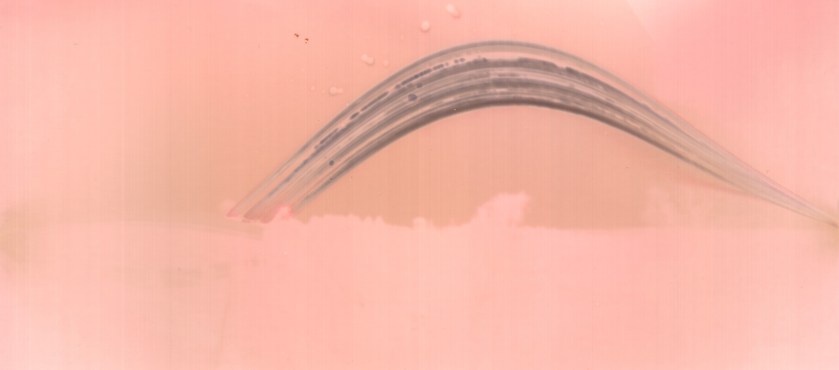
I’m thinking I might put up another and leave it for the rest of this module and then see how the two that I have already scanned fair being either in an envelope or left out without being fixed.
I have continued to photograph the cray and I’m beginning to doubt if I will see any real change in time for submission, but as I’ve started, I might as well continue. I’m thinking that maybe I should repeat the exercise outside, but try and tie it down so that its not taken the first night I set it up.
23rd June 2020
Set up two portrait shoots for the 27th June – one of the responses from the letter drop. A French lady who has migrated here and now lives with her husband and two-year-old daughter whilst working in Carterton part time for the Council. Although we have spoken on the phone and I have tried to explain that I don’t want to ‘pose’ them for formal portraits I still think she expects me to be a professional and ask them to sit and move their head way and that – not my idea for the project, as I want to see their everyday life, how they cope with the location, or not, what challenges they face. As a young couple I would imagine quite a few and there aren’t really the facilities there. The village may buzz during the summer months with ‘freedom campers’ but it’s a very different place in the winter.
The second session will be Alison the wife of Andrew the cray boat owner. Alison owns and runs the Captain’s Table, a food cart in the village which caters for the freedom campers and the locals on a Saturday night when the fire station social club is open.
24th June 2020
Continue to take advantage of the on-line free presentations being provided by various organisations around the world due to the COVID-19 pandemic. I have provided a detailed write up in my Exhibitions section, a lot drift back to the pandemic or the current ‘Black Lives Matter’ movement, however a few have been really useful as I start to think about presenting my Body of Work. I’m still hoping to complete an exhibition however if we need to go into lock down again then I might have to consider a book or I note that a large number of artists are now working across different mediums to display their work and thoughts. A number of the Lumix Festival talks have covered the ‘interactive’ website idea, using video, social media feeds from Face Book, Instagram etc.
27th June 2020
Day of the shoot! We have had several weeks of rain so it’s a little concerning as I might not be able to get there due to road slips. Wellington recorded just six minutes of sun shine in a whole month. No rain at the moment but the hills are a little close against the road side so you can never tell if there’s going to be an issue.
28th June 2020
So, managed to get there and back without any issues. Minimal damage to the roads, although I did notice that one stretch had a very large crack in it, so the council will have to come back and fix before long.
Overall, I was happy with the two sessions – will need to download and review, but I think I may have a few workable images. I’m not really that good with children but Melanie’s little girl was a dream, although she was getting sleepy towards the end. I think Melanie enjoyed the adult company as her husband (who wasn’t really interested in attending the session) was out on his boat.
Alison who runs the Captain’s Table gave me the low down on the village and how difficult it is to live there without having some sort of interest. A very down to earth character, who is involved with the local community for the last twenty years. Moved three times within the twenty years and all within Ngawi, so she has no issues with living there which was great to hear.
I’m a bit unsure about the cray project, if I should start again but outside or just carry on, but I don’t think it will every breakdown as there’s just too much shell and that must take years to dissolve as its similar to bone. Exposed to the elements would/might speed up the process but I will run the chance of something taking it – but then I have had rats/mice eating it.
30th June 2020
Got up early to attend a presentation by the Royal Photographic Society only to find that its tomorrow morning, never mind decided to take advantage of the additional time and down load the images from the photoshoot. I have made an initial selection of around 39 possible images for Alison and 80 from the Melanie session. I will work on processing these and send them copies. I provided Alison with a set from the boat session on a USB but there were over a hundred from that, these I think can be emailed or sent via a dropbox link.
I thought I might also extend my catchment area along the coast line out to the Lighthouse at Pallier. I have contacted Maritime New Zealand, who according to the website [accessed 30/06/2020: https://www.maritimenz.govt.nz/public/history/lighthouses/Cape-Palliser/default.asp] look after the property and asked if they have any old pictures or documents about the area.
They responded within a few hours to say that all their information had been transferred to the Department of Internal Affairs in the 1990’s and then stored at Archives NZ, but he did kindly send me copies of a few of the old photographs they did have, which can be seen on my Work in Progress post for June.
 Michele Usher