CV, Bio, Artist Statement
Writing a Good CV
Over the years I’ve written and re-written my professional work cv a number of times as I have changed my career from Radiographer, to Engineer, to Programme Manager to now a Commercial Manager. Each time trying to emphasise the various important aspects of my career to gain the next position on the professional ladder. I have never really considered my photography good enough. I’ve had some success at selling my work and I’ve started the honours process with the Photographic Society of New Zealand which could be areas to consider appropriate for a cv, but not sure I could fill an A4 page.
I decided to do some research and take a look at a number of my favourite photographers. The first I came across whilst completing my BoW – Tessa Bunney, her website [http://www.tessabunney.co.uk/ (accessed 02/11/21)] had a small bio section but no form of cv. But when I look at the website for Sally Mann [accessed 02/11/21: https://www.sallymann.com/] the pdf is over 18 pages long. The format is very simple stating where she was born along with the year and where she currently lives. There is a list of her educational achievements and then the long list of solo exhibitions, group exhibitions, film, television, radio, theatre, public collections, grants and honours. Maybe I should review my search.
Looking at a number of photographers that are just starting out such as Kieren Welch [https://www.kierenwelch.net/work#1 accessed 02/11/21] his cv uses a very simple type face listing, exhibitions, books, published work, teaching and education:
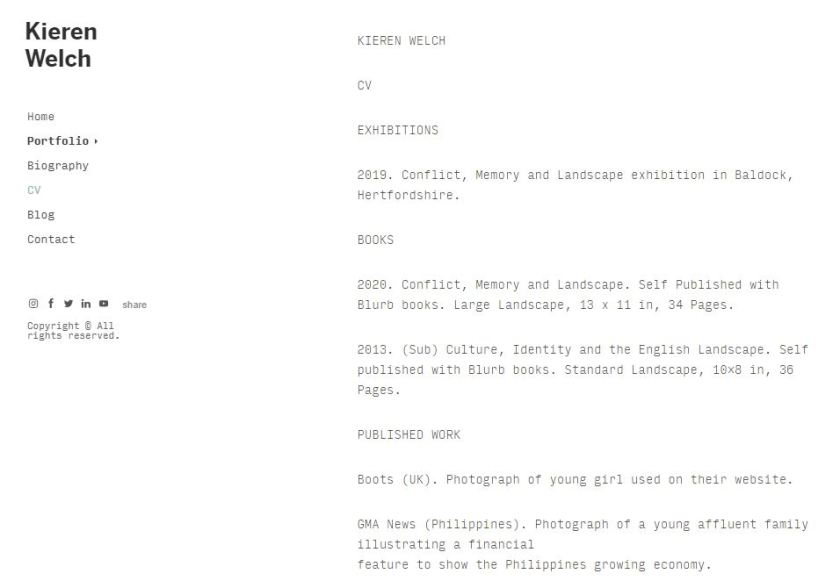
Screenshot from Kieren Welch website (02/11/21)
The format fits easily onto a page, clear and concise.
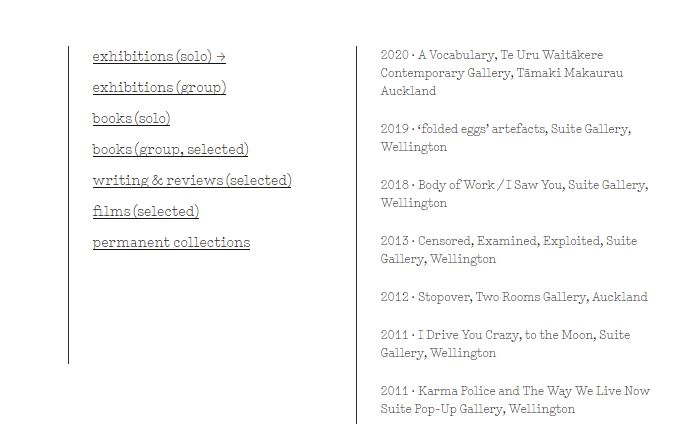
Bruce Connew is a New Zealand artist and photographer [https://bruceconnew.com/about accessed 02/11/21] who has a Bio page on his website and a simple list of subpages that detail his achievements:
Another New Zealand artist is Hannah Watkinson [https://hannahwatkinson.net/index.php/about/ accessed 02/11/21] who seems to not produce the regimented list of; place of birth, education etc, but spreads the information on the page, interlacing the information with images and links to projects, interests and exhibitions. A fair more relaxed approach to the cv format.
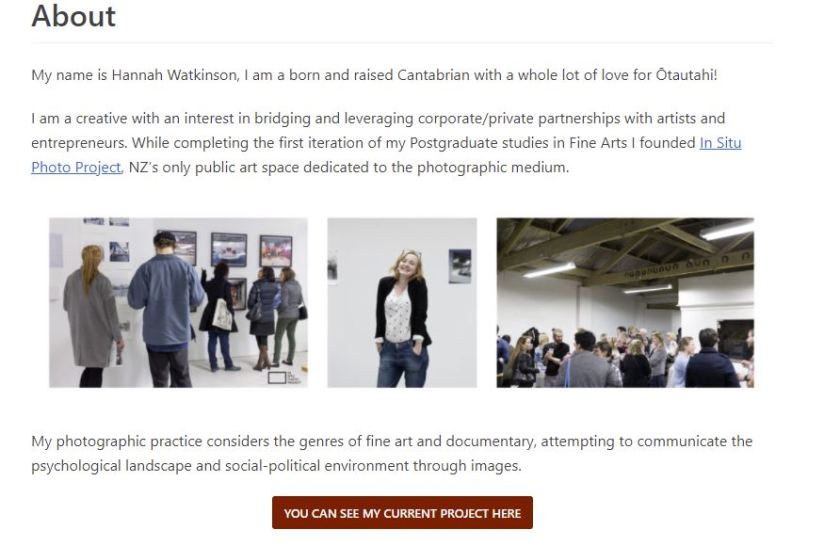
Screen shot from website [accessed 02/11/21]
My CV
Thinking about what I could include in my own cv I realised that I haven’t been an extensive writer or submitted my work to many competitions and so this really needs to change. It will mean getting out of my comfort zone and trying to promote myself something I don’t find comfortable. Initial thoughts:
- OCA study for degree since 2014;
- Licentiate Honours award with PSNZ in 2018
- Becoming a PSNZ Accredited Judge in 2017
- Exhibitions ‘Fishing for Light’ 2015 and ‘That’s how the light gets in’ 2018 with Tim McMahon
- Extended essay which was produced for CS.
Writing a good Bio
I recently wrote a bio for my submission to the OCA Student Association edge-zine issue 12:
‘Since late 2014 I have been working towards a degree in Photography and about to enter the final module ‘Sustaining your Practice’. Spending the last two years working on a major project ‘Inside the Shell’. A visual exploration of rural life within New Zealand and the effects of isolation and how the community is held together by the people. This project resulted in one of the images winning a Silver Distinction at the 2020 NZIPP Iris Awards.
I work in both analogue and digital formats and currently enjoying my own darkroom and exploring alternative printing methods such as Platinum and Palladium and carbon printing’.
Which considering the course notes was probably very much geared towards that particular submission and not really a general bio. Looking at other examples like Alec Soth [https://alecsoth.com/photography/about accessed 04/11/21] and Susan Meiselas [https://www.susanmeiselas.com/info accessed 04/11/21] both who I follow and admire have a bio written in the third person. The latter even includes her Magnum Photo id. The Narrative Bio is long and lists in detail her work throughout her career.
Returning to Tessa Bunney the Bio is very much written in the first person, relaxed and informative, covering her career, achievements, and her most recent project. I like the style, it engages with the reader. There is a strong cross over with the next section of the course – the artist statement. This approach to the Bio would mean the need to keep up-dating and refreshing as you add new work. There seems to be a fine line between general information and promoting your latest work and keeping it fresh and up to date.
For my Bio I have tried to clarify where I have come from and my main areas of interest that of landscape, documentary and social photography. Through my Body of Work I have gained an interest in the techniques of Photovoice and would like to continue this following my current studies. SYP will mean that I can develop and explore alternative printing and I would like to produce a solo exhibition of platinum and palladium prints from my collection of Ngawi images.
Artist Statement
For me this is where things get a bit confusing. There seems to be a bit of a cross over between the Bio and the Artist Statement. The course material suggests
‘When you come to write your artist’s statement, look at the major works you’ve made and identify the threads running between them. Ask yourself what drives you as a photographer and write about it in a short paragraph’.
So then maybe the artist statement is more focused on the body of work that you are producing than you as a photographer. I had always assumed that this would be produced for each major work. If this is the case then I have just completed a statement for my submission to the OCA Student Zine which I think addresses the requirements, although it might be considered a little long and too project focused.
Inside the Shell
This series has been created around the coastal community of Ngawi (pronounced ‘naa-wee’). A small fishing village which is located just five kilometres from Cape Palliser, the southernmost point of New Zealand’s North Island. Known for having more bulldozers per capita than permanent residents this project scratches the hard-male surface and discovers what is holding the community together, the very backbone under the shell.
The location is exposed, with intense and prolonged periods of high winds and heat during the summer months. With very few trees, what kind of person is prepared to endure these conditions? Only the strongest it seems. Regardless of the media headlines of declining mental health conditions within rural New Zealand communities, the strength lies within the softer gender in these locations. They are the ones holding things together, making do and patching up both mentally and physically.
When I started this project the New Zealand press were highlighting the issues of mental health within rural communities and how we as a country had one of the highest rates of suicide, especially amongst young farmers and within rural communities and it was time for the government to act. This resulted in a $1.2billion injection but it was hard to see where this went.
My proposal was to explore and get to know a local rural community. To discover the real stories behind the Kiwi ‘she’ll be alright’ approach to life. I wanted to discover if everything that was written in the media was in fact correct. The location I chose makes it’s living from cray fishing and tourists that surf and pass through on their way to the lighthouse and fur seals that inhabit the coastline.
This project has taken many twists and turns and throw in a world pandemic it’s a wonder it even got finished, but in a small country known to punch above its weight we came out the other side and I managed to photograph and gain the friendship of some amazing Kiwi individuals.
Through these eight women I have explored the relationship between the land, space and the community who inhabit it. I have tried to capture a feeling of the location through landscape, portraits and still life, showing the hard conditions and the environment which gives a feeling of isolation, hardship, mental health issues, but also the softer side. The women that through their own strength hold the community together by making do and sticking together to support each other.
The use of black and white images contrast with the softer images of the portraits and everyday life. The black and white offer the feeling of the hard external shell that keeps the community protected, but for me I found the strength in the softness of these women, they were and are the glue to this community.
 Michele Usher